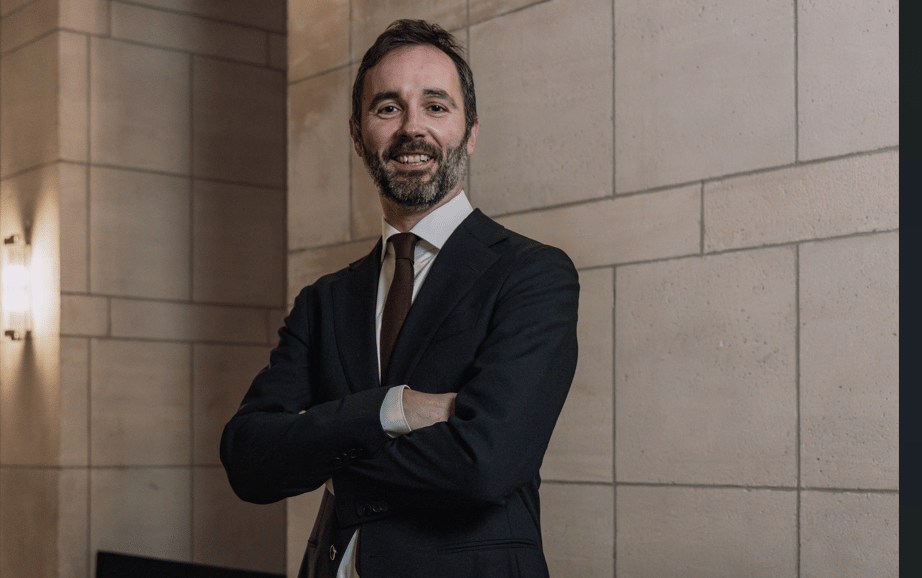
Benjamin Billiard from Pergam is our Fund Manager of the Month

25 MAR, 2026


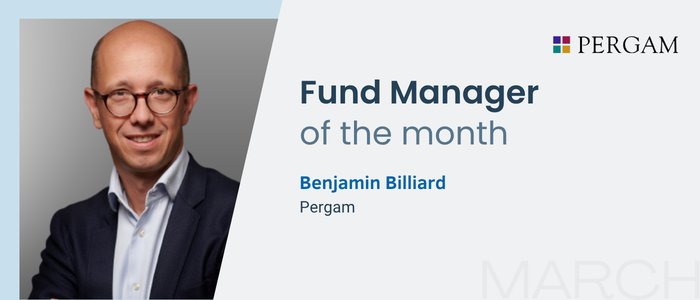
Benjamin Billiard started his career in consulting before moving into equity research at Merrill Lynch, then spent fifteen years as a buy-side analyst and portfolio manager across both long-only and long/short European equity funds in London. He joined Pergam in 2021 to launch and manage PBH, a concentrated listed holdings fund. He is based in Paris.
When and why did you start your career in the financial sector?
I joined Merrill Lynch in London right after completing my MBA, which I had pursued specifically with a career change in mind. My background was in consulting, which I genuinely enjoyed for its intellectual intensity, but I had always been drawn to financial markets and had invested on the side throughout those years. What ultimately pulled me in was the nature of the game: you compete on ideas, you take measured risks, and the market gives you completely objective feedback on whether you are right or wrong. I find that deeply stimulating.
How has the sector and your role changed during all those years?
The industry has become significantly more professional and technology-intensive, with a much broader set of tools available to investors, from proprietary datasets and expert networks to sophisticated analytical platforms. The consequence is that information itself has become a commodity. The edge has shifted to the quality of judgment applied to it: the ability to form a differentiated view, size it correctly, and hold it with conviction through the noise. Critical thinking, common sense and the capacity to think laterally have become the scarce resources.
What does your usual workday involve? How do you manage and structure your time?
Reading is at the core of my day, and I try to protect that time deliberately because there is no shortage of noise. Beyond that, I spend significant energy on conversations with a wide range of sources: management teams, competitors, clients, sell-side analysts, other investors. The goal is always to understand what the market is arguing about a given stock and where the consensus is vulnerable to being wrong. I focus my energy on what actually matters for a thesis rather than spreading it across everything that is merely interesting.
What has been the biggest challenge you have faced as a fund manager?
The transition from analyst to portfolio manager is genuinely one of the hardest steps in this career because it is not a promotion, it is a different job. As an analyst you operate purely bottom-up, but as a PM you must develop a top-down view and think rigorously about portfolio construction, sizing and risk in ways most analysts are simply not trained for. A related challenge is managing a position that moves against you: know exactly why it is going against you, cut decisively if you cannot strongly disagree with the market, and change your mind when the world changes without abandoning a valid thesis prematurely. Beyond the role transition, the end of globalisation has forced me to develop a much more rigorous macro view than a purely bottom-up investor ever needed before. Most of us built our pattern recognition in a single macro regime, and the challenge now is incorporating structural macro shifts into what has always been a predominantly bottom-up framework.
How do you stay on top of an ever-evolving market? How do you distinguish meaningful changes from market noise?
The market has become dramatically more short-term in its orientation, which means being aware of catalysts and understanding how the market is positioned into quarterly results has become as important as the fundamental view itself. Valuation disconnects from fair value more readily and for longer than it used to, which is simultaneously a risk and an opportunity: the greater the dislocation, the more compelling the long-term entry point, even if the journey is painful. What has not changed is that markets remain driven by human emotion, and that is where judgment still matters.
What indicators or signals do you trust the most, and which have lost relevance?
Momentum, both in share price and in earnings revisions, has become the single most important short-term driver of performance and ignoring it is costly. The bedrock of any long-term investment case remains whether a business earns above its cost of capital. Valuation has lost its relevance as a short-term timing tool, but it remains indispensable as a measure of margin of safety. Being contrarian is still essential, but the key is doing it with measure. In practice, I try to maintain a portfolio with acceptable momentum scores, with the help of our quant team.
How is AI or automation changing your investment process?
I use Claude in Excel daily for modelling and scenario building. It saves time and, more importantly, allows me to ask myself more questions than I otherwise could. The human judgment remains irreplaceable, but AI has raised the quality of the analytical work.
What advice would you give to young professionals considering a career in asset management? What should they keep in mind?
Passion for markets has to be genuine. Beyond that, my advice to aspiring analysts is to be introspective early: ask yourself honestly whether you are wired for the psychological demands of this job, the periods of being wrong, the need to hold conviction under pressure, the objective feedback of the market. Temperament and stamina are far more predictive of long-term success than academic excellence.
Outside of finance, what interests or activities help shape your broader perspective?
I am drawn to competitive activities such as cards and board games. Sport matters for discipline and resilience, both of which this job demands. But more than anything, family is what keeps perspective: being reminded that a bad quarter is not a bad life matters more than people admit. I also read a great deal, deliberately outside of finance, because useful perspectives on investing often come from completely unrelated fields.