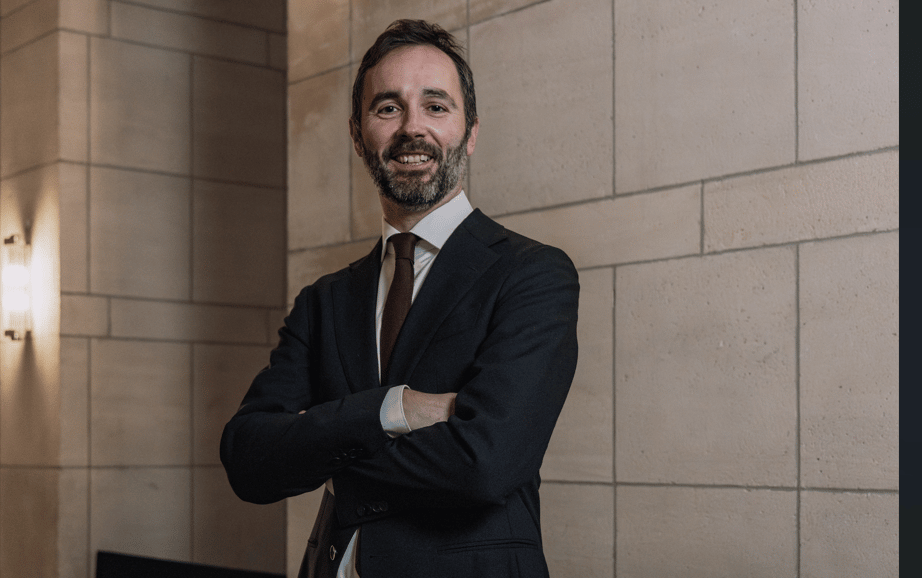
Benoit de Lacoste de Laval from BNP Paribas AM is our Fund Manager of the Month

8 JAN, 2026
By Joanna Piwko from RankiaPro Europe


Benoit is a Senior Portfolio Manager within the Euro Investment Grade Credit team. He is responsible for managing several Credit portfolios, including AXA WF Euro Credit Total Return. As a Portfolio Manager Analyst, he provides relative value coverage for the Banking, Basics and Transportation sectors.
He joined AXA IM (today BNP Paribas Asset Management) in December 2019 as a Portfolio Manager for AXA funds and mandates. He was specifically in charge of all P&L funds for AXA France. Before that, he used to be a Credit Portfolio Manager at Metropole Gestion.
Benoit in an engineer graduated from ENSTA Bretagne and holds a Master in Finance from Audencia Nantes. Benoit is also a CFA charterholder.
What first drew you to the world of investments, was there a defining moment or mentor who shaped your approach to fund management?
I was fortunate enough to be around investors from a very young age. I was always impressed by their ability to synthesize vast amounts of information to ultimately define a clear strategy and make investment decisions. I always wanted to emulate these individuals, who I felt all shared common traits: strong convictions and compelling personalities.
During my first job at a Parisian independent asset management boutique, I had the privilege of being mentored by a person with extraordinary market knowledge, but above all, an exceptional ability to persuade their clients. This person was a tremendous inspiration to me.
What do you find most rewarding — and most challenging — about being a fund manager?
One of my favourite hobbies ever since I was young has been reading business newspapers. Today, I consider that I'm paid to do what I'm passionate about, and that's what I find most rewarding.
A portfolio manager can very quickly gain significant visibility with their clients or the market as a whole. It's great to feel close to your clients and that they are listening to you, but it shouldn't affect one’s judgment in decision-making. A manager must remain consistent and rise above the crowd. That's perhaps the most challenging thing; it's a constant battle.
In a world still adapting to post-pandemic shifts and policy uncertainty, what areas of the market do you find most attractive?
With rates stabilising, fixed income offers compelling income opportunities without excessive duration risk. Notably, I have a constructive outlook on the European credit market, which stands out for its relative resilience and attractive carry, especially in high-quality investment grade names.
I see strong value in European bank credit, especially subordinated debt like AT1 and Tier 2, which offers attractive spreads and solid fundamentals. The subordination premium remains compelling across high-quality issuers.
Which global themes or structural trends do you think investors are underestimating today?
I always say that liquidity is key in financial market, and the ability to actually benefit from the theoretical value of an asset. Today, I wonder if the risks associated with the illiquidity of certain assets (i.e. private markets) are being underestimated in the context of high long-term interest rates.
How do you see technology reshaping asset management in the next decade?
I'm obviously thinking about AI, which is already having a tangible impact on our industry. Tools now allow us to collect and analyse financial information much more quickly and efficiently.
I believe AI needs to be controlled and regulated, but it can be a fantastic tool that will ultimately help optimise the services we provide to our clients.
What factors are most important when assessing whether a company deserves a place in a portfolio?
Beyond the financial and balance sheet aspects available to the entire market, our team of analysts/fund managers aim to understand the less tangible elements of a company (i.e. governance, strategy) which are key to successfully navigating economic cycles.
What are the most relevant economic signals you track to guide your investment strategy?
Flexible and dynamic management requires constant self-assessment to allow room for doubt. This self-assessment involves questioning preconceived notions: what was true yesterday may be false today.
I observe that the economic factors influencing market sentiment can change very quickly: one day it's central banks, another day it's political deadlines, and another it's the results of companies in a specific sector. I must adapt to this shifting landscape and therefore avoid strong biases in my assessments.
How do you define success — both professionally and personally?
First of all, I think that success should be a consequence, not a goal. In my personal life, I'm very wary of success. Success is fleeting; stability is what matters to me most.
Professionally, success is having clients satisfied with the service provided.
Outside of work, what do you enjoy doing? What are your hobbies?
I have many passions and I try to dedicate time to them despite a busy professional and family schedule. Sports, reading, gastronomy and spending time with friends are among many hobbies that excite me.