Frederik Fischer from Allianz Global Investors is our Fund Manager of the Month

22 APR, 2026


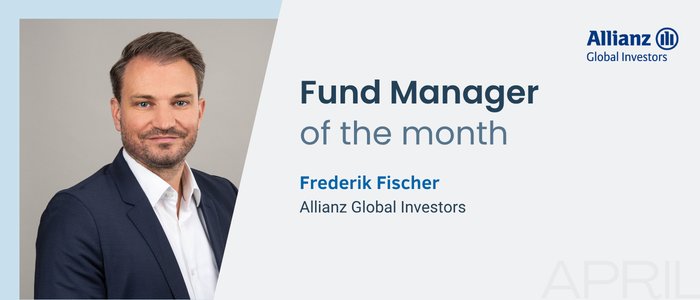
Frederik Fischer is Director / Senior Portfolio Manager for Multi Asset and Commodity Funds at Allianz Global Investors. He leads the Vermögens Management Classics team, is a voting member of the Fundamental Multi Asset Committee and is co-head of the global commodities group. He joined the company in 2004 and has held various roles as a Portfolio Manager and Business Manager in the CIO Office. Frederik Fischer holds a bachelor’s degree in business administration from Frankfurt School of Finance and Management and an MBA from IE University of Madrid. In addition, he is a certified Investment Fund Professional (IHK) and CFA Charterholder.
What inspired you to enter the financial industry and how has your career evolved over the past twenty years?
My journey into finance was sparked by the disruptive business models and extraordinary market momentum of the late-90s dot-com boom. I quickly observed a recurring pattern: first price quotes post-listing almost consistently outperformed their IPO prices. This led me to target IPO allocations to capitalize on these price movements. While researching the performance drivers of the funds my parents had invested in for me, I discovered the Junior Program at dit (now Allianz Global Investors). I applied, was accepted, and moved from the countryside to Frankfurt to seize this opportunity. During the junior program, I rotated through various departments, including an impactful stint with the Energy and Mining Equity team, which sparked my early fascination for commodities markets. I then spent five years in the CIO Office before joining the Multi Asset Overlay team, where I managed asset allocations for large pension funds and a specialized commodities fund. Five years later, I transitioned to the Vermögensmanagement (Wealth Management) team, taking over responsibility for Multi Asset Retail funds.
What’s the biggest misunderstanding people have about working in this field, and what aspects of the job have surprised you?
The biggest misunderstanding is that markets are driven solely by hard fundamental data. In reality, what surprised me most—and what many people consistently underestimate—is the profound role of Behavioral Finance. It’s not just about the data itself, but how market participants react to it and, crucially, what the market has already priced in. Beyond the fundamentals, I have become increasingly fascinated by identifying asymmetric opportunities—scenarios where the potential upside significantly outweighs the downside risk.
What does a typical day look like for you, and how do you prioritize your tasks amidst constant information flow?
My morning begins with an intensive review of global overnight developments via Bloomberg, identifying significant outliers to determine if they represent emerging risks or new opportunities. My focus shifts depending on market dynamics: on calmer days, I dedicate time to deep-work research and long-term projects; during periods of high volatility, my priority is immediate market action and portfolio positioning. To navigate the constant flow of information, I rely heavily on intellectual exchange seeking discussions with colleagues and external experts to challenge my own views. Hearing opposing perspectives is crucial: it ensures robust investment convictionsand provides a clear-eyed view of potential catalysts, as well as both upside and downside potentials.
What has been the toughest obstacle you’ve faced as a fund manager, and how did you navigate it?
Over the past 25 years, we have witnessed an extraordinary succession of market shocks. From the Dot-com bubble, to the 2008 Financial Crisis, the European Sovereign Debt Crisis leading to Quantitative Easing and negative interest rates, the unprecedented pandemic lockdowns and the Russia-Ukraine conflict, leading to the return of inflation and the most aggressive interest rate hikes in 200 years.
Last year’s tariff conflicts, followed by the U.S. interventions in Venezuela and Iran, and the historic closure of the Strait of Hormuz, have created a level of geopolitical complexity rarely seen before. In such moments, the sheer speed of information and the prevailing market sentiment—be it Fear Of Missing Out (FOMO) or outright panic—can easily lead to emotional decision-making. To me, it is vital to avoid these common behavioral finance traps and maintain a disciplined, process-driven approach. In moments of systemic panic, my focus is on distinguishing between temporary noise and structural shifts. When faced with an unfavorable positioning, I believe it is essential to reassess, regardless of past decisions. I focus on what the market has already priced in and actively search for asymmetric opportunities—scenarios where the worst-case is largely reflected in the price, allowing a more favorable outcome to translate into significant gains.
In such a fast-moving market, how do you separate meaningful shifts from short-term noise?
The first question you must ask yourself is: What would be a rational solution or a rational outcome? Short-term noise is often characterized by emotional overshooting rather than a rational result. It tends to extrapolate current events, rather than factoring in the inevitable reactions and adaptations that follow any shock. Mostly, it’s not the end of the world, and the world eventually finds a solution to even the most complex problems. My approach is to look ahead beyond the immediate headlines, consider the market positioning, and identify asymmetric opportunities—those moments where the market’s overreaction has created a disconnect between price and long-term reality.
Which indicators do you consider most reliable for guiding investment decisions, and which ones have lost relevance?
To guide investment decisions, I rely on a multi-dimensional set of indicators tailored to each asset class. For Bonds valuation plays a large role due to a strong catalyst - you get your money back on maturity date if you have properly done your credit risk analysis. For other asset classes positioning plays an important role as well.
My portfolio construction is based on a robust framework: I segment the market into four macro scenarios based on the trajectory of economic growth and inflation. The goal is to remain balanced across all scenarios to ensure resilience. In today’s regime-switching environment, relying solely on backward-looking indicators is no longer sufficient; you must be forward-looking to capture the shifts.
How do you integrate AI or automation into your process, and where is judgment and experience irreplaceable?
In our process, AI and automation serve as powerful catalysts for efficiency, particularly in research, data analysis, reporting, and coding. However, AI outputs must always be verified; since these systems can occasionally produce incorrect results.
Where in Europe do you see the strongest opportunities in the current market environment?
In the current European landscape, I currently see the strongest opportunities in European Banks. Despite the broader market volatility, the sector continues to trade at attractive valuations while demonstrating robust earnings growth. The fundamental environment—characterized by a higher interest rate regime compared to the last decade—has significantly bolstered their net interest margins. Beyond the pure numbers, many European financial institutions have significantly strengthened their balance sheets and are now in a position to offer attractive shareholder returns through dividends and buybacks. From a behavioral finance perspective, we still see a lingering skepticism towards European financials rooted in past crises.
Which interests or activities beyond work help you maintain perspective and inform your decision-making?
To maintain perspective, I find that traveling and engaging with people from different cultures is wonderful and broadens the horizon. A more recent passion of mine is surfing. I particularly enjoy being in Portugal in November (when it is dark and rainy in Germany), sitting on my surfboard in the sun and watching for the next wave. There is something deeply relaxing about it. However, I must admit that the financial markets are also a hobby of mine—I believe you couldn't truly excel in this profession if you didn't have a genuine passion for it. Just like surfing, the markets require you to monitor the environment, stay patient, and time your move perfectly when the right opportunity arises.