Bogdan Popescu from Amchor Investment Strategies is our Sales Manager of the Month

20 NOV, 2024
By Jose Luis Palmer from RankiaPro Europe


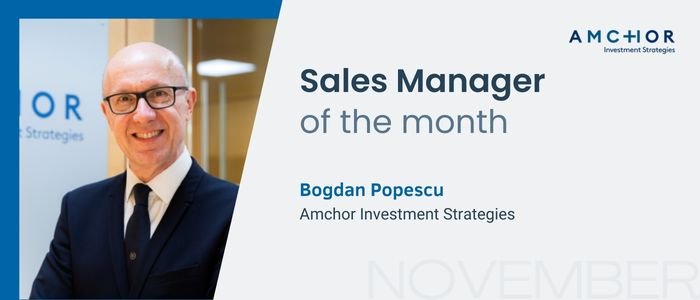
Bogdan joined AMCHOR in July 2024 as Country Head of France.
Bogdan rejoined from London, where he has worked for 6 years mainly for J O Hambro Capital Management, and subsequently for Trium Capital, where he has held European Sales Director roles.
He began his career in 1992 in Paris working for SocGen and in 2000 joined SG Asset Management as Sales Director. He subsequently worked for East Capital AM and Skandia Investment Group before co-founding Hilbert Investment solutions. He then moved to London.
Bogdan holds a degree in Electrical Engineering (DEA) and in Finance (DESS) from Paris 6 (Faculty of Science, Sorbonne University, Paris).
What made you decide to go into the financial sector? Did you have any other vocations? How were your first steps in the sector?
I started working in the financial sector by accident. I was a student in electrical engineering when I realized that the more I studied it, the less I liked it. Just upon finishing my postgrad, I read an article about the banks recruiting engineers in their capital markets departments and I immediately send my CV. Much to my surprise, things went very quickly and one week later, I had already signed my contract. There, I joined a team of newcomers who knew nothing about capital markets, because our boss was very contrarian and his philosophy was “only beginners are competent, because they don’t know anything, therefore they question everything”. Good old times, not sure this could still happen today.
What does a typical workday look like for you? What do you enjoy the most about your job?
There is no such thing as a typical day and probably this is why I enjoy my work. A working day can be about organising roadshows or delivering them, going to lunch with a client, listening to a webinar, attending an event. Selling funds is at the confluence of economics, finance, human relations, psychology, technical knowledge of products and good self-organisation. Hard to find something richer.
In your opinion, what are the key drivers for successful fund distribution? How do you approach building and maintaining relationships with clients?
The key driver for successful fund distribution is trust, which you build by understanding the foundations of the industry, the trends in the market, the client needs and the knowledge of the products that you sell. As I often say to the clients, a fund is a tool so you need to understand how it works, when it is supposed to work but even more important, when it may not work.
Could you highlight any topic on which investors should focus for the long term?
I sell funds to professionals who have the skills and the experience to know what they are looking for; therefore, I will not be immodest and think that I can highlight a topic that they might not be aware of. Nevertheless, I think it is difficult not to mention AI, as it is expected to be a significant game changer in many fields, although at this stage it is difficult to quantify. I personally am quite positive and optimistic about it because I noticed that every scientifical and technological leap forward brought fears, but we always managed to successfully overcome those fears.
How do you stay informed about market trends and changes in the asset management industry?
At Amchor, we are lucky to have an excellent economist, Álvaro Sanmartín who proactively fuels us with his scenarios and commentaries. I also follow Christophe Barraud, who is arguably the best forecaster in economy. This area being so well covered, I read articles in different industry publications and asset management websites, and I speak to the clients about their granular needs and changes in their portfolios, with the macro-economic landscape in mind, so we can connect the scenery with the solutions.
What is your advice to investors, how should they position their portfolios with the current environment?
Again, given the high specialisation of my clients and their multiple skills and qualifications, I would not venture to give any advise about their portfolios. My feeling is that the US being what they are from an economic, political, geostrategic perspective, US equities should continue to have a decent chunk in the portfolios. After all, innovation in IT, AI, big pharma, biotech comes massively from the US. A wise diversification does not need to be wide, so I’d select asset classes such as Emerging markets equities, especially frontier and emerging markets debt which in the current situation, especially for the frontier debt should be a “no brainer” given the low correlation with traditional asset classes and the upside triggered by the perspectives on the USD. Liquid alts could be a bit more in the vision of the investors give the wide spectrum of solutions that they can bring to a portfolio (global macro, absolute return, equity dispersion, trend following).
What is the most exciting thing you have seen in the markets since you started working in the financial sector? And the biggest challenge you had to face?
The world is dialectical: any challenge and stressful period come with its part of excitement. Navigating through crisis and stormy markets is extenuating but this is what gives value to strategies, to PM and to sales. That said, the greatest challenge was undoubtedly GFC in 2008; Covid also was a hellish period because it added this dystopic, existential panic to a very severe crisis both in terms of public health and economics. Let us not forget the war in Ukraine, which we all hope it will come to an end soon, because of the deaths and destructions.
What do you see as the biggest challenges and opportunities in the asset management industry today, and how would you address them as a Sales Manager?
The biggest challenges come from a new and significant wave of migration towards ETFs but this is also an opportunity for active management because we now have the active ETFs. In the end, active management will continue its robust development. In the US we are facing a new paradigm: current valuations are distorted VS historical valuations, showing very high multiples. Put otherwise, US equities especially the large and mega caps are “very expensive”. But versus what? We do not know if we are in a bubble or if we need to amend the way we apprehend the multiples. Are we about to enter in a new era in which “the winners take it all”, in which case current prices are justified? The new POTUS is yet to set his agenda. Many things will unfold based on his words, intentions, acts, and decisions. Expect some volatility out there. I try to address all these challenges in a very pragmatic way, by constantly monitoring macro-economic and financial signals, by speaking to the clients and by assessing with our team which solutions are best for our clients to navigate through these complex times.
When you have free time, what do you like to do?
My children are now gown ups but it’s always a pleasure to spend time with them. I still practice quite a lot of sports, tennis and especially running. I like to train and to take part at 10-15Km cross country competitions, because we run in the middle of nature, and I don’t like to run on tarmac or in urban areas. I am not really a marathon person. On the contrary, I practice sprinting which is not mainstream. I am now looking forward to a nice lineup of indoor and outdoor competitions. Wish me luck for the next 60- and 100-meters dash.