Bryan Elbaz from Alpha Advisory is our Advisor of the Month

20 AUG, 2025
By Jose Luis Palmer from RankiaPro Europe


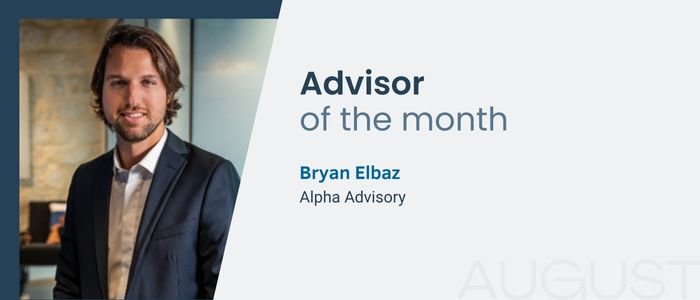
Bryan Elbaz started his academic studies in Boston, where he double majored in Econometrics and Finance. To further enhance his expertise, Bryan completed an MBA in London in Finance, with a focus in Private Equity.
Bryan's professional journey began nearly a decade ago at Eurazeo (formerly Idinvest Partners), where he contributed to the launch of an innovative investment fund. This fund was focused on private debt strategies that capitalized on core assets to generate growth for companies without equity dilution.
Following this, Bryan Elbaz joined Flexam Invest, part of Kartesia Group, where he focused on deal origination, due diligence, and structuration.
Later, he joined Norman K, a global advisory firm with offices in Paris, London, Geneva, and the French Riviera. Norman k aims to create value by offering customized financing and investment solutions to international entrepreneurs, families, and institutional clients. At Norman K, Bryan was responsible for structuring the firm’s asset finance strategy. In 2025, Bryan founded Alpha advisory, an independent firm focusing on venture capital, fundraising from private and institutional investors, equity investment allocation on private equity funds, external growth projects and asset finance.
Why did you choose to go into financial advice? Did you have other vocations? How were your first steps in the financial sector?
I chose this career path to structure complex financial strategies to meet long-term goals.
When it came to make a career decision, becoming a plane engineer was also amongst my choices, as I developed when I was young, a passion for numbers and analytical thinking, though I routed my studies toward investment and finance because it is more thrilling.
My first steps started in a private equity funds whereby I contributed to the structuration of a fund aiming to support the growth of companies across Europe through the financing of strategic assets with a focus on real economy.
How do you see the current macroeconomic environment? Which macro data do you look at most when advising your clients?
The current macroeconomic environment in Europe is gradually stabilizing, with inflation retreating from its peak and the European Central Bank beginning to ease its monetary stance. Growth remains modest across the eurozone, with Germany facing headwinds while Southern Europe shows relative resilience.
It is important to focus on macro economic eurozone data, market comparables, and have a clear view on the current financial stability as well as the upcoming cash flows related to the companies on which we focus our due diligence. These metrics guide strategic asset allocation and risk management decisions.
How should investors orient their portfolios for 2025? Which do you think will be the biggest challenges and opportunities?
Investors should orient their portfolios for 2025 with a focus on resilience, diversification, and selective risk-taking. With interest rates expected to stabilize, high-quality fixed income such as in the industrial sector, infrastructure, energy transition and mobility offers attractive yields, while equities, particularly in sectors like AI and the newly interesting macro-driven sector of defense, present long-term growth opportunities.
Geopolitical tensions and a potential global slowdown remain key risks, emphasizing the need for geographic diversification.
Private markets may offer alpha, but selectivity is crucial amid tighter liquidity. Flexibility and active management will be essential in navigating shifting macro dynamics.
What characteristics do you think a good financial advisor should have?
They should possess strong analytical skills, sound judgment, and deep financial acumen to assess complex situations. Integrity and fiduciary responsibility are paramount. Strong communication skills are essential to clearly articulate investment opportunities, risks, and long-term plans. Emotional intelligence is critical as well as having a deep understanding of the whole spectrum of investment opportunities, even on more exotic investment solutions such as illiquid assets to build long-term capital structures.
Which portfolio allocations are most interesting in the current market situation? Which sector do you consider particularly interesting at the moment?
In the current market, it is paramount to focus on resilient, cash-generative businesses sectors. With rising interest rates and macro uncertainty, capital efficiency and pricing power are key. Some of the bullish sectors are infrastructure, industry, mobility, and specialized green investments (with scalable models), which are also attractive due to strong regulatory support, long-term visibility, and alignment with ESG. These sectors benefit from secular trends and increasing institutional capital flows, offering downside protection and inflation-linked returns.
What does a typical workday look like for you? How do you organize your time?
My day starts early, reviewing global market updates. I allocate mornings to high-impact worksuch as deal sourcing, investment memorandum preparation, and financial modeling. Afternoons are for management calls, due diligence, and strategic reviews with operating partners with whom we structure the deals. I block time for deep work and use structured agendas to drive efficient meetings. Later that day, I set priorities for the next day.
What role do you think regulation plays or should play in driving Socially Responsible Investment?
I am deeply convinced that regulation plays a vital role in driving Socially Responsible Investment. Ensuring transparency, consistency, and accountability across ESG practices is key. It establishes clear disclosure standards, combats greenwashing, and protects investors. Regulatory frameworks also help align fiduciary duties with ESG integration by recognizing sustainability as financially material. Regulation plays a vital role not only suporting ethical investment goals but also by reinforcing risk management practices. Ultimately, regulation channels capital toward sustainable sectors and it institutionalizes sustainability as a core component of financial decision-making.
What do you like to do in your free time?
In my free time, I like to challenge myself and compete at the highest level, it’s a way for me to grow, stay disciplined, and tap into the deepest level of resilience which is particularly aligned with the level of exigence in our current market. Through sport, not only do I challenge myself, but also push the boundaries of what is possible. As an accomplishment, I competed for the Triathlon IronMan European Championship in Hamburg in 2023.