Julie Lemoine from Vigifinance is our Advisor of the Month

29 APR, 2026
By Joanna Piwko from RankiaPro Europe


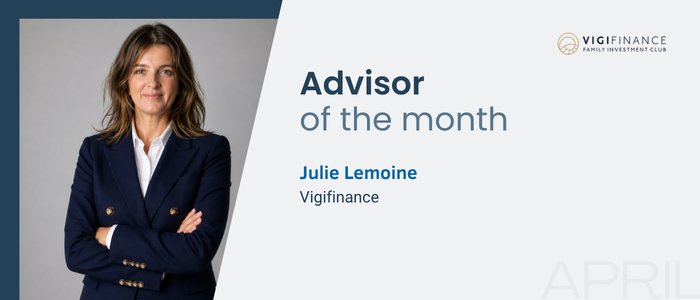
Julie Lemoin is Head of Investments at Vigifinance. She supports all clients in defining their investment strategies, implements asset allocation, and oversees research and asset selection activities.
Before joining Vigifinance in 2014 as a fund analyst, Julie worked for three years as an analyst—first in multi-management at OFI Asset Management, then in credit markets at Rothschild & Co Asset Management.
She holds a dual degree in Finance from Léonard de Vinci School of Management and London South Bank University, as well as a Specialized Master’s in Financial Analysis from NEOMA Business School.
If I weren’t working in the financial sector, I would…? Have you ever considered other career paths, and how did you end up in asset management?
I would likely be building something tangible—probably in tableware craft industry where time, patience and attention to detail define value. I’ve always been drawn to environments where excellence is visible and lasting, whether in craftsmanship or design.
That said, asset management appealed to me for similar reasons. It combines long-term thinking, discipline, and the responsibility of allocating capital in a way that shapes real outcomes.
What’s an early-career lesson that still shapes the way you advise clients today?
Early in my career, I realised that technical expertise is only half the job. The other half is clarity. Clients rarely remember the model you built, but they always remember whether you made complexity understandable and whether you were reliable when it mattered.
Since then, I’ve tried to reduce everything to what truly matters: clear reasoning, honest communication, and consistency over time.
How has technological development, such as AI, impacted your role?
AI is not changing the core of our job—it’s changing the allocation of our attention. It removes friction: gathering information, structuring data, challenging assumptions.
What it doesn’t replace is judgment. In fact, it raises the bar. When information becomes abundant, the real differentiator is the ability to filter, prioritise, and decide under uncertainty.
Is there a commonly accepted market belief right now that you think should be questioned more closely? Why?
A widely held belief today is that markets are becoming increasingly predictable thanks to data, models, and central bank guidance. I think this confidence should be challenged.
In reality, markets remain driven by uncertainty, regime shifts, and human behavior—factors that cannot be fully modeled. Over-reliance on consensus views and quantitative frameworks can create blind spots, especially at turning points.
For me, this reinforces the importance of humility in portfolio construction and the need to build strategies that are robust across different scenarios,
In such a fast-moving market, how do you separate meaningful shifts from short-term noise?
I approach this by structuring portfolios into two distinct building blocks, each with a clear role.
The first is an alpha-generation pocket, where we deliberately take exposure to strong, long-term themes. This part of the portfolio is inherently more volatile, but it is designed to capture meaningful upside when structural trends play out.
The second is a defensive pocket, built with strategies selected for their resilience—either low volatility or genuine decorrelation. This typically includes alternatives and certain fixed income strategies that provide stability and a form of “carry” or defensive yield.
This dual approach enables us to stay confident in our portfolios when risk is at top level and even increase exposure during market pullbacks.
What’s an interesting trend in France’s markets right now that you think deserves attention? And which European markets look the most promising today?
In France, I find the resilience and transformation of mid-cap companies particularly interesting. Many are quietly adapting to structural shifts—energy transition, reindustrialisation, supply chain reshaping—while remaining underrepresented in global portfolios.
Across the world, we are closely focusing on structural themes such as the growing need for electrification across the economy, the expansion of the space ecosystem, and the rise of the emerging markets consumer.
Beyond performance, what do you believe builds lasting trust between an advisor and their clients?
Lasting trust is built on clear alignment of interests between the client and the portfolio manager. Trust also comes from discipline in how results are assessed. It is not enough to invest “properly”—portfolios must be consistently challenged against relevant benchmarks and peer groups. This external reference point is essential to ensure accountability and to avoid complacency.
For young professionals starting out in asset management today, what mindset or habit is most important for building a credible, long-term career?
Patience: asset management is a long-term discipline and credibility is built over time, not through short-term results.
Ability to think independently: developing your own judgment.
Listen to experienced portfolio managers: this is a profession where experience matters deeply.
Outside of work, what interests or activities help you stay grounded and shape the way you make decisions?
Outside of work, I try to stay curious. Museums are a great source of ideas and perspective. I also spend a lot of time with my children — they constantly remind me that there’s an infinite number of ways to look at anything ! And I value conversations with others. Discussing ideas helps challenge and refine my views.