Christopher Rossbach from J. Stern & Co. is our Fund Manager of the Month

3 SEPT, 2025
By Jose Luis Palmer from RankiaPro Europe


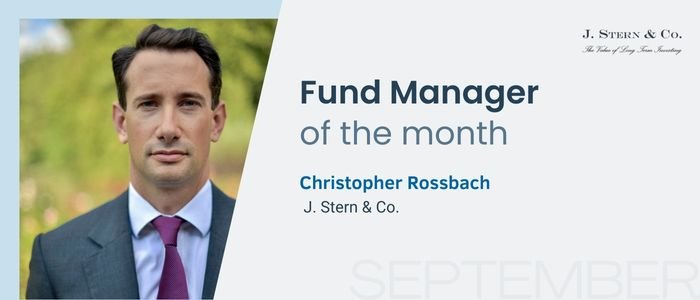
Christopher Rossbach is a Co-Founder, Managing Partner and Chief Investment Officer of J. Stern & Co., a global independent asset manager of the World Stars Global Equity strategy, focused on delivering long-term capital growth by investing in a concentrated group of high-quality, large and mega-cap global stocks.
Previously he was Co-Founder and CIO of Merian Capital, CEO Europe at Magnetar Capital, Lansdowne Partners and Perry Capital. Before moving into institutional asset management, Chris worked in investment banking at Lazard Frères in New York. He holds a BA from Yale University and an MBA from Harvard Business School.
You’ve had a remarkable journey. What first drew you to the financial sector, and did you ever imagine this path when you started? Were there any other vocations you considered before committing to finance?
Growing up in Germany at a time of great historical change, I have always been fascinated by the way in which politics and economics work and how individuals can make a difference.
I became fascinated with George Soros and, through him, Karl Popper, the Austrian philosopher who escaped to Britain in the 1930s, and who founded the department of philosophy at the London School of Economics. His book The Open Society and its Enemies had a great influence on me at the time when the unimaginable happened in Europe – the Soviet Union collapsed, Central Europe became free, and Germany was reunited. Soros also referred to Karl Popper's theory of science, which is to base theories on empirical knowledge and to seek to falsify, not confirm it. I have always thought that it takes courage to have a hypothesis and an openness of mind to falsify them with the facts. This basic approach of openness and intellectual curiosity has been at the core of my thinking and investing.
I grew up with a German father and an American mother and studied humanities at Yale University. I decided to go into finance after university, have greatly enjoyed the constant challenge of trying to understand companies and their businesses, why they have quality and are successful, and how they can generate value over the long term. So, in a way, I have always seen myself as an investor – but I have also felt that it is important to be engaged in society. I have been able to work with different institutions in London as a board member, including the Warburg Institute, which was founded by Aby Warburg of the German banking family.
What is your view of the current macroeconomic environment and how might it affect markets? How does uncertainty affect global equities?
We think it is important to take a long-term view and to keep perspective amid the geopolitical and macroeconomic uncertainty.
We began 2025 with a constructive outlook based on strong economic fundamentals – robust corporate investment in efficiency, capacity and innovation; resilient consumer spending supported by rising real wages; moderating inflation, and supportive monetary policy. The Trump administration's deliberately disruptive approach to domestic and foreign policy has increased uncertainty and market volatility, creating both opportunities and challenges for companies, consumers and investors.
However, volatility can be positive as well as negative, and as the strong performance of our World Stars Global Equity strategy has shown so far this year, it has been right to take a long-term and reasoned view that the US government’s policies – whether on tariffs and trade restrictions, cost cutting, spending or immigration – would differ from their announcements, and that they would be constrained by the reality of US economic needs and global financial markets.
While political and economic uncertainty has increased, we are positive about the ability of our companies to generate value. That is why our investment approach remains focused on underlying business fundamentals, quality and valuation. To quote Warren Buffett, ‘Whether we're talking about stocks or socks, I like buying quality merchandise when it is marked down.’ Our task is not to predict what politicians do but to focus on the fundamentals, and we believe that quality will matter even more in the period ahead.
Given the evolving global landscape, how should long-term investors think about portfolio construction today? What major risks should they be cautious of, and where do you see opportunities being overlooked?
Investors must accept that uncertainty is what President Trump does, but the laws of economics have not been suspended. Investors should focus on the benefit of long-term compounding and position themselves to take advantage of opportunities as they arise.
The risks are where they always are when faced with uncertainty and volatility – leverage, structural risk, and illiquidity. Investors have to ask themselves if now is the time to invest in speculative assets like cryptocurrencies or to buy illiquid private investments in equity and debt that may lock them in for many years – this at a time when many private equity and venture capital firms are struggling to sell their companies at the prices they have promised their investors and are instead looking for ways to pass them on to retail investors.
Markets are always open, so they could do IPOs of their companies. The fact that they do not like the prices markets are willing to pay should give pause to investors asked to buy them at the prices they are marked at. There are many opportunities, but stock selection will matter more than ever.
What differentiates the J. Stern & Co. World Stars Global Equity Fund from others and what advantages can it bring to an investor’s portfolio in the current scenario?
Our World Stars Global Equity strategy is differentiated in numerous ways.
We offer great alignment as an independent asset manager, managed by a team of experienced investors which has worked together for more than 10 years; all senior members of the team are partners in the firm, with 20% of our assets emanating from the Stern family, partners and employees.
We have a clear focus on quality. It is a gating condition for us, and if a company does not fulfil our criteria for quality, we simply will not invest. This includes companies in information technology but also consumer products, healthcare, and importantly, industrials.
We think that sustainability is a core attribute of quality and look at it as an opportunity, not just as a risk. We do our own financial and sustainability analysis and have generated some of our strongest returns from industrial companies providing solutions to the many problems we are facing – Eaton and Amphenol for example, both world leaders in power management and electrical connectors.
These companies are highly differentiated and have strong prospects as the promise of AI, robotics and other technologies can only be realised if the data centres and other facilities can be built, powered, heated and cooled in a sustainable and responsible way.
We have a concentrated portfolio of 20-30 global quality companies and invest with a very long-time horizon of five to ten years, with the intention of holding companies for 25 years or more. Our low turnover of 10-15% is fully in line with our long-term investment horizon, and of particular importance to certain taxable investors cognisant of realising capital gains.
The advantage of our World Stars Global Equity strategy for investors is that at a time when major stock market indices are fully valued and highly concentrated in a few companies – several of which are highly overvalued – we can offer investors concentrated, differentiated exposure to the best quality companies on a global basis, at valuations that have the prospect of generating strong long-term returns in absolute terms and outperformance compared to industries, and in line with our long-term track record.
How would you describe J. Stern’s investment philosophy? Can you give us an example of a position that you have held for a long time in your portfolios and why?
We invest in companies, not markets, and do not seek to time markets but to choose quality companies that will deliver significant returns over time, through economic and investment cycles, and periods of uncertainty and adversity.
This rigorous approach leads us to invest in the world’s largest and best companies, many of which are also disruptors. These companies have enduring and sustainable competitive advantages in attractive long-term growth industries, notably information technology but also consumer products, healthcare and industrials. They have above-average pricing power through branding, ownership of intellectual capital, and low exposure to the main areas of current inflationary pressure in their cost base.
We are only at the beginning of the digital transformation of the global economy, and there is much more to come. Companies like Alphabet and Amazon have been holdings for the past ten years. We bought Nvidia in 2022 and ASML in 2023. These companies will be long-term beneficiaries of digital transformation, and we expect them to continue to represent the largest part of our portfolio.
What specific metrics or qualitative characteristics must a company meet to earn a place in the World Stars portfolio? Can you walk us through how your investment selection process works – from idea generation to execution?
We do our own qualitative, financial and sustainability analysis. We start with a universe that comprises the MSCI World and the largest global exchanges and apply a proprietary screening to look for quality attributes like consistency of growth, margins and dividends, low leverage and high returns on capital employed. If they fulfil our quality criteria, they move from the watch list to the approved list. If, in addition they have attractive valuations, we select them for the portfolio.
We have stocks that have been on our approved list for years, but that we think are fully valued to buy for the portfolio. We look to make decisions proactively, not reactively, and base our decisions on company fundamentals and valuation. This is an ongoing process. It can take several months for us to decide to buy or sell a position, but it can also take a day if there is significant information that we believe requires immediate action.
What do you like to do in your free time?
I am greatly interested in art, culture and society. I read widely and am involved in educational and arts institutions through my charitable commitments, like the Warburg Institute. I also enjoy spending time with family and friends and doing sports like running, golf, tennis and sailing, when I have the opportunity.
I was in Patmos this summer, a Greek island with extraordinary history, an ancient monastery with a stunning library, beautiful beaches and great food – a wonderful combination of everything I like.