Cyriaque Dailland is our Fund Manager of the Month

16 JUN, 2026


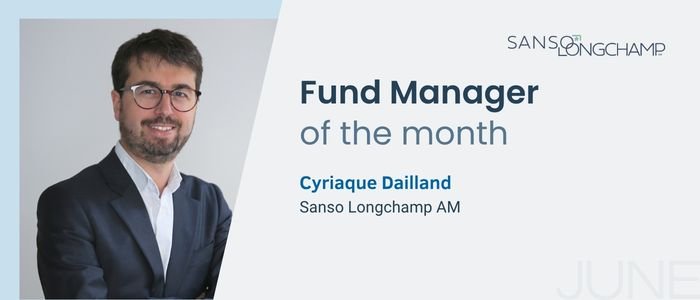
Cyriaque Dailland started his career as a fund selector at La Française des Placements in 2008. In 2009, he joined Convictions Asset Management as an analyst-manager. He specializes in asset allocation. In 2019, he joined Sanso Longchamp AM as a portfolio manager. He currently manages Sanso Convictions (global multi-asset fund), Sanso MultiStrategies (quantitative absolute return fund), and dedicated funds.
Cyriaque graduated from the Master 2 Finance program with a specialization in Financial Markets at IAE Clermont Auvergne.
What were your early career beginnings like? What has surprised you most since then, and how have you seen the sector change over time?
I started my career in 2008 at La Française des Placements, within the Multi-Assets team, specializing in fund selection.
Throughout my career, I have been struck by the contrast between the scale of financial stakes and - sometimes – the surprisingly informal nature or craft-based nature of certain investment practices. This realization has shaped a significant part of my investment approach: I have focused on building robust investment processes based on analytical and decision-making tools, enabling a more objective analysis of the macroeconomic environment, risks, and performance. I believe this shift has since become more widespread across the industry in recent years.
The other major shift in the industry has been the rise of ETFs. These instruments have forced active managers to adopt greater discipline in terms of performance and pricing. In my view, this has been a positive development, raising the level of standards and strengthening the competitiveness of the profession.
What person or specific event has influenced your career the most?
I started my career in the summer of 2008, just before the collapse of Lehman Brothers, which was shortly followed by the Madoff scandal. Experiencing a crisis of such magnitude at the very beginning of my career was highly formative. It taught me how to operate in extreme market environments and to develop strong resilience in the face of uncertainty. This period also taught me that, in investing, it is essential to have convictions—but never certainties.
What do you find most exciting about the asset management sector, and what has been the toughest part for you?
Portfolio management is a constantly evolving profession which I find very stimulating. Each day brings new questions, directly connected to global economic, financial, and geopolitical developments. In my case, as a top-down investor, this dimension is even more pronounced - I build global allocations across all asset classes.
In this context, the main challenge has been learning to step back. Markets never sleep, and when you are exposed to all geographic regions, the temptation to remain constantly connected is strong. Early in one’s career, this intensity can even lead to excessive activity. Learning how to filter information, prioritize, and remain patient is therefore essential.
What does a typical workday look like for you, and how do you organize and manage your time?
My day always starts with an in-depth review of market research produced by our counterparties, which I complement with my own analysis, particularly on key macroeconomic releases. I then dedicate a significant amount of time to analyzing portfolios using internal tools, to better understand performance drivers and risk exposures. The goal is to ensure my positions always reflect my convictions. The afternoon is more often dedicated to developing new tools or quantitative strategies. Finally, interactions with clients and prospects are an important part of my day. Beyond the commercial aspect, these discussions are highly valuable as they help enrich my investment thinking.
What indicators or signals do you trust the most, and which have lost relevance?
If I had to retain only one indicator, it would undoubtedly be the Global Composite PMI, which I consider the most relevant indicator for understanding the macroeconomic cycle and guiding asset allocation. That said, my approach relies on a broad set of indicators, notably integrated into a proprietary model I developed, the Sanso Macro Screening. Beyond macroeconomic data, market signals are essential: volatility term structure, sectoral dynamics in equities, developments in sovereign yields, and credit spreads. The combination of these indicators allows for the generation of actionable signals, which I apply on either a discretionary or systematic basis, depending on the funds.
Being based in France, what recent trends or shifts in the market should investors be watching?
France benefits from a historically strong asset management ecosystem. What I find particularly interesting today is the emergence of new asset managers and funds offering differentiated approaches, which are still under-recognized internationally. Take absolute return strategies or emerging market debt, for instance.
How is AI or automation shaping the way you approach investing?
For around ten years now, I have been working closely with Matthieu Barrailler, a quantitative engineer and PhD in finance. Together, we have built investment processes in which automation plays a central role, with the aim of optimizing both information processing and decision-making. The rise of artificial intelligence represents a major acceleration in terms of analytical and computational capabilities. However, I see it more as a natural evolution than a disruption: it extends a framework we have been building for over a decade.
How would you describe the markets in 2026 so far in one word?
Dissonance. Since the beginning of the year, different asset classes have been sending divergent signals. Equity markets continue to be supported by particularly strong corporate earnings, while sovereign bond markets are more focused on geopolitical tensions and inflationary risks. Such divergences are not unprecedented, but they are by nature temporary.
What do you enjoy doing outside of work to switch off and step away from the markets?
Outside of work, I devote most of my time to my two daughters. These are essential moments that help me reconnect and take a step back. In addition, having initially studied cinema, I have retained a deep passion for movies, which remains an excellent way for me to unwind.