David Afonso from IM Gestão de Ativos is our Fund Manager of the Month

4 NOV, 2026
By Joanna Piwko from RankiaPro Europe


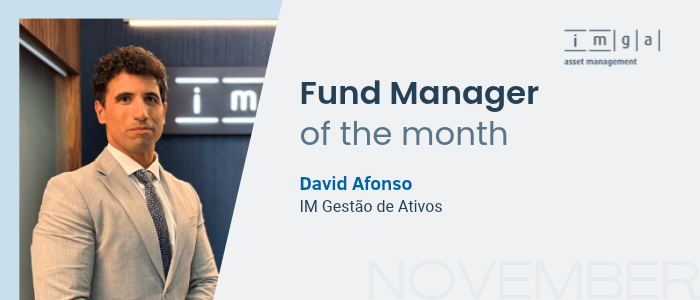
David Afonso is an Equity Portfolio Manager at IM Gestão de Ativos (IMGA), the largest independent asset management company in Portugal, with more than €6 billion in assets under management. He joined IMGA in August 2020, where he is responsible for three equity mutual funds with distinct investment strategies and universes, combining fundamental and quantitative approaches in portfolio construction. He is also the comanager of other two equity funds.
Before IMGA, David was Business Operations Officer in the CEO Office at Euronext, where he acted as the CEO's chief of staff and oversaw the global implementation of new products and initiatives, namely related with ESG. Previously, at Caixa Gestão de Ativos, he worked as an equity portfolio manager for four years, managing the investment strategy of several different funds, including the entirety of the Portuguese equity investments. He also managed European and American equity investments in the Energy, Materials, Industrials and Consumer Discretionary sectors, and contributed to the launch of the first Socially Responsible Investment fund in Portugal. He began his career at Millennium BCP as a market analyst in the equity research team.
David is a CFA Charterholder since 2022 and a CESGA Charterholder since 2023. He holds a degree in Economics from Nova School of Business and Economics and a Master's in Finance from Católica-Lisbon School of Business and Economics. He has more than 12 years of experience in the financial markets.
Every fund manager takes a different route into the industry. What was yours?
I found my passion for the world of finance in the very first years of college, as the courses related to the subject sounded far more interesting to me than other subjects. It didn’t feel like studying; it felt more like digging deeper into a curiosity I already had about the topic.
When I started my career, I was lucky enough to gain experience in the equity world by joining the equity research team at Millennium BCP. Starting on the sell side, I have since had a broad range of experiences. I then moved to Caixa Gestão de Ativos, where I got my first job as a Portfolio Manager, and later had one of my most out-of-the-box experiences when I joined Euronext. Working inside the exchange gave me a holistic view of the financial ecosystem.
For the last six years, I have been part of IMGA, where I have taken the helm of several funds, with the standout being IMGA Ações Portugal, which I have seen grow from under €20 million to more than €500 million.
If you could go back to your first year in asset management, what would you tell yourself?
Advice around persistence, consistency and patience would be the most valuable. A good investment thesis does not necessarily work immediately, and a bad one does not necessarily fail immediately either. The key is to constantly distinguish between being wrong and simply being early.
Over time, I have learned that the real edge often comes from knowing where you have genuine insight and where you don’t.
The Portuguese equity market has changed a great deal since you started your career. What changes do you find most interesting?
The most interesting change to me is that Portuguese equities have consistently attracted more interest from international investors. This increased interest has allowed the Portuguese equity market to grow in both size and liquidity.
Having managed investments in Portugal for most of my career, the reduced breadth and depth of the Portuguese market have always been a challenge for the investment thesis. However, this has steadily improved as Portuguese equities have increasingly appeared on the radar of international investors.
Nowadays, the Portuguese equity market capitalisation is around €100 billion and daily liquidity surpasses €200 million — figures that haven’t been seen for several years.
How do you tell a lasting shift from a short-term market reaction?
I try to look for evidence that the change is reaching a company’s fundamentals rather than simply being reflected in its share price. So, I dive deep into fundamental analysis, looking at future earnings, capital allocation, margins, cash generation and competitive dynamics.
If management is changing investment plans, competitors are responding and the economics of the industry are changing, that gives me much more confidence that we are looking at a structural shift.
What skill do you think the next generation of fund managers will need that yours didn't?
The ability to combine investment judgement with technology and data.
Quantitative tools and AI can already process enormous amounts of information much faster than any individual investor. The advantage will not necessarily come from having more information, but from knowing which information matters, how to test it and how to incorporate it into an investment process without losing judgement.
I have increasingly used both fundamental and quantitative approaches in portfolio construction, and I think that combination will become increasingly important. The future fund manager will probably need to be comfortable moving between company analysis, datasets, alternative information and AI tools — while still understanding that none of these things replaces judgement.
Looking at European equities more broadly, which theme do you think the market is still underpricing, and which looks crowded?
Europe should have used the Draghi report in a more transformative way. With that being said, I believe that, if Europe really wants to remain relevant in the coming decades, there needs to be a broader investment cycle around European infrastructure — meaning grids, electrification, power management and industrial automation.
Without this, the famous AI theme may well play out everywhere but in Europe. These structural changes — even those that go beyond infrastructure — need to happen if Europe does not want to simply be a spectator.
On the one hand, European infrastructure investments may still be overlooked. On the other, some other parts of the AI theme certainly look crowded, as expectations around the returns on investment in the theme continue to increase. So far, companies have been able to deliver robust numbers, but as the bar rises, even great companies can struggle to outperform expectations.
What indicators or signals do you trust the most, and which have lost relevance?
I put a lot of weight on earnings, free cash flow, return on invested capital and balance-sheet strength. I also pay close attention to the gap between what the market expects and what I believe is realistically achievable.
One signal I particularly value is the combination of earnings revisions and price action. When estimates are moving up and the market has not fully reacted, that can be very informative. Conversely, when a stock keeps rising while fundamentals are deteriorating, I become much more cautious.
On the other hand, multiples per se can be misleading. A low P/E does not necessarily mean a stock is cheap, and a high multiple does not necessarily mean it is expensive. I believe it is important to dig deep into why companies trade at those multiples and whether they are warranted by the specifics of their business models.
What habit or discipline do you think separates good equity managers from great ones over the long run?
Above all, consistency in the investment process. The same principle applies to almost everything in life: define a goal, set a plan and follow it with discipline.
Results will not always come as expected, but a consistent, repeatable process improves the chances of success. Trust the process, incorporate new information and adapt when necessary.
When reviewing decisions, judge them based on the information available at the time rather than with hindsight. Avoiding behavioural mistakes can be just as important as identifying the next great stock.
What do you enjoy doing when you're away from the screens?
Football has been a big part of my life for a long time. For 10 seasons, I was a football referee, and I actually think refereeing has taught me quite a lot that is relevant to investing: making decisions under pressure, staying focused when people disagree with you, communicating clearly and, perhaps most importantly, accepting that you have to make decisions with imperfect information.
Nowadays, even though I’m no longer on the field, I still love watching the game.