Hugo Verdiere from DPAM is our Fund Manager of the Month

14 OCT, 2026
By Joanna Piwko from RankiaPro Europe


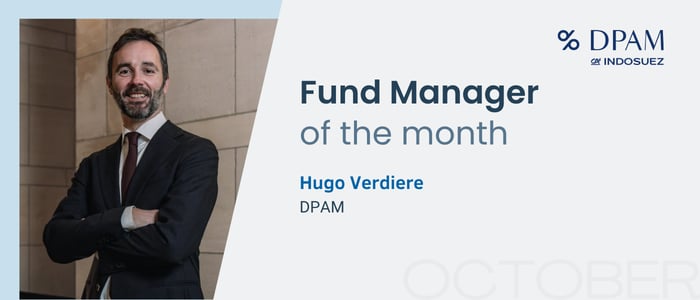
Hugo is a seasoned fund manager with 16 years’ experience in the industry. In his career he covered various positions within the global bonds sector for renowned international players such as Exane, SOGECAP, Amundi, EDF Investment Group and Candriam where he served as Senior Fund Manager, Credit and Global Bonds for four years. He joined DPAM in 2019 and since then he is part of our Emerging Markets Bonds team co-managing our emerging markets debt sustainable strategy. CFA charterholder, Hugo holds a Master of Science in Management from ESSEC Business School.
You started your career just before the 2008 financial crisis hit. What was it like beginning your career at that exact moment, and how has the sector changed since?
That was one of the best possible training. I learnt about volatility and I witnessed liquidity vanishing in products that still looked sound a few weeks before. I realised that, even if fundamentals like credit risk matter, it’s actually liquidity that can kill your portfolio.
Regarding the sector, it has obviously changed enormously since. We have seen some consolidation due to the rise of passive investing and pressure on fees, especially in the era of low rates, and lower return dispersion made it tough for active managers to generate alpha. I think now the pendulum is moving back and it’s time for active management to shine again.
Speaking of EM debt, it has emerged from somewhat still a niche asset class back then, to becoming more mainstream in asset allocations. Clients understand local currency debt better and have recently witnessed its merits in terms of risk-adjusted returns and diversification.
What do you find most exciting about investing in EM and frontier sovereign debt — markets like Africa, the CIS, and Türkiye — and what's been the hardest part of building expertise there?
What’s exciting is the diversity of the investment cases and the variety of economic situations. EM is a vague denomination encompassing many countries which exhibit very different characteristics one to another. They have different geographies, demographics, history etc which make investing there about understanding the countries’ specifics, their past and where they are heading. You also need to grasp what the local market forces and technicals are. For that purpose, there’s no better way than travelling and going on-site to meet with regulators, policymakers, the civil society and local investors. That’s also the hardest part of building expertise, it’s because you can have a framework, but you always have to adapt it to the countries’ specificities. Relying purely on quantitative screening doesn’t work well and risks and valuations cannot be summarized just by a rating and a spread or real yield.
How would you describe Belgium's asset management culture compared to its larger European neighbors, and has being based in Brussels shaped your approach to EM investing in any way?
Belgium is a smaller financial center compared to its neighbors and that shapes the culture in a concrete way. Teams are small so portfolio managers sit very close to the research, and investment decisions are taken quickly because there is no long chain of decision-making. Also, the fact we are a bit more remote from the main pools of EM investors probably leads us to invest slightly differently and take calls that are less consensus-driven.
How is AI or automation shaping the way you approach country analysis and sovereign risk assessment?
Not a great deal honestly. I’m using it to screen through the mass of data that is available to us, and to build models more efficiently. It’s true we’ve built some fancier tools than before with the help of our quantitative colleagues and AI, but in essence I haven’t changed my approach to country analysis. I don’t want AI to be the thing that forms my convictions.
What's the most important quality for a portfolio manager to have when investing in less-covered or less-liquid markets?
Intellectual honesty about the limits of what you can pull from the data. Data quality and transparency are sometimes weak so you can’t take official figures at face value. You need to cross-check across sources, look for data which are harder to dress up and look for alternative data. For instance the parallel rate for a currency tells you more than the official rate in some countries. Experience matters because it tells you where to look and identify the potential issues with the data. I would add that forming an investment call is only half he job, sizing correctly matters as well especially in less-liquid markets. The size should be decided by what you can realistically exit, not just by valuation.
When a market you cover experiences a sudden shock — political, currency, or otherwise — what's the first thing you do?
If my portfolio is actually exposed, I will check where my stops are and what I can realistically trade. In local debt you can trade the bonds but also the currency risk via NDFs for instance. I also get in touch with locals to understand their reading of the situation. In those markets price discovery is sometimes a challenge so the first move is not necessarily the clearing level for the market, and trading in the first hours can be an expensive decision. I need to understand if it’s a change in valuation or a change in the investment story. In the former case, it might be an opportunity to trade.
If you weren't working in finance, what do you think you'd be doing instead?
It’s still related to finance but pretty different from what I do today: I hesitated between portfolio management and project finance. What attracted me is that you can actually see what you’re financing and the risk doesn’t lie in a spread, it’s about construction delays, maintenance, factors affecting the production, counterparties within the project etc. You have to understand the country you invest in on top of the project itself. Finally, you cannot just sell it first thing in the morning if you change your mind so you need to do your due diligence correctly.
Outside of work, what helps you switch off from the markets?
Outside of work, I’m afraid I’m not going to be very original but I enjoy spending some time with my family and friends, eating out, and going for a run. In all honesty I do sometimes think of markets when I run, but I enjoy it precisely because it lets me organise my thoughts without being distracted by screens and emails.