Michael Israel from IVO Capital Partners is our Fund Manager of the Month

12 AUG, 2026
By Joanna Piwko from RankiaPro Europe


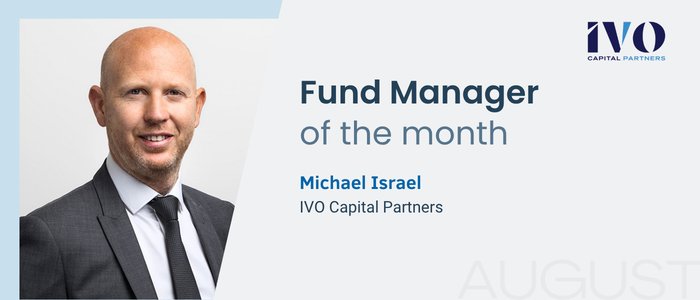
In 2012, Michael Israel founded IVO Capital with Sidney Oury. As Chairman of the firm, he manages the funds in the IVO range and is also a member of the investment committee for the Litigation Finance funds managed by IVO Capital Partners. Before founding IVO, Michael worked at Paribas, Rothschild & Cie, and finally Merrill Lynch, where he led a management team specializing in corporate credit in special situations. Michael holds a Master's degree from Toulouse Business School.
What first sparked your interest in investing and ultimately led you into asset management?
Growing up in Morocco gave me an early and visceral sense of what a developing economy looks and feels like. I was surrounded by entrepreneurs, local and international, building businesses, taking risks, and investing with genuine conviction in the future. These weren't always large-scale ventures; often they were family-run businesses making modest but meaningful investments. Yet the energy was unmistakable: optimism, ambition, a belief that tomorrow would be larger than today. I think that environment planted in me a lasting fascination, intellectual and economic, with growth, value creation, and the role investment plays in building an economy.
The second defining moment came at the end of my studies, when I was finishing a Master's in Banking and Financial Markets. I had secured an internship at PricewaterhouseCoopers, well-paid, prestigious, a solid start. But at the last moment, a Wealth Management internship opened up at Paribas. It paid five times less. I took it without hesitation. I knew instinctively that being close to portfolios, clients, and real investment decisions mattered more than the salary. That single choice shaped everything that followed, from private wealth management to, eventually, collective asset management.
Your career has spanned multiple market cycles. Which period taught you the most as an investor?
Crises teach you more than anything else — about markets, about economics, and perhaps most importantly, about yourself.
I began my career just before the dot-com bubble burst. Witnessing that swing from euphoric optimism to absolute despair was formative, even if I was perhaps too young at the time to extract every lesson from it. What struck me most, in retrospect, is how long it took markets to recover, something we haven't really seen since. Every major dislocation post-Lehman has been resolved relatively swiftly by central bank intervention.
But the defining moment of my career was undoubtedly the Lehman Brothers collapse. I was at Merrill Lynch at the time, and we all remember that extraordinary night when the US government chose to let Lehman fail while forcing Bank of America to acquire Merrill. That decision, and the deep internal tensions that followed from merging a pure investment bank with a commercial banking group, ultimately led me to found IVO. I can only be grateful for it.
From a markets perspective, the Lehman crisis created extraordinary dislocation in fixed income and credit. I've always believed that being a strong investor during a crisis is, frankly, not that difficult: when everything is cheap, the opportunities are obvious. What truly matters is having the right clients, those who trust you enough to deploy capital during that moments and not the opposite. I'm proud to say my clients have been with me for over twenty years, through Rothschild, Merrill Lynch, and IVO. They gave me the opportunity to prove myself when it mattered most. I owe them a great deal.
What skills are more important for investment professionals today than they were at the beginning of your career?
Undoubtedly, AI literacy stands out as the defining new requirement, across every industry, every role, and every level of seniority. For someone starting their career today, mastering AI tools is simply non-negotiable in a way it wasn't when I began mine.
That said, I firmly believe that certain qualities remain as essential as ever, and no technology will change that. Curiosity. Humility. And crucially, the right balance between humility and the self-confidence needed to make decisions and act. Being a person of action is rarer than it sounds. Throughout my career, I've consistently seen that the differentiator between professionals was less about raw intelligence and more about the capacity to actually do things, to move, to decide, to execute, rather than endlessly intellectualising.
And beyond that, what always rises to the surface in the long run is straightforward: seriousness, hard work, and integrity. There is no sustainable value creation without them. These qualities are timeless. They were essential at the start of my career, and they will remain essential long after AI has reshaped everything else.
What theme or trend do you believe investors are not discussing enough today?
At the risk of sounding self-serving, I'll say it anyway because I genuinely believe it: emerging markets. As a whole, whether equity or debt, they remain structurally underrepresented in indices and in portfolios, and they rarely sit at the top of asset allocators' agendas. Yet emerging economies already account for a significant share of global GDP, trade flows, and supply chain dependencies, and their share of global financing needs will only grow. The underrepresentation is partly explained by the complexity of the asset class: over sixty countries, highly heterogeneous, with little in common from one to the next. That complexity makes it harder to follow, less crowded, and less thoroughly analysed than other asset classes. For us at IVO, that is precisely where the opportunity lies.
The second theme, and perhaps the defining investment question of the next decade, is the trajectory of public debt in developed economies. Debt levels in the world's largest economies are, frankly, unsustainable, and the political systems of democratic regimes make it extremely difficult to summon the fiscal courage needed to address them. This issue tends to get pushed aside, either through optimism about AI-driven productivity gains, or through a quiet acceptance that high debt has simply become the new normal. But if it is the new normal, then risk models, credit ratings, and currency valuations all need to be fundamentally rethought. The consequences, whether for developed market currencies or for long-term growth prospects, are not being taken seriously enough yet.
Are there any metrics, indicators, or frameworks you find particularly useful when evaluating opportunities?
The foundation of any investment analysis, in my view, is not simply identifying risks or opportunities, anyone can do that. The real discipline is developing a rigorous, consistent framework for assessing the upside and the downside of each investment, and then building portfolios on that basis. That asymmetry lens, always asking how much you can make versus how much you can lose, and under what scenarios, is the cornerstone of how we invest at IVO.
Beyond the standard metrics that every fixed income investor monitors, leverage ratios, free cash flow generation, debt sustainability, I would highlight one dimension that carries particular weight in our asset class: strategic importance. Understanding whether a given issuer holds strategic significance for its country, its region, or its shareholders fundamentally changes the risk profile. When an investment carries real strategic weight, it tends to realign the interests of all stakeholders in a stress scenario. That alignment is, in itself, a form of downside protection, and one that is often underappreciated by investors who focus purely on financial metrics.
How are new technologies changing the way you research, analyze, or manage investments?
Honestly, I would love to say it has already been a revolution, but at IVO, we are still in the early stages of adoption. The impact on our day-to-day work is not yet transformative. That said, we can clearly sense what is coming, and it is compelling.
What excites me most is the capacity to deepen our understanding of industries and businesses in ways that simply weren't possible before. AI gives us an almost unlimited source of information and, in a sense, a conversation partner we can question endlessly, without the constraints of time, availability, or even the hesitation one might feel asking what seems like a basic question to a human expert. We can now explore angles, stress-test assumptions, and build context at a speed and depth that would have been inconceivable just a few years ago.
In a profession where understanding your investments as thoroughly as possible is the entire job, that capability is significant. The revolution is not quite here yet, but it is not far off.
How do you think the role of a fund manager will evolve in an increasingly digital world?
One underappreciated consequence of AI and digital tools is that they risk producing a convergence of thinking. When everyone uses the same tools, trains on the same data, and follows the same analytical frameworks, there is a natural tendency toward uniformity of thought. And in investment, uniformity of thought is both an opportunity and a warning sign.
I believe there will always be a vital role for fund managers who can step back, identify what the consensus view actually is, and deliberately position themselves to extract value from it. The most enduring edge in our profession has never been access to data, it has been the quality of judgment and the courage to think differently. If anything, a more digitalised world makes that human differentiator more valuable, not less.
What qualities do the most successful investment professionals have in common?
Whether in investing or in entrepreneurship, I am convinced that the single most differentiating quality among top performers is the capacity to decide and to act, and to accept that action will inevitably produce both successes and disappointments.
The best investors are comfortable moving forward without having all the answers. They make their best assessment of the upside and downside at the moment of decision, commit, and then remain willing to evolve their position as new information emerges. It is that combination, the willingness to act, and the discipline to continuously reassess, that separates truly great investors from the rest.
What I find fascinating is that the analytical starting point is often remarkably similar across professionals. Give a hundred experienced investors the same situation, and their initial reading will be broadly comparable, almost academic in its convergence. But what happens next is where they diverge dramatically: not everyone will act, and among those who do, not everyone will manage that position actively and intelligently over time. The edge is rarely in the analysis. It is in the action, and in the ongoing courage to keep acting once a decision has already been made.
What would people be surprised to learn about you outside of your professional life?
Honestly? Probably nothing. I suspect I am one of those people who is more or less the same in every room, what you see professionally is largely what you get personally. I have never been very good at compartmentalising.
And if there were something truly surprising, something my professional acquaintances don't already know, then I can only conclude that my subconscious has decided, quite wisely, to keep it to itself. So I won't be the one to overrule it.