David Dudding from Columbia Threadneedle Investments is our Fund Manager of the Month

31 JUL, 2024
By Jose Luis Palmer from RankiaPro Europe


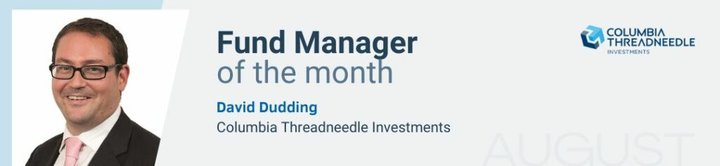
David Dudding is a Senior Portfolio Manager at Columbia Threadneedle Investments where he is the lead portfolio manager of the Global Focus strategy. He joined the company as an equity research analyst in 1999, moving on to manage the European Smaller Companies strategy for 10 years until December 2012. David previously worked for John Swire and Sons in Hong Kong and for Investors Chronicle as a financial journalist. David holds a Modern History degree and a European Politics Master’s degree from Oxford University. He also holds the Chartered Financial Analyst designation and is a member of the CFA Society of the UK.
When and why did you start your career in the financial sector?
I was a bit older than most of my colleagues when I started my career in asset management. It was back in 1999, I was 28 years old; after doing various jobs I went back to university to do a master's degree in European politics and I joined the graduate program at Threadneedle. The financial sector appealed to me because it combined many of my interests. I had experience as a financial journalist, so entering this field allowed me to merge my passion for business with my academic background in history and politics.
What is a 'typical day' like in your job? How do you organise your time?
The great thing about my job is that every day is different. Usually, the first meeting of the day is at 9:30am with the global team, during which we review news from around the world. By this time, our European and UK equity teams would already had their team meetings, so we focus on updates from America, Asia, and the main ongoing developments in Europe. These updates can range from macroeconomic trends to specific company news. A significant part of my day is spent on the phone, but also meeting companies, talking to analysts, conducting research or going to conferences... Many companies that we invest in, we've been invested for a long time and we have a good relationships with them; I also believe that face-to-face interactions are essential to maintain strong relationships.
What key principles guide your investment process?
The guiding principle is that of "competitive advantage": the primary objective is to buy companies with a good margin for improvement. Ideally, I look for companies capable of compounding cash flow growth in excess of 10% per annum, with low levels of debt, a solid earnings profile and a high return on investment. Our focus is on good long term businesses with a completive advantage such as intangible assets (e.g. brand strength), network effects (as demonstrated by many internet service companies), costs, transition costs and size. Thanks to the expertise and the intensive research work done by our global team of analysts, we have direct access to local market knowledge, which is extremely important to our investment process. An additional positive factor is to know that the companies we hold in the portfolio also have the same conviction as we do about what makes a company “excellent”.
How are you adapting your portfolio to the current market situation?
We are not really doing much adjusting because we aim to have portfolios predominantly exposed to medium and long-term secular themes. The primary focus is to invest in companies that we believe will perform well over the next three to five years. We avoid making frequent adjustments to the portfolio based on market conditions because we don't consider market timing as a strength. We acknowledge that we don't have a significant edge in predicting macroeconomic trends and their impacts on businesses, so we stick to our core competency of finding and investing in high-quality, long-term compounders as well as identifying great long-term growth businesses. Having said that, of course factors such as interest rates and economic growth can influence our valuation due to their impact on the cost of capital.
What are the most interesting types of companies you look to when constructing your portfolio? Which companies should you never invest in?
There is no sector I would exclude, even though there might be the tendency to avoid some. In general, I am inclined to prefer growth rather than value and to steer clear of commoditized, capital-intensive areas. Moreover, I try not to invest based on themes per se, even though some themes recur across portfolios, but because we are strong believers in them as a company – like for example technology. Demographics and climate change sometimes also take the forefront in our investment decisions.
What is the biggest challenge you have faced as a fund manager?
The biggest challenges in investing often arise during times of crisis, when assets are very cheap and, as a sector, we face significant stress. These events tend to create an environment where, paradoxically, just as we identify attractive investment opportunities, investor sentiment can lead to panic and subsequent withdrawals. This means that at times when we most want to invest, we might be forced to sell due to client panic, making it difficult to capitalize on those opportunities. Another great challenge is that investing is always done with imperfect information, and to truly generate returns, one often has to adopt a contrarian approach — being greedy when others are fearful and fearful when others are greedy. Balancing the identification of investment opportunities with managing client responses during crises remains a significant and ongoing challenge in our work.
What advice would you give to someone who wants to pursue a career in asset management?
To succeed in this profession, I would say that you need to be inquisitive and open-minded, never ruling anything out. If you enjoy learning, it’s a fantastic career. It’s also important to keep in mind that perfection is unattainable, so you will never have the “perfect portfolio”. You can never be 100% right and you have to learn to live with it. There will be times when you are very wrong, and those periods can be long and demoralizing. Developing a thick skin is crucial to handle these challenges and to continue to move forward.
What do you like to do when you are not working?
One of my greatest passions is sports, mostly cricket and football. Nevertheless, I must say that I quite enjoy watching theatre and reading as well. Most of my time away from work, though, is spent with my 12-year-old daughter, whether that means watching movies or doing other activities she enjoys.