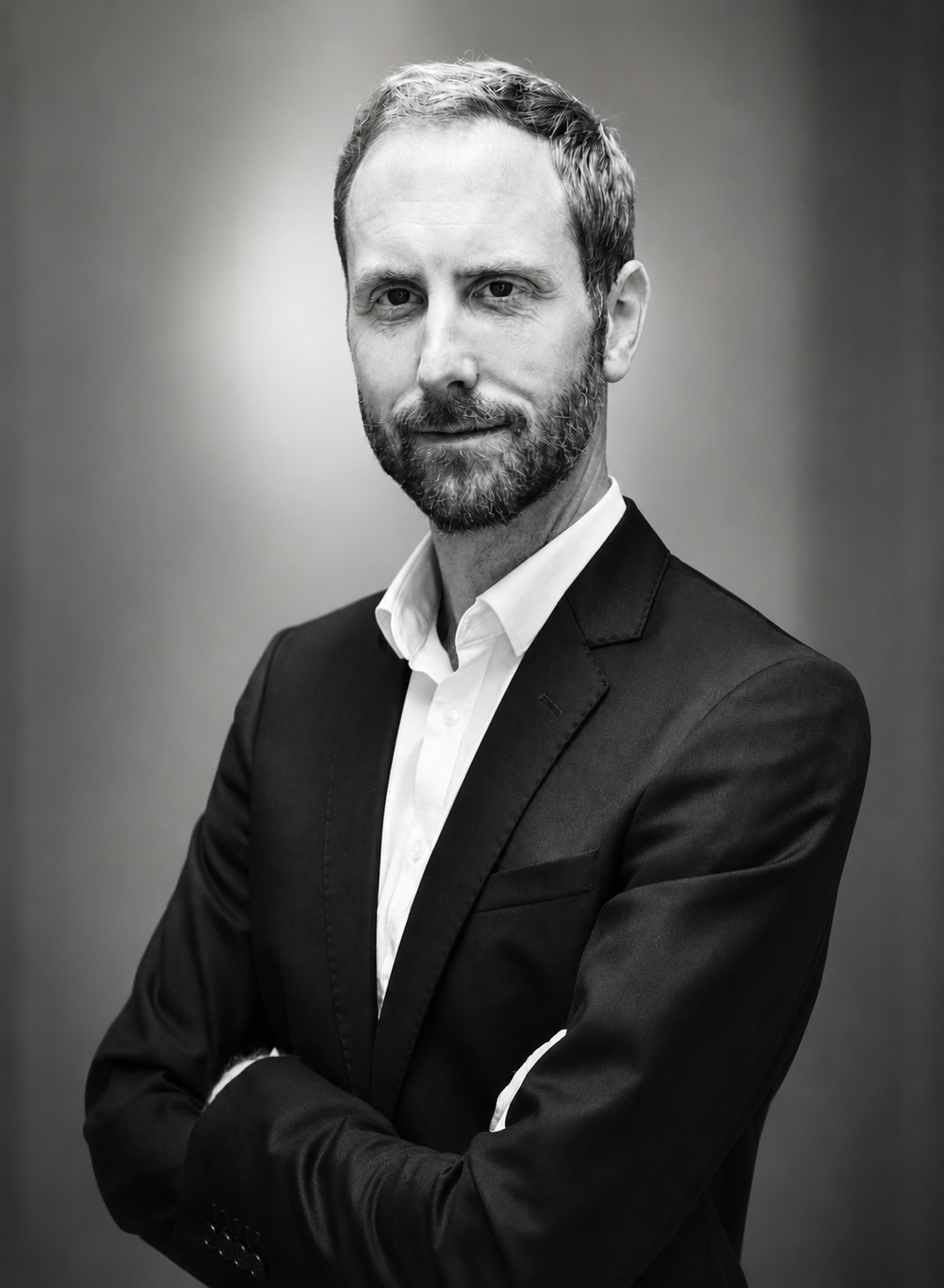
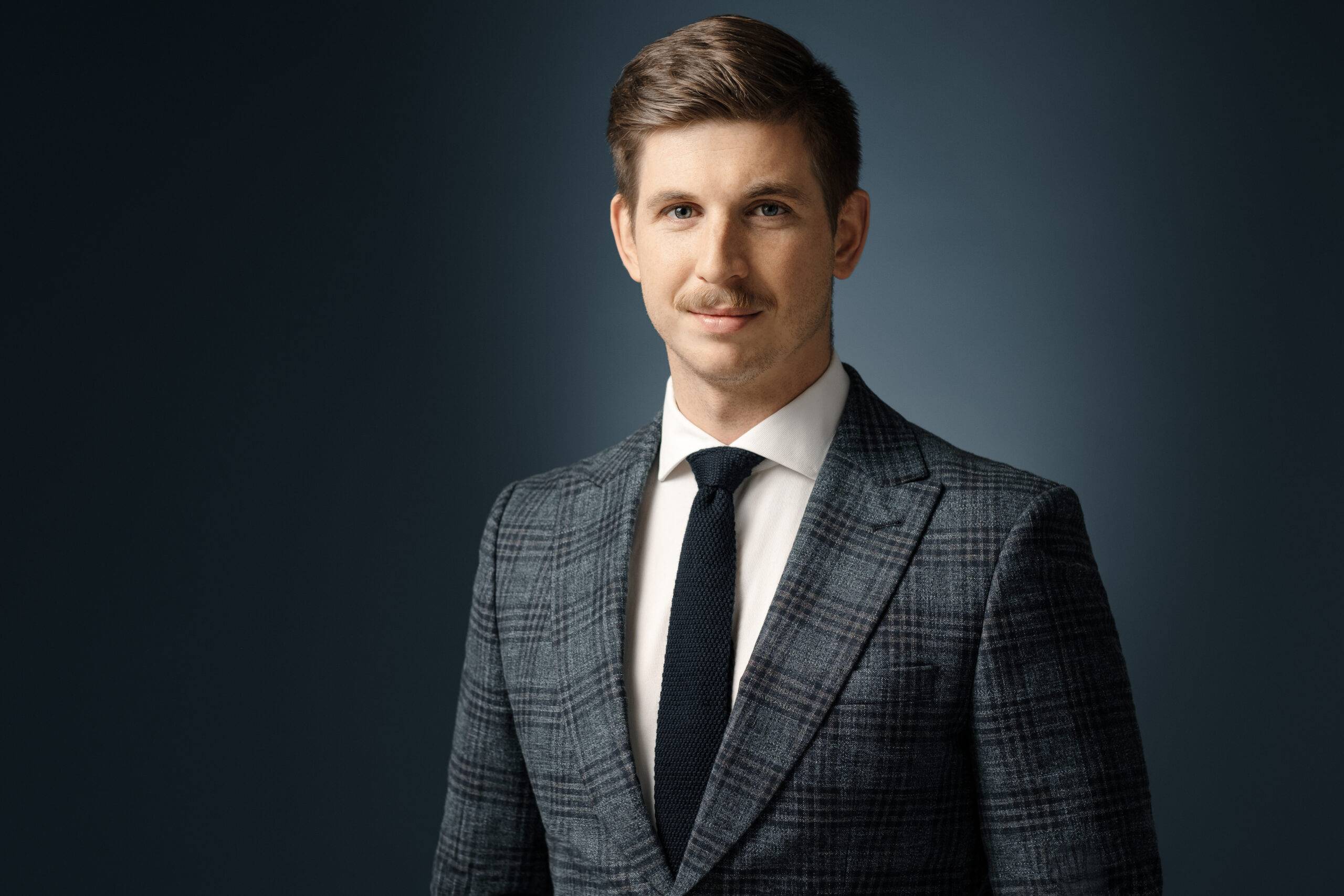
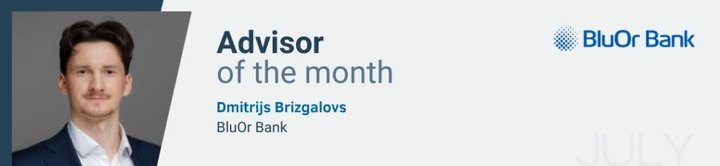
Dmitrijs Brizgalovs from BluOr Bank is our Advisor of the Month

24 JUL, 2024
By Jose Luis Palmer from RankiaPro Europe


Dmitrijs Brizgalovs is an Investment Portfolio Manager at BluOr Bank, where he manages discretionary client portfolios. Apart from investment management, his career spans across alternative investments, investment banking and central banking, both in Latvia and internationally.
In his role at BluOr Bank, Dmitrijs leverages his developed skills and knowledge to position client portfolios around strong medium to longer-term investment themes, taking into account the individual situations and needs of each client. He is dedicated to staying ahead of market trends and identifying unique investment opportunities that others might overlook.
Dmitrijs is determined to help clients navigate increasingly complex investment landscapes and achieve their financial goals.
Why did you choose to go into financial advice? Did you have other vocations? What were your first steps in the financial sector?
I think finance and investing in particular is just a perfect fit for my personality, mindset and traits I have developed throughout my life.
As long as I can remember, I have always been curious. I liked to understand how and why things worked around me. Sports was and still is a major part of my life. I played basketball since I was four (my father is a basketball coach, so didn’t get much choice there). I loved it. It gave me discipline, competitiveness and result driven mindset. In addition, I like numbers. Numbers have always made more sense to me than words, which is why I chose to study finance and economics at university.
My professional journey has consistently revolved around investments, from alternative investments platforms to investment banking and the Central Bank. Each role has provided me with invaluable and diverse experience, skills, and knowledge, enhancing my understanding of different parts of the financial system.
Putting it all together, it’s a logical progression that I find myself where I am today. The traits and knowledge I acquired along the way help me greatly to succeed in this always-fascinating field of investments management.
How do you see the current macroeconomic environment? What macro data do you look at most when advising your clients?
The past couple of years have been extraordinary, to say the least. Even legendary investor Stanley Druckenmiller has commented on the difficulties of the current investing environment, describing it as one of the most challenging periods he has encountered.
Interest rates skyrocketed from zero to 5.5% in a record short period, significantly impacting asset prices, especially in 2022. The speed of this change was more crucial than the level itself. Once rates started to stabilize at this higher level and nothing really broke in between, the “higher for longer” mindset set in, and we started seeing momentum picking up again. Now major indices are reaching new all-time highs every other day. However, it’s important to note that only a handful of stocks have been the largest contributors to this advancement, so we need to keep a close eye on the market’s breadth.
Federal Reserve is the one who sets the tone for the global monetary policy, and its mandate is price stability and maximum employment. Therefore, it is important to consistently monitor these variables.
When the Fed eventually cuts rates, we don’t expect them going back to zero. The period between the Global Financial Crisis and Covid-19 was an anomaly. In this cycle, we foresee structurally higher inflation driven by factors such as elevated commodity prices, geopolitical uncertainties, wars, fiscal stimulus impacts—all inherently inflationary. Another key area is the manufacturing sector. Global Manufacturing PMI seems to have bottomed out and is starting to expand again.
Higher inflation, expanding manufacturing, and lower interest rates create a recipe for higher commodity prices. More importantly, adding to this mix structurally weak supply due to underinvestment, and increasing demand, we can easily imagine a strong upward movement in commodity prices.
In this new environment, it's crucial to think outside the box and not rely on the playbook from the previous cycle. This approach helps spot the opportunities that lie ahead.
How should investors orient their portfolios for the remainder of 2024?
Well, it always depends on the investor. There are many opportunities in the market, and they don’t need to be related to the Mag-7 or any other abbreviation that is currently used to describe the hottest stocks. For example, there are companies in the energy sector that can pay out 30-40% dividends if they choose, and others have even outperformed Nvidia in 2023. These are cheap companies that generate substantial cash flow for their shareholders. Emerging market debt also currently provides very attractive yields. It is definitely an asset class to look at, but here it is important to partner with a right active manager with local market expertise that can add additional alpha.
We avoid making short-term predictions, instead positioning client portfolios around strong medium to longer-term themes. Given the record-low breadth of the market and sky-high valuations for the largest stocks, it's advisable for investors to be cautious and ask the right questions before buying these top performing stocks. I’m definitely not calling for a top in these stocks, but they do always form on peak excitement.
Generally, investors should consider more exposure to commodities, either by buying the commodities themselves or investing in producers. Commodities will play a key role in the current cycle. The world needs them to build a better future, but the supply of these crucial materials is being very challenged.
What characteristics do you think a good financial advisor should have?
To be a good investment manager, you need a healthy mix of analytical skills and the ability to recognize patterns, along with curiosity and imagination. That is essentially what we do - we try to envision how the world will look in the future and make investments today that will benefit when that future arrives.
Good communication skills are also crucial, as we regularly meet with clients and need to explain complex subjects in an understandable and concise way. Moreover, you need to genuinely enjoy what you're doing. That passion is visible during interactions with clients, and their trust grows even more when they see that sparkle in your eye.
Which portfolio allocations are most interesting in the current market situation? Which sector do you consider particularly interesting at the moment?
Currently, the setup for commodities makes them the most interesting sector with the most convex opportunities. The supply and demand dynamics are highly favorable. More specifically:
Copper: The green transition heavily relies on copper, as it is the main material for transmitting electricity from point A to point B. It makes copper one of the most critical materials of the next decades. However, the supply is decreasing each year, with no new mines opening anytime soon. This creates a significant opportunity, as demand will only continue to rise.
Oil/Natural Gas: The energy transition is called a transition for a reason, we can’t just turn off the conventional energy sources we are currently using overnight. Also, developing countries are driving new demand as they seek to boost economic growth and living standards. That is all happening while the producers in this sector are currently priced as if there is no tomorrow for them.
Uranium: It is one of the best alternatives for base load power generation, with buyers such as nuclear reactor operators being very price insensitive. As the world looks for stable and low-carbon energy sources, uranium becomes increasingly crucial.
Gold: In an inflationary environment, gold stands out as the ultimate store of value. Buyers from developing countries are looking to gold as a long-term value preserver and central banks are again increasing their gold reserves to become less reliant on US Treasuries.
What does a typical workday look like for you? How do you organize your time?
My workday typically starts during my commute to work. I use these 30 minutes to listen to my favorite podcasts related to investing, markets, or geopolitics to gain some interesting insights and new ideas.
Upon arriving at the office, I review our client portfolios to assess their performance and determine if any adjustments are necessary. I also check for any new developments overnight that might impact our positions.
Communication with existing and potential clients is a significant part of my day. This involves meetings, calls, or emails where I explain our services to potential clients, and review portfolio performance, discuss individual positions, and explore additional investments with existing clients.
But the largest portion of my day is dedicated to reading, research, and generating new investment ideas. This involves consuming a wide range of materials, including market and company-specific news, research reports, industry blogs, company presentations, different commentaries. The content I read varies, but it is always related to the markets in some way or another.
What role do you think regulation plays or should you play in driving Socially Responsible Investments?
Regulation is an important part of the financial system, ensuring it operates fairly and transparently. However, for regulations to be effective, they must be well-developed and clearly communicated to industry practitioners. The reasoning behind the regulations—the "why"—is particularly important for gaining industry buy-in and driving positive change.
Current ESG regulations often fall short of this standard. They can appear more populist rather than genuinely effective in driving positive change. Practitioners like myself frequently find it challenging to understand what is required, and just as they do, the rules change again. This creates confusion and undermines the effectiveness of the regulations.
For example, consider the copper mining industry. While mining as a process has a negative environmental impact, it is essential for obtaining the critical materials needed for a green future. If ESG regulations make it harder to invest in such industries, we risk delaying the transition to a greener and better world. It's crucial to strike a balance where regulations promote socially responsible investments without hindering the essential processes required for achieving long-term sustainability goals. We need to look at the world realistically, not through the lens of wishful thinking.
In essence, regulation should provide clear guidelines that are grounded in reality and the complexities of the world, ensuring that the path to a green future is feasible and supported by necessary industries.
What do you like to do in your free time?
Since sports have been an important part of my life, I still regularly work out but with a “little” less intensity—more like three times a week instead of twice a day. I try to free up my time to enjoy various types of sports depending on the season, such as wakeboarding, beach volleyball, and snowboarding. Not so much basketball nowadays.
I also enjoy reading, and not just finance-related materials. Occasionally, I play the guitar, which is a great way to relax and learn something new. Speaking of new skills, I just started learning Italian (can’t really say more than “io sono Dmitrijs,” but I’m getting there).
Driving and taking trips out of the city over the weekend to clear my head and connect with nature is another activity I really value after a busy workweek.