Emilie Fleury-Caduc from Justae is our Advisor of the Month

18 FEB, 2026


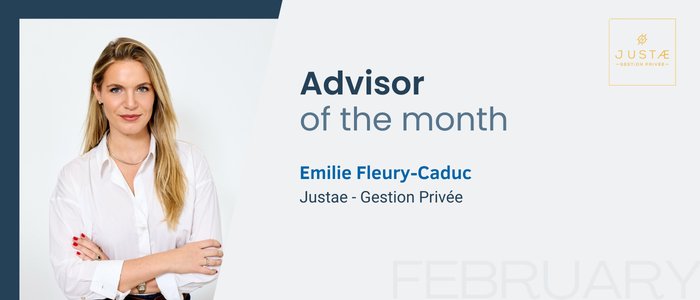
Emilie Fleury-Caduc is Chief Investment Officer at Justae, an independent multi-family office in Paris advising entrepreneurs and international families on bespoke wealth and investment strategies. She oversees multi-asset portfolios across liquid and private markets, with a strong focus on due diligence rigor, risk alignment, and long-term resilience. She previously held leadership roles in sustainable finance and multi-family office environments, including Partner at Arvella and Head of Sustainable Finance at Greenly. Earlier in her career, she gained international institutional investment experience in London at Morningstar Investment Management. Emilie holds a Master’s degree in Asset Management from Université Paris-Dauphine and is actively involved in promoting women in finance through 100 Women in Finance.
What made you decide to go into the financial sector? Did you have any other vocations?
My path into finance was quite natural, but also shaped by international exposure early on. During my studies, I chose to alternate academic training with professional experience, which led me to London and to Morningstar Investment Management. That immersion in portfolio construction and institutional investing was a decisive moment.
I discovered how intellectually stimulating and globally connected the investment world is, but also how human it can be when advising clients. That combination — analytical rigor and relationship-driven work — strongly resonated with me.
I did explore more academic or research-oriented paths at first, but the Asset Management environment offered me a much more dynamic environment and the opportunity to work at the intersection of markets, strategy, and real-world impact.
What does a typical workday look like for you? How do you organize your time, and which key indicators or market news do you follow on a daily basis?
My role spans multi-asset investing, portfolio construction, and close client dialogue, so my days are naturally very varied. I usually start with a global market review across asset classes — interest rates, inflation expectations, credit spreads, equity positioning, and capital flows — to frame the overall risk environment.
I then dedicate time to both liquid and private investments: monitoring public markets, assessing tactical opportunities, and conducting manager selection and due diligence in private markets. Designing diversified allocations that align with each client’s objectives, constraints, and time horizon is a central part of my work.
Beyond quantitative indicators, I rely heavily on qualitative exchanges with fund managers and industry peers. Having worked in both London and Paris, I value maintaining an international perspective on markets and opportunities.
Which portfolio allocations are most interesting in the current market situation?
Today, diversified portfolios combining liquid assets and private markets are particularly relevant. Private assets provide long-term premia and diversification, while public markets ensure liquidity and tactical flexibility.
Within private markets, private credit offers attractive income with controlled risk, infrastructure provides long-term visibility and inflation resilience, and secondary private equity strategies allow investors to access mature assets while mitigating the J-curve.
Overall, the most compelling allocations today balance income, resilience, and long-term growth, while carefully managing liquidity — which is essential in wealth management.
Which sector do you consider particularly interesting at the moment?
Artificial intelligence is clearly one of the most transformative themes today, but I find the most interesting opportunities often lie beyond the large, highly valued U.S. technology leaders. Valuations are elevated and the ecosystem is highly interconnected, which concentrates risk.
What I look at with particular interest is how to gain exposure to the AI theme through other geographies and along the broader value chain — for instance suppliers of critical components, digital infrastructure enablers, or companies that are major beneficiaries of productivity gains from AI adoption.
At the same time, the current geopolitical environment has renewed structural interest in the defense and security sector, particularly in Europe, where spending cycles and industrial capacity are expanding after decades of underinvestment.
More broadly, I remain very constructive on sectors driven by long-term structural trends such as digital infrastructure, energy transition, and resource efficiency, which offer strong visibility and diversification within portfolios.
When you think about 2026, what changes or events do you find most interesting to follow as an investor?
Several themes will be key to watch. First, the path of interest rates and inflation normalization will continue to shape valuations across asset classes. Second, the evolution of global capital flows — particularly toward real assets and private markets — will influence opportunity sets.
Geopolitical fragmentation and energy transition policies will also have major investment implications, especially in infrastructure, commodities, and industrial transformation.
Finally, the maturation of private market structures — including evergreen vehicles and secondary markets — is reshaping how investors access illiquid assets, which I find particularly interesting.
Based on your journey, what characteristics do you think are essential to being a successful financial advisor?
Being a successful financial advisor requires both strong technical rigor and a deeply client-centric approach. Sound investment decisions rely on robust analysis, disciplined due diligence, and the ability to continuously reassess assumptions and adapt convictions in evolving markets.
At the same time, technical quality alone is not enough. A portfolio is only truly successful if it is aligned with the client’s objectives, constraints, relationship to risk, and level of comfort with uncertainty. This requires deep listening, trust, and a genuine understanding of how each client perceives and experiences risk.
Pedagogy is therefore central to the role: explaining markets, risks, and investment choices in a clear and accessible way ensures that clients not only hold well-constructed portfolios, but also remain confident and committed to them over the long term. In that sense, the advisor’s role is to connect technical excellence with human understanding.
As technology continues to reshape markets, which tech-driven trend or innovation do you think investors should be watching most closely?
Artificial intelligence applied to the real economy — particularly productivity enhancement and industrial optimization — will likely be one of the most transformative forces.
Beyond pure tech companies, the most interesting impact may come from how AI reshapes traditional sectors: manufacturing, energy systems, logistics, healthcare and infrastructure management.
For investors, the key is not only investing in technology itself, but also identifying businesses and assets that benefit structurally from its adoption.
Have you ever trusted your conviction over the market’s consensus? What happened, and what did it teach you?
Yes — particularly in private markets, where consensus often forms slowly. I have supported investments in emerging or less crowded strategies when long-term structural fundamentals were strong, even if they were not yet widely adopted.
These experiences reinforced a key lesson: conviction must always be grounded in rigorous analysis and disciplined due diligence. When a thesis is robust and aligned with long-term trends, it can justify diverging from consensus in the short term.
Over time, fundamentals tend to prevail — especially in long-duration investments.
When you step away from the office, what passions or hobbies give you energy?
Maintaining balance outside work is essential to me, both physically and intellectually. Physical activity — particularly Pilates and wellness practices — helps me recharge and sustain energy in a demanding profession.
I am also deeply committed to supporting women in finance. I volunteer within the Paris committee of 100 Women in Finance, an international association of more than 30,000 members worldwide. Beyond supporting women at different stages of their careers, I strongly advocate for women’s financial education, which I believe is a fundamental pillar of independence throughout life.
These engagements outside the office are very meaningful to me and bring perspective, purpose, and renewed energy to my professional life.