Flurry de Quinsonas from Guinness Global Investors is our Sales Manager of the Month

11 NOV, 2026
By Joanna Piwko from RankiaPro Europe


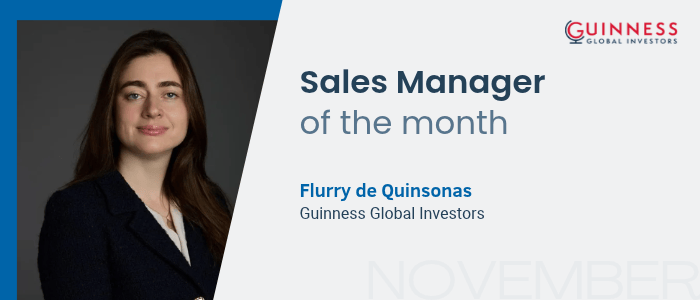
Flurry de Quinsonas (née Wright) is Head of European and South African Distribution at Guinness Global Investors, based in London. She joined the firm in October 2012, and before her current role she worked as a sales manager covering clients in the Channel Islands, Ireland, Italy, Luxembourg and the UK. In 2024 she took on leadership of both European and South African distribution, after more than a decade in UK and European sales. Before Guinness, she worked at PsychologyOnline as a business development and research intern. She graduated from Worcester College, University of Oxford, in 2011 with a degree in English.
Take us back to the start of your career — what made you choose finance over other paths that were open to you at the time?
Growing up, finance was not a natural part of my world. I lived on a farm, and my two great interests were horses and books. My first encounter with finance came from a rather unexpected source: Daniel Defoe.
Defoe is best known for writing Robinson Crusoe, often regarded as the first English novel. Less well known is that he was also a financial journalist. My introduction to finance was through one of his essays promoting government bonds to the public. I read it in 2009, while studying English Literature at Oxford University, against the backdrop of the global financial crisis. The crisis itself felt distant from student life, but Defoe’s involvement in the South Sea Bubble made me curious about the connection between finance, markets and human behaviour.
At the time, most of my contemporaries were considering careers in law or teaching. I had never seriously thought about finance. But Defoe opened a door. Curiosity led me to seek out work experience, and soon I developed a new habit of reading the Financial Times. I became fascinated by the way finance offered a different lens through which to understand the world: to interpret events, weigh competing forces and, ultimately, try to anticipate what might happen next.
What was it about your early experiences in the industry that made you want to stay, rather than move on to something else?
Our offices occupied the third and fourth floors of a beautiful Queen Anne townhouse just off St James’s Park. The early years, however, were far from glamorous. The building had its own microclimate (sweltering in summer and stuffy in winter). Budgets were tiny, so creative thinking was essential. In fact, I remember one afternoon walking around London delivering cream teas to fund selectors’ offices, in the hope of persuading them to come to an event.
Each year, however, the funds grew, and my career grew alongside the company. No two days have ever been the same, and I have never stopped learning. I enjoy the intellectual challenge of keeping on top of the funds and markets, and then translating that knowledge into conversations with clients.
The company has grown from around $300 million to $11 billion during my time here. It has been a hugely rewarding and exciting journey. And, fortunately, the offices are now modern- and have air conditioning too!
Which asset class or region do you think is most misunderstood by investors today?
I would pick the energy sector—both conventional and sustainable energy. We are living through an extraordinary period for energy markets, and I think both sides of the sector deserve a closer look. The current disruption has highlighted just how important energy security remains. We have seen significant disruption to oil and gas supply, while so far the impact on prices has been cushioned by inventory releases, changes in trade flows and some moderation in demand. As we move into autumn, however, the underlying uncertainty remains.
History is useful here. The two major oil shocks of the 1970s, the 1973 Arab oil embargo and the supply disruptions that followed the Iranian Revolution and the Iran-Iraq War, put energy security firmly on the political agenda. One of the longer-term consequences was a huge increase in investment in alternative and sustainable energy technologies.
I think there are parallels today. Conventional energy remains strategically important, and historically oil and gas equities have provided an effective hedge against inflation. At the same time, the growth of electricity demand, particularly from data centres in the US, is creating a powerful new incentive for investment across the sustainable energy sector.
So rather than viewing conventional and sustainable energy as competing investment themes, I think investors should consider them as two parts of the same much bigger story: how the world will produce, secure and ultimately pay for the energy it needs.
Is there a narrative dominating client conversations right now that you’re sceptical of?
Some investors have become sceptical of quality investing. I would say that reports of its death are greatly exaggerated. It is perhaps not surprising that I take that view, given that investing in quality companies is central to the Guinness philosophy. But I think there is a more fundamental reason to be sceptical of the narrative. Quality investing is based on a fairly simple observation- the market often underestimates how long genuinely good companies can remain good companies.
Businesses with consistently high returns on capital, strong balance sheets and attractive competitive positions tend to outperform over full market cycles. That does not mean they are immune to downturns, or that they will outperform every year. Rather, their underlying resilience is often greater and more enduring than the market gives them credit for. For me, that is what makes quality investing interesting. It is less about trying to predict the next quarter and more about identifying businesses whose ability to compound value can persist for much longer than investors expect.
What’s the hardest part of maintaining a client’s trust during a difficult market environment?
Our funds have clearly defined investment philosophies and processes, and our fund managers have the conviction to stick to them. That inevitably means there will be periods when the funds are out of favour with the market.
Those periods can be uncomfortable. There is always a temptation to change the process when something is not working, particularly when clients are asking questions or the prevailing market narrative is moving in a different direction.
Some clients find that difficult; others find it reassuring. Our aim is to make sure clients understand how we invest, why we invest that way, and what they should expect from us over a full market cycle. If they understand the process, then periods of underperformance become easier to put into context. We can then focus on the long term rather than reacting to the market noise.
What skills do you think will matter most for the next generation of sales professionals — beyond the technical knowledge?
Be a human, not a robot.
That said, artificial intelligence is incredibly useful—and, in preparing for this interview, I did what I suspect many people now do and quickly asked ChatGPT the same question. Its answer was “the ability to listen”, which is actually pretty good advice.
So listen. But when you come to respond, find your own voice. Don’t simply repeat what you think people want to hear, or send over “AI slop”. The best conversations are still the ones where you can tell there is a person behind the words.
What separates the sales professionals who last decades in this industry from those who don’t?
You cannot control the markets, the funds, or even the transport connections. There will be days when the market plummets, your fund manager’s style is out of favour, and, just to make things more interesting, a herd of cows escapes onto the airport runway and grounds all the flights (– which really has happened on a sales trip.)
At times like that, the old advice to “be cheerful, strive to be happy” has rarely been more appropriate. It is, of course, easier said than done. I also think resilience is more of an output than an input. Over time, I have found that the people who remain successful are those with genuine intellectual curiosity, an ability to adapt when circumstances change, and enough perspective not to be knocked off course by every setback.
(And a sense of humour certainly helps. Particularly when there are cows on the runway.)
Outside of finance, is there another career you sometimes think you’d have enjoyed?
I’m always curious about the path not taken. There have been a few interesting possibilities over the years, including one involving a rather nascent Mongolian tourist board, which could certainly have led me somewhere very different.
Perhaps I could have followed the family business and gone into farming. I grew up around it, and there is something appealing about working with something tangible, if unpredictable. Although, having spent a career in the markets, I’m not sure I escaped unpredictability - the markets can be every bit as unpredictable as the weather.
Coming back to Daniel Defoe, I think I would have enjoyed being a writer. Perhaps one day, if I find myself shipwrecked on a desert island, I’ll finally get around to writing that novel...