Francesca Mozzati from Exane Asset Management is our Sales Manager of the Month

19 MAR, 2025
By Jose Luis Palmer from RankiaPro Europe


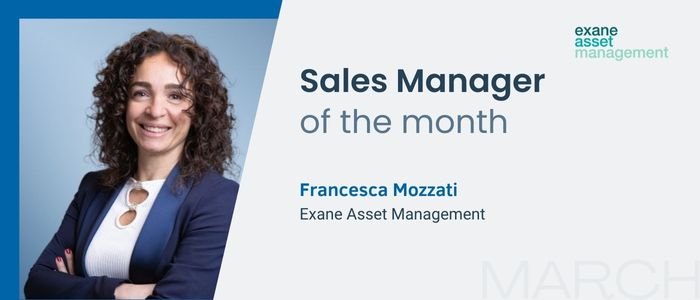
After 13 years as head of equity sales for Italy at Natixis, where she developed strong expertise in business development, Francesca Mozzati joined the Corporate Access team at Natixis in 2013, focusing on origination and managing corporate events. In 2015, she played a key role during the creation and development of a team dedicated to the commercial promotion of structured products for the BPCE banking network. In 2018, she embarked on a new journey at Sycomore AM, where she took charge of business development for Southern Europe, further enhancing her international expertise and ESG knowledge. She has joined Exane Asset Management in 2025 as the Head of sales for Southern Europe.
What made you decide to go into the financial sector? Did you have any other vocations? Did you focus your career on the financial sector from the beginning?
I was born and raised in Milan, and I started working in 1999 at a brokerage firm located right in Piazza Affari! After that, I moved to Paris to join CDC Bourse, which later became Natixis, as an equity broker. The energy, excitement, and speed of those years were incredible. I loved working in that environment, where trading and fundamental analysis fascinated me for their rigor and, at times, a bit of madness—especially trading.
After 15 years in equities, I transitioned to structured product sales for four years and then joined Sycomore as an ESG product specialist for seven years. The common thread throughout my career has been my connection with Italian investors, and in recent years, also Spanish and Portuguese investors.
As a child, I dreamed of becoming a ballerina and opening a dance school. That remains a dream in my heart, but today, I feel like I am dancing with the financial markets.
What does a typical workday look like for you? What do you enjoy the most about your job?
Every day, I strive to support my clients by providing updates, useful insights, or simply giving them space when the markets are turbulent. What I love most is the connection with people and being able to provide real value.
For me, the best sales professionals are those who are consistently present—through good and bad performance—who understand the client's needs and offer support without being intrusive or neglectful. There are no "good" or "bad" clients, only professionals doing their job, and it’s our role to help them succeed.
In your opinion, what are the key drivers for successful fund distribution? What are the key elements to rely on an asset manager?
The foundation of successful fund distribution lies in trust, consistency, and the ability to provide solutions that truly meet investors' needs. A strong, long-term relationship with clients is essential, along with deep product knowledge and an ability to navigate both market opportunities and challenges.
When choosing an asset manager, the most important factors to consider are expertise, transparency, alignment of interests, and performance. A strong track record in asset management, particularly in the area of long/short equity strategies, is essential. Exane Asset Management, for instance, has a deep understanding of European equities and focuses on achieving sustainable capital growth through well-researched strategies.
Last but not least, clear and frequent communication regarding investment strategies, risk management, and fund performance is critical. A reliable asset manager will provide clients with comprehensive updates, showing the rationale behind portfolio decisions and adjustments.
Finally, the best asset managers align their interests with those of their clients. This could include having skin in the game, ensuring that their compensation structure reflects the success they deliver to investors.
Could you highlight any topic on which investors should focus for the long term?
For long-term investing, there are several key topics to focus on: diversification, technological innovation and market evolution, risk management and of course… active management!
Staying ahead of the curve on technological advancements and changes in the financial market landscape will benefit investors. Then, a diversified portfolio is critical for managing risk over the long term. Investors should focus on spreading their investments across different asset classes and geographic regions to mitigate risk from any one market or sector.
Finally, the debate between active and passive management is crucial. Long-term investors may benefit from active management strategies that seek to exploit inefficiencies and capitalize on changing market conditions
What is your advice to investors, how should they position their portfolios with the current environment?
Geolitical, geopolitical and economic events observed throughout 2024, notably the strength of the US economy, the election of Donald Trump and intervention by the Chinese government to support the struggling domestic economy, combined with an alarming political environment in Europe, have led to strongly consensual market flows at the start of 2025, involving a flight out of European stocks and particularly away from France, and towards the US.
Given this situation, we are anticipating further strong performance dispersion in 2025. Stock picking will therefore be a determining factor in an equity market which is likely to be less bullish than in 2024. We are therefore more convinced than ever that our long/short strategy, led by a team of seasoned sector portfolio managers, is perfectly adapted to this market environment, as our approach captures divergent stock performances, whether the markets are bullish, bearish or flatlining.
I believe that clients need "all-terrain" solutions that are adapted to all market conditions and resilient. In times of uncertainty or high volatility, it is essential to offer strategies that can quickly adjust to these changes. Long/Short Market Neutral solutions, for example, are particularly effective in this context. They allow low correlation from traditional market indices, providing stability and comfort to investors who seek protection against extreme market movements. These strategies aim to generate returns while reducing exposure to directional risks, which is crucial in times of significant uncertainty.
How do you stay informed about market trends and changes in the asset management industry?
I stay informed by reading articles from sources like Rankia, Citywire, and other financial publications, as well as following news on various websites. However, the most important source of information is the market itself. The discussions I have with clients, my managers, brokers, suppliers, and colleagues in finance are crucial. You need to have your eyes and ears everywhere to truly understand what’s happening and adapt to changes quickly.
What is the most exciting thing you have seen in the markets since you started working in the financial sector? And the biggest challenge you had to face?
The late 1990s and early 2000s were fascinating years. The stock market was like what we see in movies today—fast-paced, spontaneous, and full of adrenaline. Being part of that environment, even for a short time, was an incredible opportunity. Today, markets are more regulated and structured, which brings more precision and pragmatism.
The biggest challenge I faced was being on the trading desk during the September 11 attacks. I watched the events unfold live while phones were ringing nonstop, orders needed to be processed, and the markets were collapsing. Balancing the shock and grief with the pressure of the job in that moment was an incredibly difficult experience.
When you have free time, what do you like to do?
I love traveling with my family, dancing, practicing Pilates, yoga, and barre au sol, and going for walks with my dog, Spritz. Movement has always been a passion for me, and although I didn't become a professional dancer, I find my own rhythm in both life and the financial markets.