Francesco Rustici from iMGP is our Fund Manager of the Month

26 MAR, 2025
By Jose Luis Palmer from RankiaPro Europe


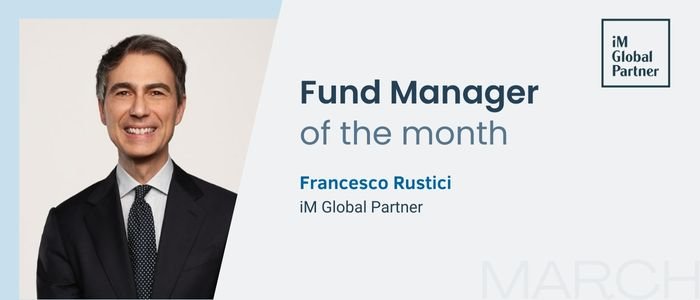
Francesco Rustici, CFA, joined Zadig Asset Management in 2020. He has been responsible for the Memnon Opportunities strategy since 2020 as well as providing research ideas for the Memnon European strategy since July 2023. Prior to joining Zadig European equity team, he was Managing Director and Deputy Portfolio Manager at Chilton Investment Co, which he joined in 2011. Previously he worked in equity research roles at Theorema, since 2004, and in the asset management businesses of Citigroup and the Zurich Group, starting in 1996. He graduated from the Università Cattolica in Milan in 1996.
Francesco is lead manager of the iMGP Euro Select Fund, which he runs with Régis Bégué, and also the head portfolio manager of the Memnon Opportunities Fund which he manages with the help of Aurelien Favre.
Why and how did you decide to go into the financial sector, did you have other vocations?
Well, in the early nineties a career in finance in London would have ranked at the very top in desirability for a young graduate from Milan, so that is the road I pursued!
What is your view of the current macroeconomic environment and how might it affect markets? How do you manage the current and future uncertainty?
Over the last couple of months, it is safe to say we have witnessed very rapid swings in investors’ sentiment towards European equities. The pace of these changes, relative to any actual change in macro fundamentals, may be questionable. However, with the seemingly unavoidable fiscal stimulus coming, there is indeed ground for optimism, especially in the context of still depressed valuations in Europe. Nevertheless, we manage the uncertainty by avoiding investments that are completely dominated by macro drivers – typically, miners, for example – and we help ourselves by building bull and bear case scenarios: we ultimately do not know how the macro will play out, but we only invest when the risk/reward looks favourable to us.
How should investors orient their portfolios in this environment? What are the biggest risks facing investors?
We do not build our portfolios based on top-down, macro views. Our approach is based on bottom-up stock picking. However, we make sure that our ideas are, as much as possible, decorrelated from one another. Risk concentration is one of the most significant pitfalls, and our effort to ensure driver diversification across our ideas is our primary tool for risk management.
What differentiates the iMGP Euro Select Fund from the others and what advantages can it bring to an investor’s portfolio in the current scenario?
What differentiates us is that we do not have a predefined style bias, for example towards value or growth. At any time, we try to have diversification by style and we aim to build “all weather” portfolios. Partly as a consequence of our approach, the returns of our portfolios tend to be decorrelated from those of our peers. In addition, the iMGP Euro Select Fund has a “multi caps” approach, meaning that we do not just focus our investments on large caps. This way, we can take advantage of the exceptional valuation opportunities in the mid-caps space currently.
Can you give us an example of a position that you have held for a long time in your portfolios and why? How would you describe Zadig’s investment philosophy?
We have owned Fresenius, the German healthcare business, since around March 2023. Fresenius was a market darling for a long time, before becoming a value trap. About two years ago, a new CEO was appointed. He decided to deconsolidate the dialysis business (which is separately listed), highlighting the appeal and undervaluation of the remaining activities. But, valuation aside, profits growth was finally inflecting. A strong driver is their biosimilars business, which is entering a “harvesting” phase with many product launches. The investment in Fresenius was consistent with our approach: we do not shy away from looking at slightly contrarian or anti-consensual ideas, and we accept we may be wrong, but we are very disciplined at measuring the risk/reward on valuation, and only act when there is favourable asymmetry.
What macroeconomic data are most important to monitor in order to manage investments? What do you consider most important when including a company in your portfolio?
We monitor macro developments, but we do not conduct macro research. Ultimately our focus is on stock picking, and on identifying those situations where there is a discrepancy between our views of the fundamentals and the market’s view - translating into a valuation opportunity - and a “path” that will narrow the discrepancy in our favour.
What ratios does a company have to meet to be part of your portfolio? How is Zadig’s selection process structured?
We do not necessarily look for stocks that screen well on specific fundamental metrics, such as EPS growth, or ROCE. Also because of this, we do not have a style preference, for example for growth or value stocks. Our selection process is “Darwinian”, meaning that the best idea - with the highest conviction, and most favourable risk/reward profile - will enter the portfolio. The only constraint is that it brings some diversification. A significant part of our research process is constituted by maintaining our estimates and valuation models, and by speaking to management. These two activities really represent the bulk of our daily routine.
What do you like to do in your free time?
I like to liberate my creativity – not that you cannot do that with investing too – with photography. I also love skiing, but I cannot find much time to be in the mountains.