Guillaume Fradin from LBP AM is our Fund Manager of the Month

23 APR, 2025
By Jose Luis Palmer from RankiaPro Europe


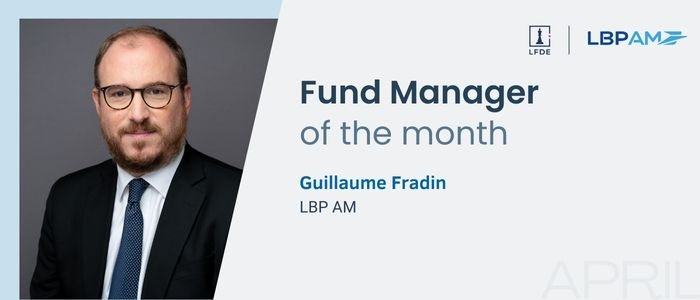
Guillaume Fradin, fund manager-analyst Absolute Return Rates & Credit - CIIA. DEUG MIAS (Mathematics and Computer Science), Master's degree and Bachelor's degree in Computer Science specializing in systems and networks from Université Paris VI. DEA in networks from Université Paris VI and ENST, Paris.
Guillaume Fradin has 25 years of experience in the industry. Guillaume Fradin began his career in 2003 as a bond fund manager at Aviva Gestion d'Actifs. In 2005, he joined Edmond De Rothschild IM as a credit and rates fund manager-analyst. As an analyst, he covered the Automotive, Construction and Industry sectors. In 2013, he joined La Française AM's credit management team. He managed the international Investment Grade fund LFP R2P Global Credit, the Crossover mandates and co-managed the subordinated debt fund La Française Sub Debt.
Guillaume Fradin joined LBP AM in 2017 as a senior credit fund manager-analyst within the Credit management team and since November 2020 within the Absolute Return Rates&Credit team.
Why and how did you decide to go into the financial sector, did you have other vocations?
I was entering into the financial market through my mathematics and computers skills at the beginning of 00’ with the IT revolution allowing the fixed income portfolios managers to develop internal tools. I could have been computer scientist with a specialty on networks, video game creator but like in a fairy tale I met an old man (also a fixed income fund manager) who made me discover and dive into fixed income asset management.
What is your view of the current macroeconomic environment and how might it affect markets? How do you manage the current and future uncertainty?
Cloudy weather and volatility are the new normal for the markets. The trade wars will push growth down and investors will ask for more premium for all the risky asset classes. As we already experienced with Canada and Mexico, the new US president blows hot and cold, but at the end he is waiting for concessions. Then, what could happen? For sure a withdrawal of economies towards more self-sufficiency and a strong impact on the US economy. The FED and ECB will have to react to protect growth, and we think more rates cut are coming. Inflation will be viewed as a secondary topic but until when? That’s a good question. And finally, many countries will have to compensate for some of the tariff’s impact by spending more money and adding some deficits, leading to more debt. At the end steepening should be more a long-term strategy than short duration.
For the credit markets: widening and decompression between HY and IG markets even if IG issuers are more exposed to global economy. Why? Because IG market gives you a good carry and you could find good strategies to hedge the short-term widening. At the opposite, the HY market could post more widening and suffer from a lack of liquidity.
The volatility of the market is feeding our funds through many strategies. First: hedging trades. Since the beginning of the year, we are adding more and more hedging strategies to protect the return of the fund, increasing the rate sensitivity and credit hedge through CDS Itraxx Main, switching part of our rate sensitivity to swap spread curves and the best of the old-fashioned methods by selling some of our high beta investments. Because of the uncertainty we have indeed implemented some long-term strategies which helped us also to lower the volatility without a strong impact on return and carry. A large part of our hedge also comes from derivatives products which could be closed quickly.
How should investors orient their portfolios in this environment? What are the biggest risks facing investors?
I think that even a long-term investor should be worried about short term volatility. The trade wars could impact the world economy and have long term impacts on the investments. All our beliefs of long-term trends could be totally different tomorrow morning. Today investors should find low volatile investments to avoid a large drawdown without missing the markets rebounds. Investors should add more low volatility funds with wide leeway, and particularly the possibility of going in negative sensitivity.
It's easier to take the question the other way around. In Europe, our main risk is the level of the 10-year German yield that could raise again quickly. On the credit part, the premium is coming back for IG but stays low for the high yield market. The main risk for the European credit market should be a persistent volatile environment that would lead to a closed primary market. In the US, the trade war could lead to an ugly credit market where spread were tighter than in Europe.
What differentiates the LBPAM ISR Absolute Return Credit from the others and what advantages can it bring to an investor’s portfolio in the current scenario?
We observe that each absolute return asset manager has its own strategy. For us, absolute return means positive performance whatever the markets conditions and low volatility. For absolute return investors, but not only, our solution is a solution to expose to the fixed income markets without worrying of market timing. Our large and experienced team of 13 funds managers (3 dedicated to the absolute return) and 15 support peoples (credit analysts, strategists, traders and quantitative analyst) allows us to find large range of diversified strategies, has a robust investment process and a strict risk framework with dedicated internal tools.
Can you give us an example of a position that you have held for a long time in your portfolios and why? How would you describe LBPAM investment philosophy?
LBPAM's absolute return approach is based on reactivity and adaptability; the fund has two bottom-up approach strategies which allow us to held position for a long period of time: carry and special situations. These two strategies are built with the support of credit analysts with a strict selection. Carry is a buy-and-hold strategy for bonds with maturities of 1 year or less. We buy the securities and hold them until repayment. The second strategy is focus on issuers or bonds which, in our opinion, will have a positive event to generate positive performance whatever the market conditions: upgrade, IPO, sector improvement, deleveraging. One good example is the Greek financial sector, in which we have long been invested through senior debt, and which has benefited from the improvement in credit ratios, as well as from the government, to return in Investment Grade.
Our absolute return approach is based on two targets we set ourselves for the fund: positive performance in all market weather and low volatility. At all times, these two pillars are taken into account in the management of our funds, which in our view has enabled us to validate our model across different market configurations. To manage this, we use plenty of different strategies and a high level of diversification, which has enabled us to limit drawn downs, but also to take advantage of market rebounds to reach our objectives.
What macroeconomic data is most important to monitor in order to manage investments? What do you consider most important when including a company in your portfolio?
The management team can rely on a number of support teams, in particular the macroeconomic team (2 peoples) who help us to define a central macro scenario each month, and more, if necessary, as well as two adverse scenarios. The most relevant data for us today are inflation and PMIs, although we also keep a close eye on indicators such as US employment. For China, we also use retails sales. But of course, the real source of volatility today comes from the negotiations on tariffs between the US and the rest of the world, as well as President Trump's tweets.
When we are looking to invest in new companies, we look at a wide variety of indicators, depending on the strategy the bonds will be part of. For the carry strategy, our analysts look in detail at the short-term liquidity profile in order to have a high degree of visibility on the issuer's ability to repay its debt. For longer-term investments, our approach is differentiated between IG and HY, as well as by sector. For HY investments, we pay particular attention to a company's ability to generate free cash flow, to its management and to its extra-financial approach. We have a cautious approach to absolute performance funds, paying close attention to avoid specific risk. In addition, depending on the level of risk we want to take on board, we will select more resilient profiles with a more sector-based approach for IG, and a more competitive focus and capacity for deleveraging for HY.
What ratios does a company have to meet to be part of your portfolio? How is LBPAM’s selection process structured? What do you like to do in your free time?
LBPAM Absolute Return Crédit is absolute return fund with wide leeway’s and a strong capacity to adapt to the markets. First of all, our investments must always have a sufficient level of liquidity, according to our internal criteria, in order to keep all our flexibility. In addition, we have different approach for IG or HY investment. For HY-rated companies, we use internal models that give us a long-term view of the business and help us to forecast possible rating upgrade or downgrade. This bottom-up approach is also fed by our top-down approach, which enables us to give a sectorial view and therefore to allocate more risk to some sectors, which could ultimately lead to investments in more riskiest credit profiles. For Investment Grade, the sectoral approach will be more important, without taking away the ability to generate FCF according to the degree of indebtedness and the level of margins.
We have a strong proven investment process at LBPAM. First of all, we have a monthly steering committee which lead to determine different macro scenarios, including a central one and opposing ones. From these different scenarios, we determine targets by asset class. For credit in particular, we determine targets by rating (IG/HY), by sector, by subordination rank and also for Europe and the United States. This committee includes all the fund managers and directors, as well as strategists and credit analysts. This committee is reviewed every week, with a focus on the implementation in our funds; but can be completely amended at any time if conditions are required. We also have a daily committee to quickly address important economic issues, as well as to comment on issuers' news at company level. In addition, we have regular committees with our credit analysts to review all the issuers in our portfolios, to ensure that investments are appropriate and that companies are always on the right track. Finally, we meet with our quantitative analysts to review our tools, market signals and portfolio risks.
What do you like to do in your free time?
My free time in the office is taken up by coffee breaks with my colleagues: we all sit together in the same open space but like to discuss related subjects during these relaxing moments. Otherwise, as soon as I'm out of the office and my tie is off, I spend lot of time with my family, but also to one of my passions: video games. And if I had a garden, I'd spend a lot of time in it, as it's a great way to re-energize myself (just for holidays).