Jean-François Lescalier from HALTRA Group is our Advisor of the Month

5 NOV, 2025
By Joanna Piwko from RankiaPro Europe


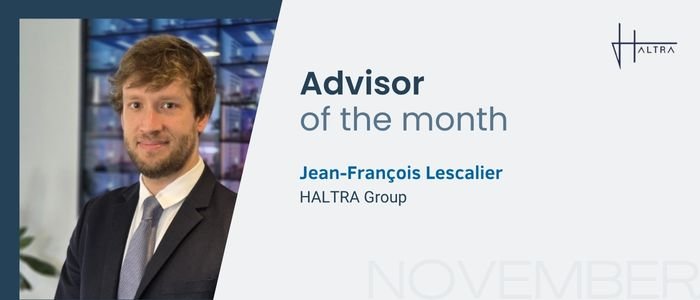
Jean-François completed his academic studies in Belgium at HEC Liège, where he earned a bachelor’s degree in economics and management followed by a master’s degree in banking and asset management. His professional journey began in Luxembourg, where he gained his first experience at Edmond de Rothschild, working in asset management and private banking for institutional clients.
He then joined KPMG Luxembourg in a team dedicated to fund analytics, focusing primarily on mutual funds. During this time, he strengthened his expertise in portfolio analysis, fund benchmarking, portfolio valuation, and OTC derivatives pricing.
Currently, he serves as an Investment Associate at HALTRA, a family-backed sustainable investment firm providing multi-asset solutions. His main responsibilities include asset allocation, portfolio construction, fund research and selection, due diligence, and macroeconomic analysis. In addition to liquid strategies, he has also developed a solid understanding of private markets, particularly in hedge funds, private debt, and real estate.
What inspired you to pursue financial advisory work? Was there a defining moment or influence that shaped your career direction?
I have always been passionate about numbers and mathematics. I was also interested in politics and economics. I wanted to understand how the world works and the key drivers.
My decision was made during the 2008 crisis. I became fascinated by the financial markets and portfolio strategies. Working in investment management and financial advisory brought together all my passions. We need to stay aware of what is going on in the world, understand what drives businesses.
I was looking for a career where I could learn, build and implement strategies to navigate the various environments and cycles.
Looking back, what were your biggest lessons during your early years in the industry?
The biggest lesson I learned is that investment management definitely requires a multi-dimensional analysis. It should involve both qualitative and quantitative review. When it is about suggesting a new investment idea or writing a proposal for a rebalancing in the portfolio, it is essential that the final decision is not mainly driven by the returns but by many other diverse factors that can be related to the fund risk (not only market but operational, legal), liquidity, terms, or investment process, … Like I read in a book, the risk is not only the volatility.
How do you view the current macroeconomic environment, and what key indicators do you monitor most closely when advising?
We are these days in a very interesting period where a lot of people are still bullish on a lot of assets while we have already reached some all-time high levels. We start to see some investors talking about “irrational exuberance”. The market conditions make the Fed task becoming complex.
In terms of macroeconomics, there seem to have some signs of slowing growth and weakening labor market. In addition to the concerns over the government deficits, we can point out the policy uncertainty impacting the financial markets across regions.
Geopolitics is playing a huge role this year and trade tensions since the announcement of tariffs appear still present despite some positive news. The fear of stagflation remains on the table.
Part of the macro indicators I keep an eye on, I would start by tracking the inflation levels, GDP growth, industrial levels (PMI), job market, housing market. Monitoring the Central Bank decisions is also definitely helpful. Then, there are some consumer sentiment or business confidence indices that can provide some flavors of the economic growth potential. Regarding the markets, valuation metrics, earning reports, the yield curve and credit spreads appear to be a must.
Are there particular sectors, regions, or asset classes you find especially compelling right now?
In the current market conditions, remaining diversified with a multi-asset approach might be helpful to navigate the uncertainty.
Designing portfolios including some alternative investments can bring an additional layer of diversification and improve the risk-return profile.
There might be some compelling opportunities in the hedge fund universe, for instance in global macro or event driven. These strategies could offer some absolute return streams with a positive asymmetry that have a low correlation with traditional asset classes such as equity or credit. These products have the potential to deliver a positive outcome when the stock markets are down. It can also reduce the portfolio volatility.
In private markets, considering a longer time horizon, there are still some interesting ideas in the infrastructure space, especially outside the energy sector, more focusing on the mobility or industrial sector. The megatrend in digitalization, for instance, is a key factor driving the future of this asset class.
In equity, capitalizing on some defensive sectors could bring stability when volatility arises. In terms of region, Europe and Emerging markets still have attractive valuation.
In credit, strategies like intellectual property (in private debt) or cat bond can still add some decorrelated and solid performance next to the more traditional liquid assets in the portfolio.
What, in your view, defines an excellent financial advisor today — beyond technical expertise?
First and foremost, I believe it is important to be passionate and curious. Markets are evolving fast; it is a continuous learning journey. There are always new types of strategies. If we genuinely love reading and talking about the topic, it brings out the energy to deliver and make things happen.
Then, I would mention the interpersonal skills, being able to listen, understand the clients, their underlying goals, communicate openly. This is necessary to build trust.
To go further, I would say it is important to meet the needs of the clients in a personalized way by being able to offer concrete tailor-made solutions, a significant added value.
Related to this, I would talk about being agile, adaptable. The client needs might change. The tools and processes might evolve that is why it seems useful to keep ourselves ready for change, ready to leverage on new tools and capitalize on new data and methods.
Last but not least, ethical standards, integrity are in my view a must at the core of the advisor mindset.
How do you continue learning and developing your skills in such a dynamic industry?
I tend to apply a multi-modal approach : reading, listening, talking, writing.
Starting by reading as much as I can, such as market analysis or books. Taking some online courses/certifications can also be another way to grasp new concepts. About listening, webinars or conferences are also a more interactive way to learn. Talking with peers is a key aspect of the learning journey. There is always an interesting idea or innovative element to take away from a conversation. It can be a moment to ask for feedback as well which is essential. Reflecting on past performance, taking notes and applying it, keeping a growth mindset is critical.
What I would highlight is that it is all about practice, learning from your mistakes and keep pushing forward.
Would you describe 2026 as a year to lean into opportunity or prioritize risk management?
With Gold and Equity flying around all-time high levels, the US Dollar weakening while geopolitics is playing its own music, it seems reasonable to keep a cautious and diversified portfolio approach.
Considering the list of elements playing together, looking for some asset strategies that can serve as hedge and safe haven in case of market drawdown or extreme volatility, might help to manage risk. Exploring the private markets could be an option.
The complex environment in several markets and recent volatility due to geopolitics could appear like a challenge to face but it could also become an opportunity to seize. This might be the moment to be more granular.
The elements that could trigger some opportunities in terms of regions, sectors or factors could be the structural weakening of the US Dollar and the global asset rotation outside the US.
What advice would you give to someone who wants to build a successful career in the financial sector today?
First of all, given the long-term impact that technology and AI can have on the financial sector, I would say that developing IT knowledge is important. Understanding how technology works and knowing how to leverage it, it can give a significant advantage, for instance, by reducing the time and cost of the investment process or by helping on the analysis of the market dynamics.
I would also mention soft skills as an important factor. In a world full of data and digital interaction, I believe that human skills will likely play a crucial role in the long term. Finance is about numbers but first, it’s about people and trust. The communication skills, listening skills, teamwork are all factors that, in my view, are truly necessary to consider for the success of an investment advisory team as well.
Outside of work, what do you enjoy doing? What are your hobbies?
I like going for a run in the morning before work. I find it good for the mind. I also enjoy playing a musical instrument, guitar or saxophone.