Julian Marks from Nomura Asset Management is our Fund Manager of the Month

6 AUG, 2025
By Jose Luis Palmer from RankiaPro Europe


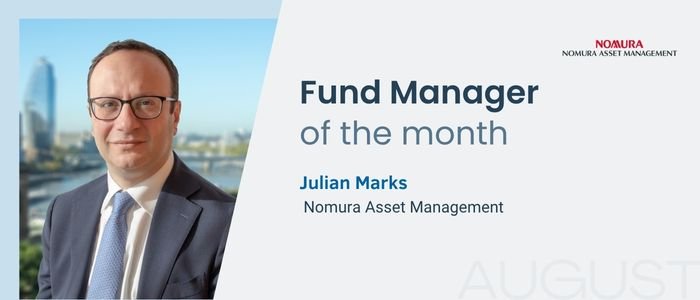
Julian joined NAM in January 2023 to launch the Corporate Hybrid Bond Strategy. Prior to joining NAM, Julian was a Senior Portfolio Manager at Neuberger Berman for 15 years, where he initiated and led the Corporate Hybrid Strategy from inception in 2015 until his departure in September 2022. Previously, Julian held a range of portfolio management and analyst roles at Commerzbank, Barclays Global Investors and Mercury Asset Management. He joined the investment industry in 1999. Julian is a CFA Charter holder and holds a BSc in Economics and Accounting from the University of Bristol.
Why and how did you decide to go into the financial sector, did you have any other vocations?
I first became interested in investing when I was 11. My class at school was set a challenge of investing a few thousand pounds over a few weeks. I am not sure how well I did, but I found it fascinating. So, I think it was always my ambition to work in the financial markets, one way or another and I was fortunate enough to get a place on a graduate programme of a top asset manager straight from university. Outside of investing, I ran a mobile disco during my student years. If I could have worked out a way to scale that, it might have been an option.
What is your view of the current macroeconomic environment and how might it affect markets? How does uncertainty affect hybrid bonds?
The macroeconomic environment is unusually uncertain and virtually impossible to model. Expect unforeseen second/third/fourth order effects to drive the magnitude of volatility in markets. Whilst the team and I follow events closely, our focus is on bottom-up analysis rather than making macro calls.
From both a sector and issuer perspective, the corporate hybrid market is as well insulated as you can get from direct tariff/macro concerns, at least in the context of credit markets. The asset class is dominated by domestically focussed, regulated utility and national champion telecoms companies. The rest of the market is largely comprised of genuinely market leading issuers from non-cyclical sectors that have been stress tested over many cycles. We would argue that real estate (which is only ~5.5% of the universe), is the riskiest and most sensitive sector to the macroeconomic backdrop. However, with the ECB having cut rates and potentially more to come, even real estate could hold up relatively well.
How should investors orient their portfolios in this environment? What are the biggest risks facing investors?
Given my previous answer, you may not be surprised to hear that we do not position portfolios for specific macro outcomes. That being said, investors should focus on valuations and where they believe they are being compensated for the higher level of uncertainty. Think long-term.
At the best of times, the biggest risk must surely be incurring permanent capital losses. Investors using leverage may become forced sellers in any resulting risk-off market, so that’s one obvious way to realise capital impairment. The other is being tempted to overpay for securities in the first place, perhaps because the particular market has been in vogue or has performed well in recent times. Investing with a margin of safety, where possible, will over the long run protect against this risk. Additionally, investors who have conducted deep research should be well positioned and not fearful to take advantage of volatility as it arises.
What differentiates the Nomura Corporate Hybrid Bond from others and what advantages can it bring to an investor’s portfolio in the current scenario?
This is difficult to answer without sounding biased so please forgive me. Prior to Nomura, I ran the largest and best performing corporate hybrid fund in the market – a track record that dates back to 2015. I joined Nomura to focus 100% of my time on corporate hybrids. We now have a 3-person team, including my Co PM from my previous firm, dedicated exclusively to this strategy. We are unaware of any competitors with this level of resource and experience solely for corporate hybrids. So far, this has translated to outperformance once again, both versus our benchmark and our peer group. In addition, we are supported by an investment grade only credit research team, centred in London. From here, we are ideally positioned to cover the whole market and exchange views in real time. As for the advantages of corporate hybrids in the current environment, investors can achieve yields far in excess of traditional IG and in-line with high-yield and CoCos but with significantly less credit risk. The asset class also has a long history of outperforming high-yield and CoCos in down markets. I have discussed the defensiveness of corporate hybrids in a previous answer but it’s also important to highlight that corporate hybrids offer diversification away from the US and away from USD, both of which dominate most credit benchmarks and both of which are in the eye of the storm currently. Diversification away from financials is the cherry on top.
Can you give us an example of a position that you have held for a long time in your portfolios and why? How would you describe Nomura’s investment philosophy?
Volkswagen is one example of a company that I have held for the best part of the last decade. Ever since Dieselgate in 2015, the company has traded at a discount. Clearly there are and have been various issues but valuations have been pricing in numerous notches of downgrade to varying degrees ever since. That’s more downside than our most conservative assumptions have ever implied. It has certainly paid off to earn the extra spread on offer over the years.
I will comment specifically on the Nomura Corporate Hybrid Bond Fund rather than Nomura as a whole. We employ a long-term, fundamental, value-oriented investment approach focusing on identifying relative value opportunities through market cycles. We seek to identify and select mis-pricings in the market without exposing the portfolio to persistent tilts or biases. We believe consistent attractive returns are derived from investment insight and judgement applied to the portfolio within a risk-controlled framework. Deep, fundamental research allows us to take advantage of volatility and company specific situations as they occur. Where we find mis-pricings, we are prepared to be aggressive in allocating capital to them.
What macroeconomic data are most important to monitor in order to manage investments? What do you consider most important when including a company in your portfolio?
Again, we do not place any significant weight on macroeconomic data to manage the portfolio. Of course, we pay close attention to credit spreads and valuations more broadly but our portfolio will be a function of bottom-up security selection.
Difficult question. If we are isolating the most important thing, it has to be the price we pay versus our assessment of fair value. Some of our best investments have actually come from deteriorating companies but where valuations have ended up pricing in more than the worst case scenario. Being open minded to these situations is key.
What ratios does a company have to meet to be part of your portfolio? How is Nomura’s selection process structured?
There are many factors to consider, including but not limited to, whether the company is recession resistant, has regulated cash flows, is market leading, has conservative leverage and has been paying regular dividends. However, there are no definitive ratios that need to be satisfied to warrant inclusion (note that we only buy Investment Grade rated companies so naturally those companies with ratios/metrics that place them in High Yield are excluded). We analyse each company and bond in our investable universe and make a decision based on a holistic view of the opportunity on offer.
There are 3 parts;
- Deep credit research of each company,
- Analysis of how the fundamentals will interact with the specific corporate hybrid structures and
- Relative value analysis i.e. making sure we construct a portfolio with the best possibility to outperform over a 3–5 year cycle. This process is repeatable and reliable.
What do you like to do in your free time?
Outside of work, I like to spend time with family – including playing football and chess with my 6-year-old son – hanging out with friends, trying not to watch Manchester United play, walking and reading.