Ludovic Cauchie from Privalux Management is our Fund Selector of the Month

28 JAN, 2026


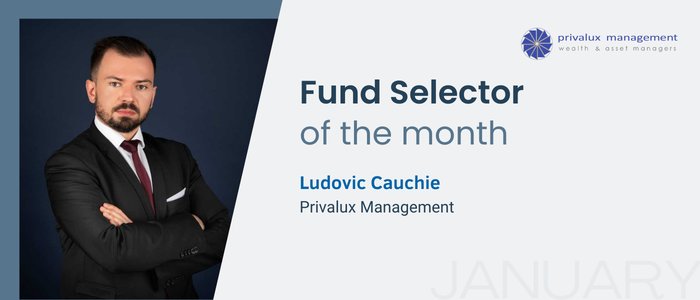
Ludovic Cauchie is a wealth manager at Privalux Management, an independent asset manager, with over ten years of experience in financial markets. He studied Economics and Finance at Sorbonne University (Paris 1) and holds an MBA from ESLSCA Business School. He is a CFA charterholder and specializes primarily in fixed income, fund selection, and portfolio construction. He also manages a convertible bond fund and works across a broad range of investment strategies, including systematic approaches. His focus is on identifying differentiated solutions that perform consistently across varying market environments.
How did you get started with fund selection? Did you consider other career paths before that?
I have been working as a wealth manager since 2019, with fund selection becoming a core part of my role as my firm needed to strengthen this expertise. What I enjoy most is the intellectual curiosity it involves: meeting different managers, understanding diverse strategies, and exploring a wide range of investment themes beyond mainstream offerings. I work for an independent asset manager, Privalux Management, which allows me to focus on truly differentiated solutions for clients rather than standardized bank products. As for alternative careers, I once dreamed of becoming an airline pilot — after all, managing a multi-million fund or flying a multi-million aircraft both require discipline, judgment, and respect for risk.
How has the sector changed since you started your career?
Since I started my career, fund selection has become increasingly shaped by standardization, partly driven by the perception that passive investing is difficult to beat in the long run. As a result, some active managers have been less incentivized, leading to a more uniform product landscape. This makes the search for genuine conviction-driven strategies, aligned with our own investment beliefs, even more important. At the same time, market cycles continue to create opportunities, as illustrated by the re-emergence of dated bond funds following the sharp rise in interest rates since 2022.
Which performance indicators or financial metrics do you trust most when evaluating a fund’s potential?
I naturally look at classic risk-adjusted metrics such as Sharpe and Sortino ratios, volatility, drawdowns, and upside or downside capture, as they provide a useful quantitative starting point. In that sense, I favor clearly defined strategies and managers who demonstrate consistency in implementing their investment process through all market regimes. Beyond standalone metrics, correlation is key in understanding how different areas of investment expertise can be combined to construct a well-diversified portfolio. This approach helps ensure that performance outcomes remain aligned with the strategy’s stated objectives.
What recent market changes have influenced your investment decisions the most?
The most influential change in recent years has been the shift away from a prolonged low-rate environment toward a more volatile regime with structurally higher interest rates. This has fundamentally altered portfolio construction, particularly in fixed income, where yield and carry have become meaningful sources of return again. It has also reinforced the importance of diversification and downside protection, as correlations have become less predictable. Overall, this environment favors disciplined, flexible strategies over purely directional or beta-driven approaches.
What advice would you give someone starting out in fund selection today?
My main advice would be to remain curious and patient, and to avoid relying solely on short-term performance or external ratings. Fund selection is as much about understanding people and processes as it is about analyzing numbers. Spending time with managers, challenging their assumptions, and observing how they behave in difficult markets is critical. Finally, developing a clear investment framework helps maintain conviction and consistency, especially when market noise or consensus thinking becomes overwhelming.
How important are ESG factors in the selection process today?
ESG factors are now an integral part of the fund selection framework, primarily due to regulatory requirements rather than universal client-driven demand. From my perspective, ESG should be viewed first as a tool for assessing governance quality and long-term risk, not as an investment objective in itself. There is a clear difference between managers who genuinely integrate ESG considerations into their decision-making and those who apply them in a purely formal or compliance-driven way. In fund selection, I focus on the former and remain cautious of approaches that prioritize labels over substance.
Looking ahead to 2026, which risks do you think are being underestimated? And which opportunities deserve more attention?
Looking ahead to 2026, I believe geopolitical risk remains underestimated, particularly given the growing instability and unpredictability of political leadership in an increasingly fragile geopolitical environment. Another area of concern is credit markets, where spreads appear tight relative to underlying economic and refinancing risks. On the opportunity side, emerging markets deserve closer attention, as they remain broadly underrepresented and often mispriced. In some cases, sovereign ratings artificially cap corporate valuations, creating attractive opportunities for selective, bottom-up investors.
Can you recall a time when your view differed from the consensus and proved important for performance?
One example was our decision to allocate to a Nordic debt strategy at a time when the consensus strongly favored large, traditional credit exposures. We focused on this asset class for its floating-rate nature, which we believed offered an attractive risk profile in an environment of rising interest rates. The strategy also stood out for its very low volatility, which made it a compelling diversifier within client portfolios. This positioning proved particularly relevant during periods of heightened market uncertainty.
Outside of work, what activities or interests help you recharge? And in your experience, does working in the financial sector make it possible to fully disconnect from markets and news?
Outside of work, CrossFit is one of my main ways to recharge, as it is an intense sport that demands focus, commitment, and a real mental reset. It provides a refreshing contrast to the analytical nature of my work. While it can be challenging to fully disconnect from markets and news when working in finance, I do not experience this as a constraint. Staying connected to what is happening in the markets is simply part of the passion I have for the profession.