François Gazier from Haussmann Patrimoine is our Fund Selector of the Month

4 FEB, 2026


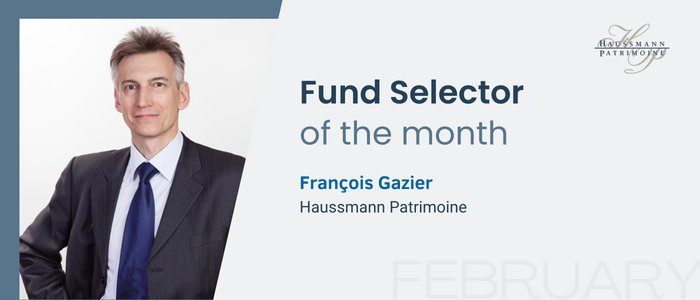
Graduate of Paris-Saclay university with a Bachelor in business and marketing, François worked during two decades for Robeco France, initially as a financial advisor for individual investors, then as head of client relationships and then (during the second decade) as head of product offering and fund selection.
In 2012, he joined Haussmann Patrimoine, an independent wealth management office founded in 2004 by his former colleague Emmanuel Narrat, as a financial advisor and head of asset allocation and fund selection.
Can you introduce your experience in fund selection? When and how did you start your career in the financial sector?
I started my career in 1989 as a junior financial advisor for private investors at Robeco France.
My fund selection experience began in 2002. At that time, I was responsible for product offering and, considering market developments, we decided to move to an open-architecture model. The main focus was on value funds and high-tracking-error management styles – as the Rotterdam-based firm’s product range was mainly composed of growth and benchmark funds.
Looking briefly at your professional background, which elements would you highlight the most?
I had the opportunity to start within an investment group that was a pioneer of international collective investment vehicles in Europe. It was a great experience – during which I learned a great deal in my early years and grew alongside the core/satellite approach.
Later on, during the transition to an open-architecture model, the mantra of my manager at the time was “target / offer / channel.” I would say that my first experience, dedicated to private investors, proved very valuable for my subsequent role focused on product offering and fund selection.
In your view, what are the most important aspects to consider when selecting a fund within a portfolio? Which ratios and indicators do you prioritize the most?
As a tool or building block within an investment portfolio, the main objective is diversification. In order to optimize the risk/return profile of a portfolio, each component must play the role expected of it.
Quite simply, I mainly look at the Sharpe ratio and the Information ratio – as well as bull beta and bear beta ratios.
What is the current asset allocation of your model portfolios?
At the beginning of this new year – and in continuity with the end of 2025 – we remain relatively cautious and highly diversified across asset classes, sectors, and themes. We are underweight US equities and the US dollar – on which we remain bearish. We are increasing our allocation to emerging market debt and intend to do so for equities as well.
We maintain exposure to European banks – despite their strong rally – to defense and space equities – to gold and strategic metals miners – despite their very high volatility – and we intend to return to European SMID caps, which we reduced in mid-January.
We are reducing investment-grade corporate bonds and increasing our allocation to alternative strategies such as long/short equities – mainly market-neutral – as the deep dispersion in markets provides a supportive environment for these strategies.
How should investors navigate the current environment of market uncertainty?
As over the past year – in what could be called “Trump 2 – Season 2” – investors must cope with a highly reversible and unpredictable environment, often marked by events occurring over the weekend when markets are closed.
More than ever, diversification and flexibility are key. In addition – and this is the role of the core/satellite approach – investors cannot ignore the major themes driven by the AI revolution across the entire value chain.
What are the most common mistakes made in fund selection?
Being overly confident in past performance.
Which assets do you believe are likely to outperform – and which ones risk suffering the most in the coming months?
This is a difficult question, as the market environment can change very quickly and sector rotation tends to intensify.
How has the role of a fund selector evolved in recent years?
The evolution is closely linked to the asset management industry’s shift toward ETFs. A new hybrid fund offering – made up of active ETFs – is gaining strong momentum in Europe, as it previously did in the US.
This trend is progressively expanding the scope of the fund selector’s role by adding greater flexibility.
How do you think it will evolve in the years ahead?
As a result, fund selectors will have to combine – on the one hand – pure active and high-conviction fund managers for the core part of portfolio construction, and – on the other hand – active ETFs for the satellite allocation and for tactical positioning.
What qualities, in your opinion, distinguish an excellent fund selector?
Being methodical and rigorous, and – when it comes to high-conviction funds – seeking to understand the personality of the fund manager behind appearances, much as one would do when assessing a candidate for recruitment.
What do you enjoy doing in your free time?
First and foremost, sports – rock climbing, trail running in nature, tennis.
Playing the guitar.
And – quite time-consuming – managing a restoration program for a listed historical monument, the birthplace of the invention of the steamboat.