Jean-Gabriel Nicolay from Candriam is our Fund Selector of the Month

4 MAR, 2026


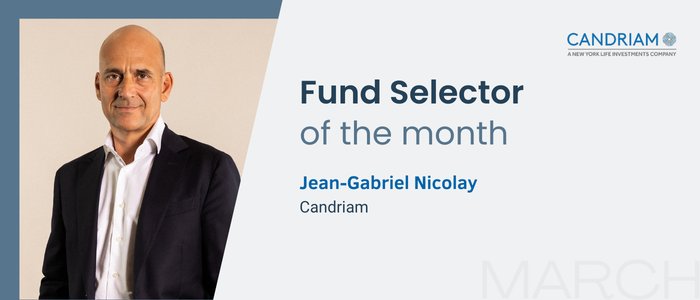
Jean-Gabriel Nicolay has been co-head of external multi-management at Candriam since 2007. Joining Candriam as a senior portfolio manager at Candriam in 1998, he became a senior external alternative multi-management portfolio manager in 2004. He began his career as a fixed income trader at Bank of America Capital Markets, eventually becoming the company’s head of fixed income proprietary trading.
Jean-Gabriel holds an engineering degree from the École Nationale Supérieure des Techniques Avancées in Paris.
Can you tell us about your background in fund selection? What drew you to this area, and did you ever consider pursuing a different career?
I began my career as a proprietary trader specializing in fixed income at Bank of America, where I spent 7 years building my foundation in financial markets and developing my analytical skills by trading and developing the underlying software we were using.
In 1998, I joined Candriam, which was pioneering alternative investment strategies at the time. This move marked a significant shift in my career trajectory. Then in 2004, I transitioned from direct investing to co-managing a fund of hedge funds - a fund that will actually celebrate its 25th anniversary this year, which I'm quite proud of.
Since 2008, Maïa Ferrand with whom I am co-heading the team, we have built a true multi-management franchise, with the capability to analyze, select, and construct portfolios across the full spectrum of funds — from Long-only and Hedge Funds to Private Assets.
I was drawn to fund selection as I wanted to take a step back from direct investing. Relying on my understanding of the markets from my previous experiences allowed me to have a clear understanding of the strategies and their risks while sourcing, meeting, and investing in the managers that shape the markets.
As an engineer, my original aspiration was to design racing sailing boats. However, my career path shifted to finance following a formative training experience at Société Générale's commodity trading desk.
How different is the sector today compared to when you first started?
I don't believe the fundamental nature of the sector has changed dramatically. When I started, most of the well-established hedge funds were closed to new investments, which forced us to identify emerging managers—many of whom have since become the blue-chip names of the industry today.
What has evolved significantly is access to information. Sourcing opportunities is much easier now, but this also means we need to be more reactive in our decision-making process.
The core challenge remains the same: finding talented managers before they become household names and capacity-constrained. The improved information flow has intensified competition for these opportunities, requiring to be more reactive.
The fundamentals of manager selection haven't changed, but the speed at which we operate has increased.
Which performance indicators or financial metrics do you trust most when evaluating a fund’s potential?
Understanding performance dynamics is absolutely key. We focus on sector specialists where alpha generation should be strong on both the long and short sides if any.
You need to have a clear view on
- The optimal market conditions where a manager excels and generates strong performance
- The challenging environments where they're likely to underperform
Beyond the returns, we also examine:
- Consistency of alpha generation across different market regimes
- The beta of the strategy
- The convexity profile of the strategy if any
- The downsize protections
- Drawdown patterns and recovery profiles
- Performance attribution between long and short book contributions
Which recent market trends have really shaped your decision-making?
Our philosophy has always been to maintain diversification both across strategies and within each strategy, while investing with specialized managers who bring deep sector expertise. Through our portfolios, we could extract three major trends:
First, AI is currently one of the most significant investment themes. It's affecting technology, energy, and industrial sectors in a big way. We're seeing huge demand for power and data centers but also splits in how software companies will perform - some will benefit from AI while others might struggle as AI makes their services less valuable.
Second, markets are becoming much more volatile due to big structural changes. We've moved away from the calm markets we had after 2010. This is happening because of US-China tensions, energy politics, government spending limits, and the risk of new tariffs. All of these create ongoing uncertainty that markets have to deal with.
Third, we observe increasing diversification beyond US equities. Investors are spreading their money across Europe, Asia, and emerging markets instead of focusing mainly on the US. This creates opportunities in different regions, especially with all the geopolitical tensions and trade policy changes we're seeing.
What advice would you give someone starting out in fund selection today?
First, you need to develop strong financial skills, including understanding market dynamics and risk management. I'd recommend starting by being part of an investment team that directly operates in the markets. This hands-on experience is essential before you can effectively move into fund selection.
How much of your fund selection is driven by quantitative metrics versus qualitative judgment and intuition?
Our assessment is primarily driven by qualitative judgment rather than quantitative metrics. In many cases, we don't have access to extensive track records, so meeting with the lead portfolio manager has always been the cornerstone of our fund selection process.
We focus on discussing the portfolio manager's background, team composition, and organizational setup, while clearly understanding the strategy's strengths and weaknesses. Through our extensive network, we verify what the manager has accomplished in previous roles - this has always been more important than quantitative assessment alone. Moreover, all our team members have different backgrounds, different skillsets which enhance our ability to assess qualitatively a manager.
We do run quantitative analysis independently so we can cross-check our findings and see if the data supports what we've assessed qualitatively. This dual approach helps validate our conclusions.
COVID highlighted how essential face-to-face interaction is, especially when we had to make decisions regarding two managers without the opportunity to meet them in person. Ultimately, we chose to delay our final decision until we could engage with them directly. Face-to-face meetings remain essential for our evaluation process.
What helps you unwind outside of work, and can you ever really disconnect from the markets?
To unwind from the markets, you can find me either on a tennis court, at a swimming pool, or at a surf spot. I had the chance to grow up by the sea, and I won't miss any opportunity to be close to the water. While these activities help me, I'll admit it's hard to completely disconnect from what's happening in the markets
Can you recall a market move that genuinely surprised you, despite closely following the trends?
The move in U.S. Treasuries during the Liberation episode in last April was particularly surprising. It was one of the first times we experienced a clear risk-off environment in which Treasuries did not rally as expected. Traditionally, they serve as a safe haven during periods of heightened uncertainty, so seeing that relationship weaken was a notable shift.
What underappreciated risks?
Among other risks, I would highlight the potential mismatch between the liquidity offered to investors and the actual liquidity of the underlying assets. Another key concern is the presence of negative convexity in certain strategies, which can leave portfolios particularly vulnerable during tail-risk events. Finally, the use of leverage deserves close attention. We are not opposed to leveraged strategies per se, but it is essential to fully understand how leverage is implemented, how it is structured, and what mechanisms or triggers could come into play if conditions deteriorate.