Marc Blanc from Ofi Invest AM is our Fund Manager of the Month

2 JUL, 2025
By Jose Luis Palmer from RankiaPro Europe


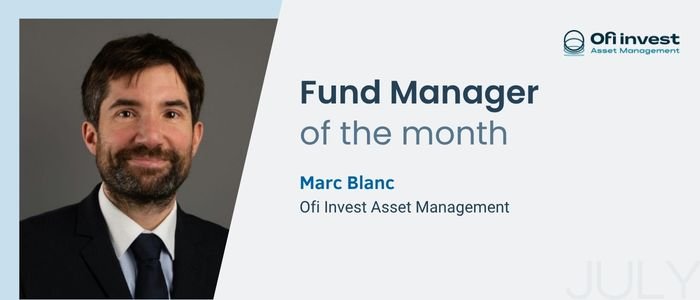
Marc Blanc is a High Yield Portfolio Manager at Ofi Invest AM, where he has been since 2014. Previously, he served as a High Yield Credit Analyst at Ofi from 2014 to 2019 and worked in Investor Relations at Groupe CASINO from 2012 to 2014. His career began as a Credit Sell-Side Analyst at Société Générale CIB in 2006.
Marc holds a master’s in finance from EDHEC Business School and is a CFA Charterholder, bringing a strong foundation in financial management to his role.
Why and how did you decide to go into the financial sector, did you have any other vocations?
I entered the sector through financial analysis. I have always found the life of large corporations and their development strategies very interesting, and that is how I started in equity research after business school, before moving on to credit. If I hadn't gone into finance, I think I would have wanted to do something completely different, teaching, with a predilection for French and classics.
What is your view of the current macroeconomic environment and how might it affect markets? How does uncertainty affect high yield bonds?
The current macroeconomic landscape is marked by considerable unpredictability, largely stemming from ongoing trade tensions, particularly between the US and key partners like China and the Eurozone. In the US, GDP contracted in the first quarter, and future consumption and investment will also likely slowdown. In the Eurozone, growth remains modest, and weak business confidence and persistently low consumption pose structural challenges.
For high yield bonds, this environment presents a mix of challenges and opportunities. Heightened market volatility and economic headwinds can lead to wider spreads and increased risk premiums, particularly affecting lower-rated credits. Conversely, low interest rates and the potential for additional central bank easing enhance the appeal of speculative high yield instruments, given their higher income potential. The asset class continues to offer carry, currently around 5.5%, which serves as a cushion against market shocks for investors with a medium-term horizon, in return with the associated risks.
How should investors orient their portfolios in this environment? What are the biggest risks facing investors?
Against the uncertain backdrop, European high yield continues to stand out due to its favorable carry. However, a balanced and flexible portfolio approach is essential. We tend to favour the BB-rated companies as well as the hybrid bonds, which offer relative stability and better liquidity in comparison with lower-rated credits. Tactical allocations to B-rated or opportunistic credits may add return potential, though these should be approached with increased caution given rising idiosyncratic risk. Ultimately, we consider that diversification and active risk management are key in the current environment.
What differentiates the Ofi Invest Euro High Yield from others and what advantages can it bring to an investor’s portfolio in the current scenario?
The Ofi Invest Euro High Yield Fund's objective is to outperform, net of fees, the Merrill Lynch Euro Non-Financial Fixed & Floating Rate High Yield Index on all units over the recommended investment horizon of 3 years.
At its core, the strategy relies on a dual framework: a top-down view helps shape broader allocations across sectors and duration, while bottom-up credit analysis drives the selection of individual issuers. A proprietary scorecard supports this process by helping to calibrate risk exposure by rating and sector, in line with market conditions.
The portfolio combines stable, core long-term positions with more tactical investments aimed at capturing value in specific market windows, in return with the associated risks of the asset class and the active strategy.
The fund also avoids systemically risky sectors such as banks and insurers and actively manages both maturity and duration based on macroeconomic signals.
The team behind the strategy is a key strength, 15 dedicated credit analysts review over 1,000 issuers (as of may 2025 and is subject to changes), supported by a wider group of investment professionals (economists, quant and solution analysts, ESG experts and interest rate portfolio managers). This depth of coverage aims at uncovering opportunities across the entire European speculative high yield universe, even in complex market environments.
The Ofi Invest Euro High Yield strategy offers a way to diversify portfolios and navigate shifting markets through active, research-driven management. Due to the fact that the fund is actively managed and its investment universe expose investors to various risks, including the risk of capital loss.
What macroeconomic data are most important to monitor in order to manage investments? What do you consider most important when including a company in your portfolio?
During our monthly credit committee meeting, we conduct a comprehensive review of the environment and define our internal high yield scorecard based on macro factors, valuation, fundamental analysis and technical aspects, the four key pillars to manage a high yield fund from a top-down perspective. Within the macro bucket, we will have a particular look at inflation and economic growth, job creation and geopolitics.
We then conduct an in-depth credit analysis of issuers likely to be included in our portfolio. Key elements include the company's ability to generate cash flow, reduce its leverage, and have a business model that is consistent with its environment.
How is Ofi Invest Asset Management’s selection process structured?
The fund management process involves several key steps. Initially, the focus is on Euro-denominated speculative High Yield bonds issued by corporates from OECD member countries, encompassing a total of around 360 issuers.
On that investment universe, we apply ESG exclusions: controversial weapons, non-compliance with the global compact & ILO conventions, thermal coal, oil and gas, tobacco, palm oil and biocides and chemicals. The non-financial analysis or rating covers at least 75% minimum of the portfolio's securities.
Then we combine the Top Down and Bottom Up approaches discussed, and build our portfolio, composed of around 150 issuers, taking position at the point of balance between conviction and diversification in order to benefit from the potential return of the speculative high yield bonds.
What do you like to do in your free time?
What I love most is watching my son grow up. Spending time with him, whatever the activity. I also enjoy playing the piano and running.