Marie-Anne Allier from Carmignac is our Fund Manager of the Month

8 JAN, 2025
By Jose Luis Palmer from RankiaPro Europe


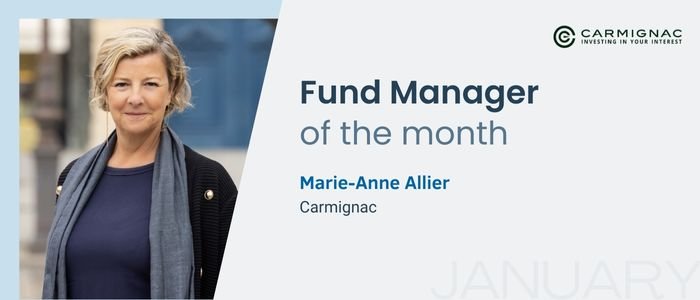
Marie-Anne Allier is a fund manager in the Fixed Income team, specializing in Euro Fixed Income. Marie-Anne joined Carmignac in 2019 as manager of Carmignac Sécurité. She previously worked at Amundi, where she was Head of Euro Fixed Income management since 2010. Over a thirty-year career, Marie-Anne also held senior fixed income management roles at SG Asset Management and GTI Finance. She began her career as a Fixed Income Manager at Sogeposte. She holds a Master Degree in Banking and Finance from the Sorbonne University of Paris.
Why and how did you decide to go into the financial sector, did you have other vocations?
My first wish after 10 years old (because before I wanted to be a teacher like many little girls), was to do genetic engineering. I started with a year in medical school. But the prospect of doing 10 years of medical school before working in genetics pushed me to look for a new orientation. The Faculty of Economics was then a choice of heart and reason. Quite naturally, finance then established itself as an exciting space, in full effervescence (we were in the second half of the 80s), where the field of possibilities did not limit ambitions. Chance encounters did the rest, and the bond markets won over my interest.
What is your view of the current macroeconomic environment and how might it affect European Markets?
We believe that the global economy is gradually slowing down, driven by a US economy that remains resilient but a labour market that is normalising. In addition, the implementation of the Trump 2.0 policy, which is widely seen as inflationary, remains to be seen but should limit the Fed's rate-cutting cycle. Europe is likely to be one of the victims of the latest developments in the US and a Trump 2.0 administration, as the growth differential is expected to widen further and the risk of renewed tariffs will gain traction, further weighing on anaemic growth. This should allow the ECB to continue its rate-cutting cycle. However, we believe that the European economy should show some resilience thanks to a number of positive factors: real wages are back in positive territory and should provide some support to consumption in the eurozone countries. In addition, the ECB's rate-cutting cycle should have a positive impact on growth, with an expected reduction of 150 basis points over the year, which should support activity via credit creation. Against this background, European yields should remain well anchored, especially at the short end of the curve, which is more sensitive to monetary policy.
How should investors orient their portfolios in this environment? What are the biggest risks facing investors?
In this environment, carry is likely to remain one of the main sources of performance in the bond segment over the coming months, particularly in corporate bonds, which offer an attractive yield in the context of monetary normalisation by the ECB. We are concentrating on defensive segments, mainly high-quality short-term bonds, favouring energy, financials and collateralised loan obligations, which offer an attractive source of carry and a low beta to market volatility.
In addition, in an environment that continues to call for caution, we are actively managing the portfolio's modified duration to navigate an environment that is likely to remain volatile, and we are implementing inflation-linked bond strategies to protect against a resurgence of inflationary pressures that could have a negative impact on the portfolio. Finally, the biggest risk for investors is probably a stagflationary environment: this would prevent central banks from easing their monetary policies, eroding the carry on investments and, in the end, neither capital gains nor carry will allow positive performance.
What differentiates the Carmignac Sécurité Fund from the others and what advantages can it bring to an investor’s portfolio in the current scenario?
Over the years, Carmignac Sécurité proved its resilience while demonstrating its ability to adapt to the ever-changing market environment. And this is actually what differentiates the fund. Indeed, if we look at performance since launch, the fund has proven its ability to navigate different market cycles. This applies to the last three years, when we have seen inflationary pressure reemerge, to the 2010s characterised by financial repression and negative interest rates imposed by the ECB, as well as to the internet bubble of the 2000s and the financial crisis of 2008. And last but not least, to the 1990s, when European economies converged towards the single European currency – the euro. The fund’s ability to meet these challenging market times is based on its capacity to evolve over time, by broadening its investment universe, reinforcing risk management, and strengthening key expertise without changing its main investment philosophy: conviction and non-benchmark management. And this is what makes Carmignac Sécurité an appealing investment solution for investors with a relatively conservative profile and a minimum two-year investment horizon.
Can you give us an example of a position that you have held for a long time in your portfolios and why?
Carmignac Sécurité has long been exposed to the financial sector, particularly banks in non-core eurozone countries, where we focus on large national champions, retail-oriented franchises in countries such as Italy, Spain and Portugal, with low leverage and whose balance sheets have already improved considerably. This sector, although well capitalised following the strict regulations introduced after 2008, often offers a premium over issuers from core countries, but also from other sectors with equivalent ratings, providing an attractive risk/reward profile for credit investors.
What ratios does a company have to meet to be part of your portfolio? How is Carmignac’s selection process structured?
The key conviction behind our investment process is that fundamental risks fluctuate throughout the economic and business cycles, while the way these risks are priced might be inefficient. Consequently, there is value in analysing and spotting the biggest gaps between our views on certain risks and how they are priced by the market. As a result, the fund’s conviction-based, non-benchmarked philosophy combined with a flexible and active approach is centred on seizing trends and inefficiencies in the market to extract performance. To do so, we aim to identify the most attractive interest rate and credit spread strategies through in-depth macroeconomic analysis and rigorous fundamental research. This opportunistic approach enables us to fully exploit his investment convictions while managing risk levels and exposure in-line with our top-down views.
To identify the best risk-adjusted opportunities, we rely on an experienced team of macroeconomic analysts and a cross-asset team, as well as the entire management team, who are involved in the rigorous analysis of key macroeconomic data. Formally on a weekly basis, but in practice on a daily basis under the responsibility of our chief economist, we review, analyse and discuss the latest macroeconomic releases and their implications for the baseline global macroeconomic outlook, as well as alternative scenarios to this baseline. This allows us to identify key investment themes and market trends, and to compare and contrast the firm's views with those of the consensus. In terms of data, all the data used to analyse and anticipate the decisions of the various central banks is particularly relevant, allowing us to take the right positioning. On the credit side, we have an experienced team of credit portfolio managers led by Pierre Verlé, who combines the qualities of traditional portfolio management with proven expertise in other less conventional segments such as distressed debt and structured credit. In this segment, our approach is resolutely opportunistic, based on two principles: ensuring that we are adequately compensated for the risk we take, and that we are sufficiently protected in the event of spread widening. That said, as our management approach is conviction-based, we do not carry out a full screening of our global investment universes. Instead, we focus only on opportunities in which we have strong convictions and draw up a shortlist of potential investments.
What do you like to do in your free time
I would have liked to answer "reading, going to the theatre and the cinema" but the reality is that the little free time I have left (grandmother is finally a second job) is mainly used for sports: pilates, golf and horseback riding are the activities that keep me most busy in my leisure time.