Michael Meier from 2M Capital Ltd is our Advisor of the Month

7 OCT, 2026
By Joanna Piwko from RankiaPro Europe


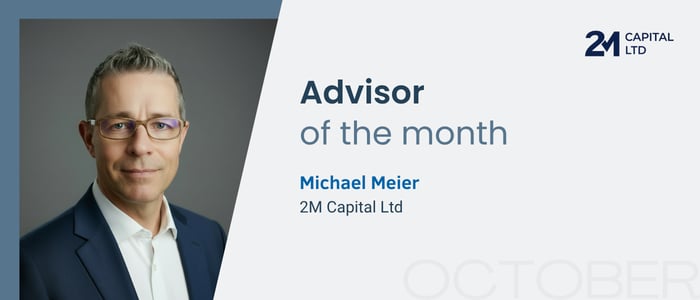
Michael Meier brings long-standing senior-level experience across investment management, investment governance, asset management, and strategic advisory. Prior to founding 2M Capital Ltd, he served as Deputy of the CIO and Deputy of the Head Asset Management at leading Swiss multi-family office and asset management platforms, before co-founding and leading an asset management boutique as CEO and CIO/Head of Hedge Funds. He has served as Board Member and external Investment Committee member, and holds professional designations including CAIA and FRM.
What first attracted you to finance and investing, and what do you remember most about the early years of your career?
Finance attracted me early. Growing up with an older brother who traded FX professionally gave me an unusually close view of the markets from a young age.
What strikes me today is how the perception of market volatility has shifted. In my early years, two percent daily moves in equity markets were simply part of the game. You absorbed them, adjusted if necessary, and moved on. Today, the same magnitude of movement triggers wall-to-wall media coverage and genuine anxiety among investors. Markets have not fundamentally changed, but our relationship with volatility has. Attention cycles are shorter, information travels faster, and the balance has shifted decisively from signal to noise. Learning to distinguish between noise and signal remains one of the most valuable skills an investor can develop.
You spent many years in portfolio management before moving into senior leadership roles. How did your investment philosophy evolve over that time?
Earlier in my career, the focus was largely on identifying opportunities, generating return, and managing individual positions. The lens widened considerably. Investment success is less about any single decision and more about the quality of the framework within which decisions are made.
That shift, from picking investments in a multi-asset portfolio context to framing and governing a sound and robust investment process, defines my philosophy today. Sustainable performance comes from clarity of mandate, consistency of process, and the discipline to hold a well-reasoned view under pressure. It also comes from knowing when you are wrong and acting on it without hesitation.
In addition, alternative investments became an increasingly important part of that conviction over time. Not because they were fashionable, but because the traditional fixed income case was quietly breaking down. When bond coupons were high, they absorbed capital losses and did their job. As yields compressed, that cushion disappeared. Alternatives filled that gap, offering genuine diversification and, in many cases, better risk-adjusted returns. That is a view I formed early and has not changed.
Having worked with different investment firms and environments, what do you think makes a strong investment organisation?
In my experience, three things. First, a clear and honest investment identity. Organisations that try to be everything to everyone end up doing nothing particularly well. The best firms I have worked with or alongside had a precise understanding of what they were trying to achieve and why.
Second, genuine governance. Not governance as a compliance exercise, but as a real mechanism for decision-making accountability. Investment committees that challenge rather than rubber-stamp, and processes that are designed to catch errors rather than confirm assumptions.
Third, senior continuity. Institutional knowledge is undervalued. Every time a key person leaves, something intangible but important goes with them. The firms that endure are those that invest in retaining and developing senior talent over the long term.
You now combine the roles of Founder, CEO and CIO at 2M Capital. How do you balance investment decisions with the broader responsibilities of running a business?
It requires clarity on what each role actually demands, and the discipline not to let one crowd out the others. Running a boutique advisory firm means that the strategic and operational responsibilities are real, but so is the intellectual work at the core of what we do for clients.
The honest answer is that the two reinforce each other more than they compete. Being deeply embedded in client situations, whether at the investment governance, M&A, or strategic advisory level, keeps the thinking sharp. And the business perspective that comes with running a firm makes the advice more grounded and practical. The challenge is first and foremost time, followed by focus, and that is where structure and clear priorities matter most.
After experiencing very different market environments throughout your career, what is one investment lesson you still rely on today?
Respect leverage and liquidity. It sounds straightforward, but it is consistently underappreciated, especially during benign market conditions when the cost of illiquidity appears negligible. What you cannot exit, you cannot manage. And when conditions change, they often change faster than most models anticipate.
Leverage deserves equal respect. It can fundamentally alter the character of an investment. A position that is well-reasoned and correctly sized can become unmanageable when leverage is applied carelessly. It compresses your time horizon, removes your ability to wait out volatility, and could turn a temporary drawdown into a permanent loss. The discipline to use leverage sparingly, and only when the risk-reward is genuinely compelling, is one that separates experienced investors from the rest.
More broadly, the lesson I carry from every difficult market environment is that humility is not optional. The markets are larger and more complex than any single participant's model. The investors who endure are those who remain curious, stay honest about what they do not know, and build portfolios and processes that can absorb surprises.
Has your definition of risk changed throughout your career?
Significantly! Early on, risk was largely synonymous with volatility: standard deviation, drawdown, VaR. Those are important tools, but they are also incomplete.
Over time I came to understand risk more broadly as the permanent impairment of capital or the inability to meet objectives. That reframing matters because it connects risk directly to purpose. What are you trying to achieve, for whom, and over what horizon? The answer shapes everything, including how you define and manage risk. A family office preserving wealth across generations has a very different risk profile from a fund manager targeting quarterly performance. Both need rigour, but their definition of risk is fundamentally different.
Do you think investors are becoming better at managing risk, or simply better at measuring it?
Better at measuring it, certainly! The tools, the data, and the computational power available today are remarkable. But measuring risk and managing it are genuinely different skills, and I am not sure the gap between the two has narrowed as much as the industry sometimes assumes.
Managing risk requires judgement, being willing to act on incomplete information, override a model when the situation demands it, and accept that the most important risks are often the ones that are hardest to quantify. Behavioural risk, governance risk, concentration risk in forms that do not appear in a standard model. Those require experience and intellectual honesty, not just better analytics.
Which investment themes do you think will matter most over the next decade?
Several stand out clearly. The restructuring of global supply chains and the geopolitical realignment that drives it will create lasting shifts in capital flows, sectoral winners and losers, and the relative attractiveness of different regions and asset classes.
AI and its integration into investment processes, business models, and entire industries will be profound and is still in early innings. The investors who understand both the opportunity and the disruption it creates will have a meaningful edge.
And finally, something I see constantly in my work, wealth built over decades needs to find its next custodian. That transition is rarely straightforward, whether it involves a family office, an independent wealth manager, or an asset management boutique. It is one of the most consequential and most underserved challenges in our industry, but also one of the most durable structural trends of the next decade. It is precisely this gap that M&ATCH.LAB was built to address, a digital platform for discreet, anonymous contact initiation between buyers and sellers in this space.
What is something people might be surprised to learn about you outside of finance?
Travelling has been one of the most formative influences on how I think, both professionally and personally. Spending time in different countries, learning from different cultures, business environments, and ways of seeing the world gives you a perspective that no textbook or conference can replicate. It teaches intellectual humility. Your own framework is just one of many, and interesting solutions rarely come from a Bloomberg terminal.
Beyond that, I enjoy being in the mountains. Switzerland makes that very easy. There is something clarifying about altitude and physical effort that I find truly restorative. It creates the kind of mental space that is hard to find behind a screen.