Michał Ejdys from Logistable Ltd. is our Advisor of the Month

15 JUL, 2026
By Joanna Piwko from RankiaPro Europe


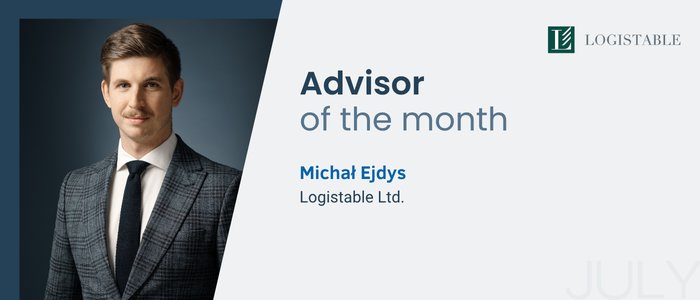
Michał Ejdys, CFA, FRM, Doradca Inwestycyjny (Polish investment-adviser licence) advises Logistable Limited, a Gibraltar-regulated investment-management firm, and its clients. He is also building Quell One, a Warsaw-based fiduciary oversight practice for principals operating across borders. His work centres on portfolio architecture, fiduciary oversight and cross-border structuring, shaped by a path through hedge-fund analysis, regulated investment-firm buildout and owner-side advisory.
What attracted you to the asset management industry, and what do you remember about your first experiences in it?
What drew me in was the quantitative side. I had come into finance from mechanical engineering, where you spend most of your time on problems that must work in the physical world. Markets felt like the same thing, only with harder feedback — every view eventually meets a price.
My first real asset-management seat was an equity-research internship at Arrowgrass, a London hedge fund, in 2017. What I remember most is how little of the work happened on a screen. The analysts I sat near spent most of their time on calls — with companies, suppliers, ex-employees, regulators — and the valuation model was where everything they had learned eventually had to reconcile. The output was rarely far from what their back-of-the-envelope calculations returned, but the discipline of building the model was where the understanding came from.
Over time, I moved towards private capital management because most institutional constraints started to feel artificial — they shape what you can hold more than what you should, and often run counter to what finance theory recommends. The framework I grew to trust most is the endowment model, and a private or family portfolio is one of the few places it can be implemented cleanly.
You've worked in different roles across the industry and in several markets. What key lessons have you taken away from that experience?
The sharpest lesson came from sitting inside a hedge fund. When you watch how managers handle their investor relationships — what gets shown, what gets framed, what gets quietly buried — manager due diligence later in your career becomes a very different exercise from reading a pitch deck.
Building out a regulated investment firm in Gibraltar taught me something almost opposite: how much of running a firm is paperwork and accountability, not investment ideas. The document trail eventually becomes the firm's memory. Most of what people call "process" is just the same idea, written down before it needs to be used.
The family-office seat in Poland taught me the third angle. The portfolio is the visible end of a much longer chain that includes the operating business, family roles, tax structures and a lot of unspoken history. A good investment decision that ignores the chain is usually still a bad decision.
Putting the three lenses together: context changes everything. The same investment is sensible or unsuitable depending on mandate, liquidity, jurisdiction and governance — and most of advisory work is turning that complexity into a clear decision.
What does a typical day in your role look like? It's a fast-moving industry, but I imagine you also follow a certain routine.
The work is centred on Smart Global Alpha, the multi-manager strategy I work on at Logistable — built to give investors one-stop, endowment-like liquid exposure. Most of my analytical hours go there.
A representative day might begin with a call with a manager I am evaluating — twenty minutes scheduled, an hour and a half actual, because the questions I want answered are operational rather than commercial. The middle of the day is usually the internal quantitative screen: pulling a manager's returns apart into common factors, looking for what is actually distinctive and what is just expensive market exposure. The afternoon turns to direct client work — helping review a financing option the way a CFO would, taking a view on a counterparty, or thinking through a cross-border structuring question.
What I protect across all of that is one rule: every decision in this seat has a calculation behind it. Nothing is purely discretionary. Intuition gets its place — but only after the numbers.
When you evaluate investment strategies today, what are the non-obvious factors you pay most attention to that others might overlook?
The tool I lean on hardest is a factor-mimicking portfolio: every manager's returns get replicated with a basket of common factor portfolios. The "systematic trend-following crypto strategy" you have been pitched can quietly turn out to be 30% US small caps and 70% money market — at which point you know you are not buying anything new, only paying more for it.
The other non-obvious factor is intuition, but only as an opt-out. After every quantitative check has been passed, I will reject a manager on a discretionary negative signal. I will not let intuition override the checks the other way round.
That same discipline shapes Smart Global Alpha from the inside. We build it so the components do not quietly reduce to the same factor mix, and so the portfolio offers a genuinely uncorrelated return stream — the kind of allocation a client can hold through market noise rather than react to it.
You're based in Warsaw. What do you see as the most attractive opportunities in the Polish market right now, and what areas still feel underdeveloped?
Poland is genuinely one of the more interesting places to be in European wealth management right now, for two reasons.
The first is outbound. A generation of first-gen Polish entrepreneurs is moving from owner-operator to investor mode. The operating company, typically founded in the 1990s, is no longer the only thing on the balance sheet, and the questions change: liquidity, succession, asset allocation, governance, reporting. This is the kind of work I do at Logistable — guiding families through exactly that transition. The firm has built a track record on it across Western Europe, and is in a strong position to support Polish families who choose to reach out.
The second is inbound. Steady growth and a deep domestic market are drawing foreign principals who want a Polish presence — often a mix of operating and investing. The structures are cross-border by definition, and that is where Quell One, my own fiduciary oversight practice, helps principals organise the local footprint without losing oversight from home.
Beyond performance, what do you believe builds lasting trust between an advisor and their clients?
Three things, I believe.
First is background. When you know the academic part of finance, tax and accounting rules, law, and have the certifications to prove it, it tends to make it easier for people to trust you. That's why it's good to do hard things when you're young.
Second is being broadly useful — beyond a narrow mandate. Trust grows when a client can ask about almost anything and get a real answer, or an honest "I do not know, but here is who would." Working together across many small things over time is what builds it.
The third one is the part I find hardest. Our industry rewards people who sound certain, and clients have learned to expect that. Saying "I was wrong about this, and here is what I now think" is uncomfortable, but from what I have seen, clients remember it longer than they remember a correct call.
What mindset or habits would you say are most important for young professionals entering asset management if they want to build a long-term, credible career?
Do hard things. They usually make sense, even if not the way you'd expect them to.
My own version of that was studying mechanical engineering at Warsaw University of Technology before finance. I did not enjoy every minute of it, but the habit of sitting with problems that don't yield easily is what I took away from it.
For someone entering asset management today, that translates into something concrete: apply to the top university, take the coveted job, sit the hardest certification exam. Not for the labels, but because each one is hard — and doing hard things again and again is how you prove, first to yourself and then to others, that you can. That is what trust in this industry quietly builds on.
How do you balance evidence-based investing with intuition built from experience across different institutions and market regimes?
My rule is that intuition is an opt-out, not an opt-in. The evidence-based, systematic funnel runs the process; intuition can reject a manager after every quantitative check has been passed, but it cannot override the checks the other way round.
That keeps the discipline intact and still leaves room for experience to do what it does best — flag the thing the model could not yet see.
What activities outside of finance help you reset, and do they bring any useful perspective back into your work?
Padel, kitesurfing, and sailing — though mostly padel, since it is the only one really feasible from landlocked Warsaw.
Padel, sailing and portfolio management share an unusual feature: the outcome at any given moment is rarely about that moment. It is almost always the result of decisions made several steps earlier. In padel, when your opponent hits a return winner, it is usually because your serve was too shallow. In sailing, getting caught by a storm usually means you did not plan the passage properly and did not check the weather GRIB files. And in portfolio management, a day's P&L is rarely about something that happened that day — it is the result of manager selection and allocation choices made months or years earlier.
The discipline that pays in all three is the same: look upstream. The decision that matters now was made some time ago.