Olivier Banneux from Banneo Consulting is our Advisor of the Month

9 SEPT, 2026
By Joanna Piwko from RankiaPro Europe


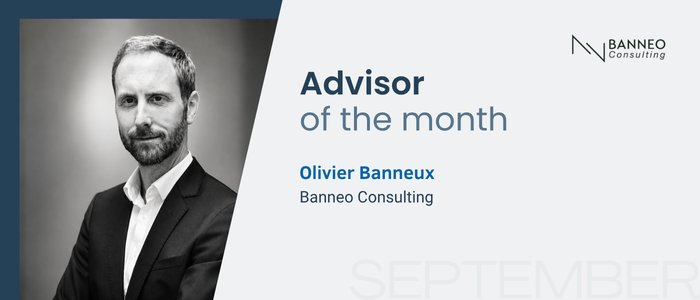
Olivier Banneux is the founder of Banneo Consulting, an independent advisory firm helping institutional and private investors navigate an increasingly complex investment landscape. With nearly two decades of experience in asset management, including senior roles at Candriam and as a member of the Executive Committee of Belfius Asset Management, he works alongside investors to build coherent long-term investment strategies. He is convinced that the best investment decisions come from asking the right questions, challenging assumptions and never losing sight of the bigger picture.
Tell us about your career. What has been the biggest turning point in your professional development as an advisor?
I have spent my career in asset management, and every step has shaped the way I think about investing.
I started in Risk Management at Candriam, where I learned that successful investing is not only about generating returns, but also about understanding uncertainty, managing risk and making disciplined decisions. I then moved into portfolio management before taking on leadership responsibilities and eventually joining the Executive Committee of Belfius Asset Management.
The biggest turning point in my career came after more than 15 years in the industry, when I decided to become independent. I wanted to work alongside investors from a broader perspective, helping them define their investment strategy, challenge key decisions and navigate an increasingly complex investment landscape. That decision led me to found Banneo Consulting, an advisory firm working with both institutional and private investors. Becoming independent gave me the opportunity to focus entirely on my clients' long-term objectives.
Looking back, I realise that my career has gradually evolved from managing portfolios to helping investors build clarity and conviction. That evolution has been the most rewarding part of my professional journey.
How has your role evolved over the years?
Early in my career, my role was primarily about analysing investments, evaluating managers and identifying attractive opportunities. That remains an essential part of my work, but today I think within a much broader framework.
My role is no longer limited to investment selection. I look at every part of the investment chain – from governance and decision-making to counterparties, costs, portfolio construction and investment solutions– to create the best possible environment for investors to make sound long-term decisions.
Ultimately, I believe my role has evolved from helping investors choose investments to helping them build a stronger investment framework. The better the framework, the better the decisions it produces.
What separates a great investment opportunity from a good one in today's environment?
To me, a great investment opportunity is not defined solely by its expected return. It is one whose investment thesis remains convincing after it has been challenged from every angle.
Of course, great investments should offer attractive long-term return potential. But what truly distinguishes them is the strength of the underlying thesis. I want to understand what could prove me wrong, not only what could prove me right. The best investment opportunities are those that become stronger – not weaker – the more rigorously you challenge them.
Experience has taught me that if an investment looks too good to be true, it usually deserves even more scrutiny.
What theme or trend do you believe investors are not discussing enough today?
If I were to slightly reframe the question, I would say that the topic we are not discussing enough today is how we think about risk.
Over the past few years, financial markets have shown remarkable resilience. Despite major geopolitical, economic and monetary shocks, corrections have often been short-lived and investors have quickly regained confidence. That resilience is impressive, but it may also lead us, almost unconsciously, to underestimate risks that remain very real.
At the same time, capital is becoming increasingly concentrated in the same companies, themes and strategies. I do not see this as a problem in itself – many market leaders fully deserve their success. But I believe it makes it even more important to keep exploring complementary approaches and challenge our own assumptions.
That is why I believe it is essential to remain open to different perspectives. Some of the best investment ideas do not come from confirming our own views, but from discussing them with peers who think differently. In our industry, learning often comes as much from thoughtful disagreement as from confirmation.
You’re based in Belgium. How do you see its investment landscape changing, and what opportunities stand out to you?
From my perspective in Belgium, although I believe this trend extends well beyond our borders, the most significant evolution has been the increasing sophistication of institutional investors.
Today, selecting good investment strategies is no longer enough. Investors are expected to integrate private markets, technology, sustainability, regulation and increasingly complex data into a coherent investment framework.
Private markets illustrate this evolution particularly well. The challenge is no longer simply to gain exposure to private equity, private debt, infrastructure or real estate. It is to understand how these asset classes work together, complement traditional investments, and how their specific liquidity, valuation and risk characteristics affect the overall portfolio.
To me, this creates one of the most exciting opportunities for our industry. The firms that will stand out will not necessarily be those offering the widest range of investment solutions, but those capable of helping investors make sense of an increasingly complex investment world and connect all the pieces into a coherent whole.
In an age of increasing automation and AI, where do you believe human advisors add the greatest value?
For many years, an advisor's value was closely linked to the ability to access information, analyse it and synthesise it. AI is fundamentally changing that reality. It makes knowledge more accessible, accelerates analysis and automates many time-consuming tasks.
But I do not believe this diminishes the role of the advisor. It reinforces what I believe has always been our greatest responsibility: transforming information into sound investment decisions. That requires judgment, prioritisation and the ability to navigate uncertainty – qualities that technology cannot easily replace.
Artificial intelligence will become increasingly effective at showing us what is possible. The role of the advisor will remain to decide what is truly worth doing.
What skill do you believe future advisors will need that previous generations didn't?
The investment world is becoming more specialised every year. Private markets, artificial intelligence, alternative data and quantitative investing all require increasingly deep expertise. No one can realistically master every discipline.
The real skill will therefore not be knowing everything. It will be understanding enough of each area to ask the right questions, connect different perspectives and make informed decisions in the best interest of the investor.
Ultimately, I believe the advisor of tomorrow will be distinguished not by knowing more than everyone else, but by bringing together the right expertise at the right time to serve the investor’s objective.
Can you recall a client interaction that reinforced why personalized advice matters?
A few weeks ago, I met with an investor who described himself as conservative and strongly committed to a defensive investment approach. As always, I started by listening. Before analyzing a portfolio, I first wanted to understand the investor behind it: their objectives, constraints and attitude towards risk.
When we reviewed the portfolio together, the contrast was striking. Despite his conservative mindset, the portfolio was heavily concentrated in just a few sectors and investment themes. Without fully realising it, the portfolio was telling a very different story from the one he had just shared with me.
That meeting reminded me that the real role of an advisor is not simply to analyse a portfolio, but to help clients see it more objectively. Sometimes the greatest value comes from revealing the gap between what investors believe and what their portfolio actually reflects.
The best conversations do not start with answers. They start with the right questions. That is often when clients discover important inconsistencies for themselves.
Ultimately, every portfolio tells a story. The advisor's role is to make sure it is the story the investor truly wants to tell.
What personal value or philosophy guides both your professional and personal life?
If there is one principle that guides both my professional and personal life, it is that trust is the foundation of every lasting relationship. And trust is never given – it is earned, day by day.
Over the years, I have come to realise that technical expertise is essential, but it is only the starting point. At a certain level, many professionals are highly competent. What turns a professional relationship into a genuine partnership is integrity, openness and the ability to challenge each other with honesty while working towards a common goal. Expertise builds credibility; values build trust.
That is probably why I believe our profession is, above all, a business of trust. Markets will evolve, technologies will change and investment strategies will continue to adapt. But integrity, respect and consistency will always remain the foundations of meaningful relationships and sound decisions.