Øyvind Fjell from DNB Asset Management is our Fund Manager of the Month

5 JUN, 2024
By Jose Luis Palmer from RankiaPro Europe


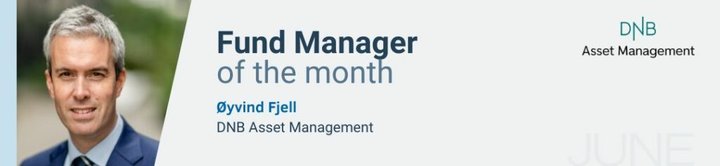
Øyvind Fjell has an MSc in Industrial Economics from the Norwegian School of Technology (NTNU) and an MBA from the Norwegian School of Economics (NHH). He was Nordic PM for Delphi Fund Management from 2007 until 2017, before joining Skagen Funds in 2017. In 2018 he joined DNB Asset Management as lead PM for the Nordic strategies.
Why and how did you decide to go into the financial sector, did you have other vocations?
During my higher education I gradually came to the conclusion that financial topics were more interesting to me than engineering ones, which I also considered. I also believe that my personality fits my trade rather well, calm and rational at most times.
How do you see the current macroeconomic environment? Which macroeconomic data matter most when it comes managing investment funds?
There is a lot of macroeconomic uncertainty still in my view, although it looks like we are looking at slightly lower interest rates from central banks and a bit of a comeback from the underlying economy in the next 6-12 months. However, even of this we can not be sure. Rather than look at one or a few measures of macro development, I prefer to focus on the companies in the portfolio.
How should investors orient their portfolios in this environment?
With the level of uncertainty still quite high, I would as ever suggest a diversified portfolio that could handle most scenarios quite well. For sure I believe that some of the portfolio should be placed in stable growth companies with high quality, but given the lagging performance of smaller companies I would suggest putting some of your chips here as well.
What differentiates the DNB Nordic Equities Fund from the others and what advantages it can bring to an investor's portfolio in the current scenario?
I think as a backdrop we are of course based in the Nordics, a region that has outperformed in the long term, but has underperformed in the short term. We believe this could reverse if interest rates come down and the economy turns a bit for the better. Furthermore we believe in investing in winners, past outperformance tend to foster future outperformance. With the fund having delivered good performance for the last couple of quarters, we believe that we are on a strong run. As a final argument I would mention that recent performance has been good even as we are overweighting green names in the portfolio, with these names on average clear underperformers in the universe. We believe that also this could reverse in the future, with new drivers like data centers for AI driving demand for for example electrification, renewables and grid investment, all trends set to benefit companies in our portfolio.
Can you give us an example of a position that you have held for a long time in your portfolios and why?
Pandora is one the larger positions in the fund. It is a Danish company, but is selling jewelry in the more affordable range globally. They have a strong business model, but have over the years been seen as a one-trick-pony with a quite narrow collection on offer. This is now changing for the better, with the company rolling out new products and collections, as well as improving the company’s operation and not the least the perception with the consumer. We think it is a company that grows its top-line between 5-10% in the medium term, and operating income should increase 10-15%. In addition they are buying back a lot of shares and paying dividends. The valuation as come up, but we believe estimates are still too low, and a PE in 2025 of 14 on consensus earnings is attractive, in particular if we get a cyclical upturn for the consumer.
What ratios does a company have to meet to be part of your portfolio?
I do not use any particular ratios to measure companies, but the total must make sense. Typically you would like to see some growth, a possibility for margins to improve and an acceptable capital efficiency. Capital allocation is also very important – does the company squander cash on acquisitions or the opposite? Even as ratios are intuitive and a decent starting point for weeding things out, I typically find that most value is created by trying to identify how these ratios can change. Most of the time noone will tell you this, you will need to do your own thinking.
In your opinion, what will be the next disruptive elements in the asset management industry?
I think all things AI comes quickly to mind these days, and I think it is logical to expect this to have an impact. Identifying exactly how the disruption could play out is however difficult to say, but I am sure that we will all need to run faster just to stand still, as ever in this industry.
What do you like to do in your free time?
With three small children and a busy work schedule I do not have much free time, but given a few hours on my own I would likely go for a run or walk in the forest in the summer or go skiing in the winter. One of the benefits of living in Oslo is the proximity to the nature!