Peter Bates from T. Rowe Price is our Fund Manager of the Month

10 JUL, 2024
By Jose Luis Palmer from RankiaPro Europe


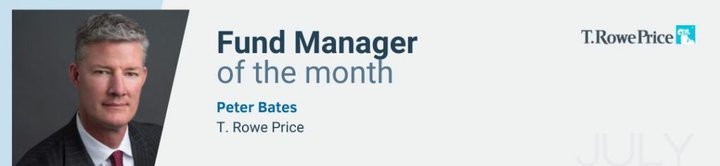
Peter Bates is the portfolio manager of the Global Select Equity Strategy in the International Equity Division. He is a member of the Investment Advisory Committees of the Global Focused Growth Equity and Japan Equity Strategies. Peter is a vice president of T. Rowe Price Group, Inc., and an executive vice president of T. Rowe Price International Ltd.
Why and how did you decide to go into the financial sector, did you have other vocations?
When I entered the Wharton School M.B.A. program at the University of Pennsylvania, I knew I wanted to pursue a career in investment management because it is a meritocracy with measurable performance.
For my first eight years at T. Rowe Price, I was an analyst covering industrials. I had the tremendous luck to work with and learn from David Giroux, who covered industrials before me and has successfully managed a U.S. capital appreciation strategy for over a decade. David taught me to “know your businesses” and always focus on risk and return. Given globalization trends 20 years ago with the emergence of China, I did a lot of traveling to Europe, Japan, China, and Brazil to seek out promising industrials investments. This experience gave me a deep understanding of global markets and the nuances of regional investing. I also spent a lot of time with our research teams across the globe, built deep relationships across this network, and gained a thorough understanding of the effectiveness of our global research platform. Became head of the global industrials sector team in 2012 and managed the sector portfolio for about eight years. I learned the difference between research and portfolio positioning. Being a global sector manager meant mentoring my analyst team in new ways and collaborating with diversified portfolio managers to help them navigate risks and opportunities in my sector.
How do you see the current macroeconomic environment? Which macroeconomic data matters most when it comes to managing investment funds?
The investment environment is changing. The post‑global financial crisis era of low rates and abundant liquidity is being replaced by one of higher rates, greater divergence of returns, and more volatile markets. We believe this period of transition will continue in the second half of 2024.
Challenging market conditions will require investors to be more valuation‑sensitive than in recent times, when a rising tide lifted all boats. Traditional skills, such as identifying stock drivers and idiosyncratic risk, will continue to be essential, but investors will need to take into account wider macroeconomic, social, and geopolitical factors along with company fundamentals.
If we look at the US, the world’s largest stock market, it has been dominated by the ‘Magnificent Seven’ technology stocks in recent years, but there are signs this once‑monolithic group of large‑cap growth firms is beginning to fragment. The outperformance of the Magnificent Seven propelled the S&P 500 to new highs earlier this year and resulted in the index becoming concentrated to an unprecedented degree. Performance within the group is now diverging, however. As the benefits of AI technology are unlikely to be evenly spread among the members of the Magnificent Seven, further dispersion within the group can be expected.
We track the sensitivity of every stock in the portfolio to rates and inflation, and own several stocks that should perform well in a high inflation and high rate environment. I like insurance companies because these businesses can pass on higher costs by raising their premiums, and demand for insurance is typically stable through business cycles and in more challenging economic times. You may stop going out to eat, but you’ll still need your car and house insurance. These companies also benefit from higher rates because they can invest the premiums, which are paid upfront before claims, in higher yielding investments which helps to grow earnings.
How should investors orient their portfolios in this environment?
We are encouraged that equity markets have started to broaden and are finding idiosyncratic ideas across our expansive opportunity set that have what we think are clear reasons why they can win moving forward. Our portfolio currently reflects a structurally bullish stance on U.S. housing and U.S. infrastructure and related re-shoring, but also has exposure to secular mega trends related to artificial intelligence and GLP-1s that we think have long runways ahead. However, we also have exposure to lower beta ideas that provide balance to the portfolio. In terms of how the portfolio looks across our three style buckets, we are overweight durable growers, though we continue to maintain meaningful exposure to cyclicals/turnarounds and disruptors as well. While we continue to monitor the macro environment, views on the market are not going to drive our portfolio performance. We think our ability to balance style and cyclical exposures helps neutralize overall macro variable exposures, which has historically resulted in stock picking driving our performance no matter the environment. Ultimately, we remain true to our mandate to manage growth-value risk and portfolio tilts and focus on finding the best ideas in the market that can add value for clients.
What differentiates the Global Select Equity Fund from the others and what advantages can bring to an investor's portfolio in the current scenario?
The Global Select Equity Strategy allows me to pursue a vast opportunity set to build a concentrated portfolio based on my highest‑conviction ideas. Many investors assume that concentration creates risk. But the number of names held is not a good proxy for risk. Even a portfolio with more than 100 holdings can end up with macro tilts because individual positions have similar factor exposures. We see that with a lot of investment products that exist today.
Part of winning is not losing big, and we are focused on building an all-weather portfolio that is balanced between style and factor tilts, with performance driven by idiosyncratic stock picking. We try to own names that are: not that cyclical; cyclicals where you get paid to take cyclical risk; and good idiosyncratic stories (growth or value).
We have seen significant swings in style leadership since the strategy was launched at the end of 2020. We believe the since inception performance track record demonstrates successful balance over periods of up/down and growth/value markets, with the portfolio generating stable alpha since inception, irrespective of the market driver.
Can you give us an example of a position that you have held for a long time in your portfolios and why?
We maintain a meaningful exposure to steady growth/cyclicals, where we added to our existing position in Steel Dynamics, which is now the top bet in the portfolio. We have a great deal of conviction behind Steel Dynamics, it is a cyclical stock however the setup is very encouraging from here; they are past their peak capex cycle and therefore returns should improve from here. At their new plant we should see production and utilisation increase and free cash flow will increase with that. They are the lowest cost producer within the USA and benefit from the steel tariffs within the country.
What ratios does a company have to meet to be part of your portfolio?
The first and key step is a qualitative assessment of the quality if the company; management is very important but also a competitive advantage and a clear understanding of how and why a company is winning or will win within their respective industry.
Risk and return assessments are critical for successful investing in cyclicals, as many industrials are. If a security only has 20% potential upside, odds are that the risk/return profile is not very good, as most cyclical stocks inherently have 50% downside. That framework has helped me manage cyclicals for the Global Select Equity Strategy. When I invest in these kinds of companies, I seek opportunities where I believe the risk/reward profile skews more heavily in our favour. I pass if the upside potential in a name does not appear high enough to justify the risk. I end up saying no to a lot of ideas because I run a highly concentrated portfolio that typically includes 30 to 45 stocks. Due to this level of concentration, the portfolio is likely to look different from many in my peer group. Many people ask the question, “What’s your target return?” I choose to focus on generating attractive risk‑adjusted returns because I believe that over time you could see more consistent overall performance—and hopefully do better when markets are weak or choppy.
In your opinion, what will the next disruptive elements in the asset management industry be?
For both passive and active, the outlook and performance of the ‘magnificent 7’, these are heavily weighted in both active and passive portfolios. And yet we are seeing increasing fragmentation and divergence in performance within the 7 names. A reversal or underperformance in the mag 7’ would be supportive for active managers versus passive. But importantly, how are active managers manage this risk and positioning sizing is going to be key for risk adjusted returns.
What do you enjoy doing in your free time?
My wife and I are deeply involved in helping our community through a charitable organization that serves the homeless who have addiction issues. This is a widespread issue, and the Helping Up Mission works tirelessly to house and support addicts recovering through treatment programs. Historically, there was no place for women addicts. But Helping Up completed a multiyear project to establish facilities to help women and their children. The opening of these facilities is a tremendous step forward. My family is my foundation, and I’m very proud of my wife and my three kids. T. Rowe Price strongly emphasizes a healthy work-life balance, and for me, it’s made all the difference in the world. I’m an empty nester, so I’m very excited to travel with my wife. It’s always been tough when I travel, leaving my wife to take care of the kids. But now she can come along with me. We’re looking forward to many adventures to come.