Reda Mandoux from Societe Generale Private Banking is our Advisor of the Month

21 AUG, 2024
By Jose Luis Palmer from RankiaPro Europe


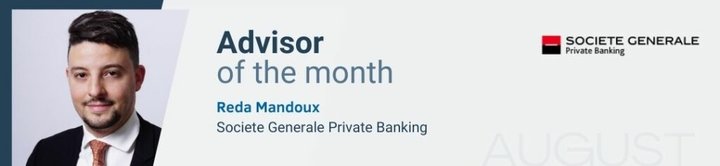
Holder of a master’s degree in wealth management obtained at the IAE of Clermont-Ferrand, I joined the Societe Generale group in 2018 having held a first position as wealth management advisor in charge of the Paris Pont Neuf and Paris Louvre branches. This position consisted of intervening on request of the agencies’ advisors and their patrimonial clients to bring them my expertise on legal and tax concepts and asset management.
Based on this experience, I joined Societe Generale Private Banking in 2021 as a private banker and supports a client portfolio (HNWI) in the structuring of their assets, the implementation of wealth strategy, legal and tax advice, and management of their financial assets. Our offices are located at 29 Boulevard Haussmann in the 9th arrondissement of Paris, which is the historic headquarters of our banking establishment and an exceptional reception place for our Private Banking clientele.
What made you decide to go into the financial sector ? Did you have any other vocations ?
To be perfectly honest, I did not have a premature vocation for wealth management. Indeed, as part of my undergraduate degree, I chose science because of my appetite for mathematics.
Influenced most certainly by my family environment, my father being an accountant and my mother a bank manager, I wanted to start my graduate studies by integrating the economics, law, management sector. Finance turned out to be an interesting trade-off between my appetite for numbers and my appetite for macroeconomics.
It was not until my last year of bachelor’s degree that I completed at the University of Clermont Ferrand that I became interested in wealth management, having had the privilege of taking on one of the most renowned masters courses in wealth management, that of the IAE of Clermont-Ferrand. The multidisciplinary aspect of this profession and especially the relational aspect with the relationship of trust that we create with the clients we accompany have definitely encouraged me to practice this profession.
To answer your second question, my other vocation would have been to practice in the field of medicine. I have a great fascination for those doctors, laboratory researchers, surgeons and nurses who help us preserve the most important capital we have, our health.
What does a typical workday look like for you ? How do you organize your time ?
Fortunately, not all the days are the same and that is what makes our profession so rich. To get an idea of the different tasks we are required to perform, I start most of my days by consulting the news, especially financial news to get an idea of the evolution of the different stock exchanges, recommendations, and strategy of our asset management company. Constant legal and fiscal monitoring is also needed to keep abreast of developments and the impact of new reforms. Naturally, this is followed by the preparation of the client appointments scheduled for the day, which may cover various and varied topics, asset allocations, financing requests, wealth strategy, legal and tax advice, etc.
The richness of our business lies in the fact that we can meet clients with different profiles, different situations, and different wealth objectives, forcing us to adapt our wealth and financial advice to match the profile of each client we support.
Which portfolio allocations are most interesting in the current market situation ?
Naturally, the recommended asset allocation will vary depending on each client’s situation, investment horizon, and risk aversion. That said, in terms of our current investment strategy, to date, we have focused on a balanced exposure in both equity and bond terms considering this rate context, allowing us to collect consistently attractive coupon rates with a preference for Investment Grade. With inflation easing, sovereign bond and corporate bond yields remain temptingly high in both nominal and real terms. We have increased the duration on our government bond yield exposure. For the equities part, we are overweight to developed equity markets, based on cheap value in Europe and healthy earnings growth in the United States. In fact, Second-quarter data show that the US economy continues to enjoy good momentum and is about to experience a soft landing. The US economy remains the best-performing of the major developed economies, GDP grew at an annualized quarterly rate of 2.8% (3% year-on-year). We are Neutral on Emerging Market equities, despite their attractive multiples, largely because of China, whose economy remains sluggish.
Which sector do you consider particularly interesting at the moment?
Indeed, we have strong convictions about certain sectors of activity that should have good growth prospects in the short, medium, and long term.
Naturally, the technology sector, with a particular focus on artificial intelligence and its components such as semiconductors, are among the themes that we integrate into our investment strategies. Even after 18 exceptional months, we think Artificial Intelligence stocks will continue to perform well, given the maturity and potential of AI and the strong profit growth of companies in the sector.
The second sector that seems to us to be particularly relevant to the current economic situation is health sectors considering various factors. An ageing population, changing lifestyles with a greater interest in physical fitness, well-being, and nutrition, coupled with major technological progress (gene therapies, immunotherapy, personalized medicine, remote health services, etc.) should benefit the health sector as a whole and its innovation component in particular. This theme thus represents an opportunity to invest in cheaper-valued stocks that offer long-term growth.
How should investors orient their portfolios in the current environment?
We have recently been going through a volatile period in which global equity markets have been rocked by the European Parliament elections, France’s parliamentary election, and a wait-and-see attitude about inflation and central bank policies. Despite these possible sources of uncertainty, and given the macroeconomic indicators that remain positive, we have maintained our investment strategy without making significant trade-offs, thereby maintaining our overexposure to developed country equity markets and bond exposure. Nevertheless, and precisely because of this volatile context, it is essential that our investor clients be able to benefit from an asset management solution that can adapt and reorient itself in a reactive manner depending on the evolution of the economic situation.
What characteristics do you think a good financial advisor should have ?
The profession of financial advisor and private banker is a multidisciplinary profession that requires mastering complex notions on the financial, legal and fiscal aspects.
To me, one of the most important qualities of being a good private banker and financial advisor is that you must be educationalist and adaptable. Indeed, we support clients with different profiles, a knowledge of asset management concepts that can be completely different from one client to another. Good advice is first and foremost advice that is understood and assimilated by the client. To do this, the financial advisor must adapt to the profile of each client and express these advices in an educational way.
When you have free time, what do you like to do ?
Being a private banker is particularly energy intensive, so it is essential to find the right balance between your professional and personal life. I take advantage of my free time to disconnect by playing sports such as tennis, a sport that I have been playing since I was a child.
During this summer period and coming back from a wonderful holiday in Crete, I must talk to you about travel that is also part of my hobbies. We love to travel with my wife, and I want to conclude this interview by wishing you a happy summer with this quote from St. Augustine: “The world is a book, and those who don’t travel read only one page of it.”