Sune Højholt Jensen from Impax Asset Management is our Fund Manager of the Month

4 JUN, 2025
By Jose Luis Palmer from RankiaPro Europe


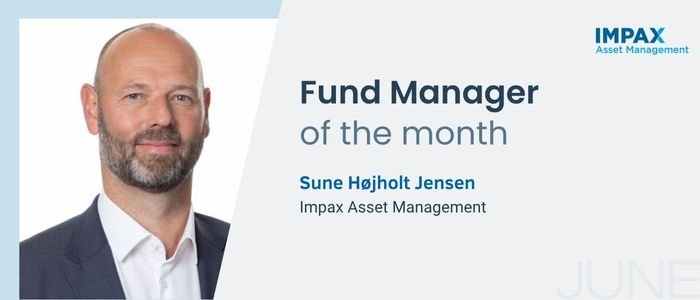
Sune joined Impax Asset Management in July 2024 and is co-Portfolio Manager of the Emerging Market Corporate bond strategy and a member of the Global High Yield team and Credit Strategy Group.
Sune began his career at Bjørnskov & Co as an equity analyst. In 1998 he moved to Nykredit Markets joining as a Credit Analyst before moving to the proprietary trading team in 2000. In 2004 he moved to Nordea as a Trader in their proprietary Corporate Bond Trading team. In 2007 he moved to Sparinvest to work alongside Klaus Blaabjerg as part of the investment team with the focus on HY corporates. Sune was managing a constrained EM sovereign debt strategy from 2007-2009. In 2010 he was appointed as the lead manager on the Sparinvest Emerging Market Corporate Debt Strategy.
Sune attended the Copenhagen Business School where he earned an MSc in Finance.
Why and how did you decide to go into the financial sector, did you have any other vocations?
I have always been very interested in applicable mathematics and post college I was looking for an education where I could explore this interest. After my time in national service in the Royal Danish Airforce, I came across a BsC offered at Copenhagen Business School, where Business Administration was combined with Mathematical Business Economics. During my second year of studying, I was offered a part time position in the research department of a local stockbroker. My main task was to update financial models of listed companies that were not covered by a sector analyst – predominantly smaller companies. I really liked financial modelling and forecasting. Because of this experience, I decided to pursue a Master’s degree in Finance and Accounting while continuing my research position. I was given more responsibility very quickly, and I was made responsible for the entire banking sector. The firm was acquired by a bank in 1998 and I was offered the opportunity to become an analyst in the proprietary corporate bond trading group which is how I made the switch to fixed income, working first as a corporate bond trader before settling in asset management.
What is your view of the current macroeconomic environment and how might it affect markets? How does uncertainty affect Emerging Markets’ bonds?
The US administration has created a lot of uncertainty at a time when most regions around the world are facing slower growth – or even recessions. The complexity around production and supply chains is high and often cannot be altered quickly enough while for some sectors and companies it does not make any economic sense to change. Consumers are likely to face higher prices and companies will likely have to absorb some costs, which could add to margin pressures. Commodity exporters are likely to be negatively impacted via slower growth and lower commodity prices.
Compounding this, some of the biggest economies are running large deficits while others are turning to fiscal stimulus to revive domestic demand. All this will be funded with issuance of more government debt. This can lead to increased interest rate uncertainty, FX volatility and higher credit premiums which are normally considered disadvantageous for emerging markets (EM) economies and corporations as the real costs of funding will increase. Furthermore, negative developments in the cost of living can lead to market-unfriendly political shifts.
The United States’ exit of multilateral arrangements can be costly – especially for some of the Frontier countries that are relying on support. It might also slow down some of the initiatives and projects that have been undertaken by these institutions. It can affect the credit profiles of EM sovereigns and related corporations, and in the end lead to higher credit premiums or defaults.
The introduction of trade barriers will change trade flows and create opportunities for others. Overall, I believe it will likely be negative, but it is very important to be active and look through these negative developments and identify who will benefit. This is better done through corporate exposure. All-in yields are high and can provide decent carry to mitigate the current uncertainty.
How should investors orient their portfolios in this environment? What are the biggest risks facing investors?
In today’s environment, diversification is key; we would recommend avoiding excessive concentration and leveraging the benefits of less correlated asset classes. This applies to both default dynamics – which vary across regions – and to return correlations, which are often imperfect. For example, emerging market corporate bonds can serve as a great diversifier to an EM Sovereign bond portfolio.
In this asset class, default risk and capital erosion is the biggest risk facing investors. Given the uncertain environment, it’s prudent to focus on issuers with strong fundamentals and favour companies with conservative capital structures and strong governance.
The market is being driven by headlines and shifting sentiment. Interest rate expectations can change rapidly and maintaining a neutral stance on duration is, in my view, the best course of action.
What differentiates the Impax Emerging Markets Corporate Bond from others and what advantages can it bring to an investor’s portfolio in the current scenario?
We believe that what makes our approach different is that we focus on company-specific fundamentals and how each bond is priced relative to its risk, rather than broad country allocations. We naturally consider the macroeconomic environment but view it through the lens of how it affects individual credits.
Our approach is centered on a three-step process focused on generating alpha through strong credit evaluation and selection. Our process combines deep fundamental credit research, an assessment of relative value complemented by quantitative analysis, and a thorough consideration of sustainability risk to ensure a more comprehensive understanding of an issuer’s risk-return profile.
This allows our strategy to identify overlooked opportunities where the market’s perception of risk diverges from the underlying credit quality of the bond. This approach is particularly beneficial when volatility has peaked, but a strong risk management framework and access to risk mitigation tools allow us to control the risk of the portfolio – even in uncertain times.
Can you give us an example of a position that you have held for a long time in your portfolios and why? How would you describe Impax’s investment philosophy?
The Impax Emerging Markets Corporate Bond Fund is a diversified strategy that invests in undervalued bonds of emerging market companies where we believe spreads are high relative to fair value and corporate fundamentals. We seek to outperform the benchmark over a market cycle through an active bottom-up, high-conviction approach aiming to limit permanent loss of capital.
We may enter a position if the issuer has strong fundamentals, the issue itself presents an attractive relative value opportunity, and we believe the sustainability risks are being appropriately addressed and managed. We continuously assess this and are comfortable being long-term holders in a particular credit so long as this criteria is met. For instance, the Turkish multinational food producer Ulker is a fine example of this. The company’s core products are biscuits, cookies and chocolates which it exports internationally to more than 100 countries. In October 2020 the company issued a five-year bond at a spread of 660 bps to US treasuries. The fund invested into this new issue. Ulker has operated under a relatively conservative capital structure with leverage below industry peers and decent margins. Apart from the company’s strong fundamentals and its attractive relative value, the company has managed its sustainability risks effectively, in our view. However, Ulker’s credit rating has historically been constrained by Turkey’s sovereign rating. We tendered the 2020 bonds in July at a premium and purchased the 2031 bonds at a tighter but still attractive spread.
What macroeconomic data are most important to monitor in order to manage investments? What do you consider most important when including a company in your portfolio?
The investment sentiment and overall health of emerging markets is normally linked to issues including GDP growth, the ability to control inflation, exchange rates and very importantly political stability and the policy environment. The macroeconomic environment naturally plays an important role in managing an emerging market corporate bond portfolio, but we prefer to analyse the effects at the micro level and thereby exploit any market dislocations. We draw upon the insights of the Impax Credit Strategy Group, which consists of senior members across the Fixed Income Platform. The group meets monthly and provides guidance on top-down views regarding sectors and regions which aid in the portfolio construction.
In a weaker economy characterized by high or rising inflation, increasing interest rates, or a depreciating currency, a domestically focused company that relies on imports would likely be vulnerable. Conversely, a company that primarily exports goods and has a cost base in the local currency would have a relative competitive advantage. Many emerging market issuers are large conglomerates or exporters with global revenue streams which provide important buffers when their local economy experiences downturns. Therefore, global demand can be more important.
Hard currency interest rates play a crucial role for many EM sovereigns and corporations. Despite the rapid growth of local financing opportunities, hard currency debt remains an important source of financing. In comparison with emerging market sovereigns, emerging market corporates may offer more stable fundamentals and better sector and country diversification all the while being relatively less exposed to political risks.
What ratios does a company have to meet to be part of your portfolio? How is Impax’s selection process structured?
We have a disciplined and repeatable investment process with an intense focus on security selection emphasizing credit fundamentals, relative value and a sound management of material sustainability risks. In Emerging Markets, we especially focus on financial credit ratios as ratings can be muddled by regional affiliation. We identify and manage material sustainability risks by using Impax’s proprietary Sustainability Framework for Fixed Income.
In our idea generation we systematically screen the emerging market corporate bond universe for undervalued bonds. An important aspect of idea generation is also considering country-level risk and the broader political and macroeconomic environment.
Credits that look attractive are further analysed by the Global Credit Research Platform together with the emerging market corporate bond portfolio managers.
Portfolio construction is driven by a disciplined focus on maximizing risk-adjusted returns and assigning the highest weights to bonds offering the most attractive return potential, regardless of their index representation. Prior to adding a new position, we analyse how the position might change the overall risk profile of the portfolio. We consider the impact to regional, sectorial and to an extent, rating compositions. We also consider the impact to various risk measures such as VaR, overall duration, and the portfolio’s beta. We proactively monitor the portfolio’s expected beta and are generally positioned within certain targets depending on the overall level of risk we feel is prudent at any given time,
Engagement is conducted as part of regular meetings with company management teams, and we use that to proactively identify and mitigate issues.
What do you like to do in your free time?
When I am off work I spend a lot of time with the family. After dinner some of us normally go for a long walk which is a very nice way to relax and have some good talks. I am supporting my three kids with their sport – mainly transporting back and forth and supporting them at competitions. I also enjoy sport myself – especially racket sports. I play badminton a couple of nights every week during the winter and also participate in tournaments. In the summer I mostly enjoy tennis, but my backhand is not always my friend - I am still trying to figure out how to hit a proper backhand like Wawrinka.