Svein Aage Aanes from DNB Asset Management is our Fund Manager of the Month

28 MAY, 2025
By Jose Luis Palmer from RankiaPro Europe


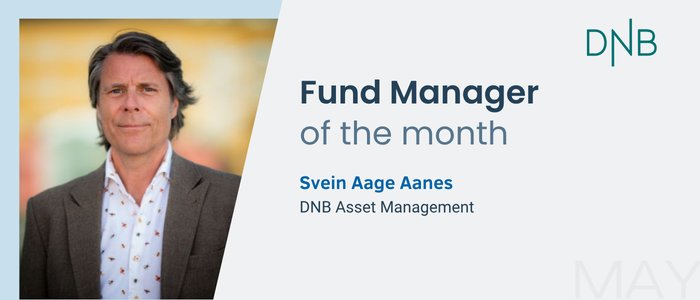
Svein Aage Aanes has been at DNB Asset Management since 1998, from 2002 as Head of Fixed Income and FX. He has a master in Economics from The Norwegian School of Economics. He worked as an assistant professor at the Norwegian School of economics and as a senior economist at DNB Markets prior to joining DNB Asset Management.
Why and how did you decide to go into the financial sector, did you have any other vocations?
Actually it was a bit of a coincidence. I worked in academia at the Norwegian School of Economics for a while and we were a group of friends playing soccer for fun, a mix of faculty and former students. One of the players worked at DNB Markets, the investment banking arm of DNB, and he mentioned that they were looking for an economist. I thought about it and decided it could be interesting to try out and worked a couple of years as a senior economist. From there it felt as a natural development to make the move to the buy side to be able to make investment decisions on the views I developed.
What is your view of the current macroeconomic environment and how might it affect markets? How does uncertainty affect Nordic bonds?
Clearly, the increase in geopolitical and trade tensions has had a negative impact on sentiment indicators from both household and businesses. So far, harder data have been decent but it is difficult to get away from the feeling that the risk of a weaker development has increased, as evidenced in periodically elevated equity volatility. We have seen effects in the form of credit spread widening in fixed income markets as well, particularly in the wake of Trump’s liberation day. If the elevated uncertainty leads to a noticeable drop in economic growth we would likely see more spread volatility in the quarters ahead, and potentially somewhat lower interest rates. The Nordic bond markets have also been impacted with credit spreads widening in early April. Since then, spreads have come back in but are still wider than late March, particularly in the high yield space.
How should investors orient their portfolios in this environment? What are the biggest risks facing investors?
The biggest risk facing investors in the present climate is that elevated uncertainty turns into a weaker economic climate through caution from consumers and businesses leading to reduced spending and investment. This would likely lead to credit spread widening, at least for a period. At the same time we find credit spreads and the steepness of credit spread curves in the Nordic region quite attractive. For Nordic investment grade bonds we find no 12 month investment period over the last 12 years in which credit has not contributed positively to return when starting from present credit spread levels. Clearly, return contributions could be negative over shorter investment horizons but carry and roll for investment grade portfolios look decent at present. This leads us to the conclusion that credit exposure will continue to be a positive for investors.
What differentiates DNB's selection of fixed income funds from others and what advantages can it bring to an investor's portfolio in the current scenario?
We are specialists in Nordic fixed income and mainly focused on corporate credit and we offer a broad selection of Nordic and Norwegian credit funds. From a broader European perspective this means that we offer exposure to a different region of Europe and a different universe of issuers. The Nordic region is an area with historically strong economic growth, stable political regimes, low public debt levels, low inequality and strong welfare systems. These characteristics has led to strong performance in equity and credit markets over time and have also contributed to the Nordic countries performing stronger (less badly) during the most recent crises in the world economy – the financial crisis, the euro debt crisis and the pandemic. We believe that exposure to the Nordic region could be interesting for European investors both from a return and a diversification perspective.
Can you give us an example of a position that you have held for a long time in your portfolios and why? How would you describe DNB's investment philosophy?
I can give an example from the high yield and investment grade side, respectively. One example from high yield could be Kistefos AS. Kistefos is an investment company which was started in the late 1990s. It has a strong owner and has been a semi-frequent issuer in the Nordic high yield market. We like the company because it has a diversified structure in its holdings and has demonstrated strong capabilities in buying, developing and selling their assets. At present it has exposure to financials (Advanzia), offshore, logistics, real estate and the TMT sector, among others. On the investment grade side an example could be Olav Thon Eiendomsselskap, a Norwegian real estate company with a long history and strong track record. We like this company as it has shown over many years that it maintains a stable risk profile and a strong risk governance with strong key risk metrics.
Our investment philosophy focuses on giving our clients exposure to Nordic credit within a structured, repeatable investment process. We focus on capital preservation and liquidity in our portfolios. We cover the entire Nordic credit market within a fundamental, bottom-up approach.
What macroeconomic data are most important to monitor in order to manage investments? What do you consider most important when including a company in your portfolio?
It is difficult to pinpoint individual macro data that are always more important as this may vary with the business cycle and different types of shocks to the economy. What we try to do is to follow the macroeconomic development within a structured investment process where we look at developments in the real economy, inflation, central bank policies and other elements to construct our internal view of interest rate and overall credit spread development. This view is then contrasted to market pricing and market positioning to evaluate where we see value in the market. An important element in this process is to also look for macroeconomic developments which could have impact on particular sectors within the credit market.
In a general sense the most important element we consider when including a company in one of our portfolios is the ability of the company to reimburse the loan at maturity. But as there are no free lunches, even in the Nordic market, we will have to take on some credit risk to receive decent credit spreads. In investment grade funds the idiosyncratic credit risk is generally quite low so elements such as roll-down on the credit curve (credit curve steepness) and choice of maturity can be important. In high yield idiosyncratic credit risk is higher and we often have to make a choice of which credit weaknesses to be exposed to. Here we are prone to favor cash flow visibility and strong ownership over instantaneous credit risk metrics.
What ratios does a company have to meet to be part of your portfolio? How is DNB's selection process structured?
There are no hard and fast rules when it comes to ratios or key credit metrics a company has to meet to be investable. The general principle is that in investment grade portfolios companies must be rated BBB- or above or have a similar credit quality (for unrated companies). In the high yield portfolios companies must be rated B- or above or have a similar credit quality. In our Nordic investment grade funds 96-98% of holdings will have an official rating whereas in high yield portfolios around 50% will have an official rating. The reason we do not have specific rules on ratios is that these typically will vary between different sectors. Key credit metrics in our credit analysis process, as well as for rating companies, will be different for real estate, banks, utilities and industrial companies.
Our selection process is based on fundamental credit analysis of all relevant issuers. We have divided the responsibility for analyzing and monitoring the issuers in the universe among team members. For this purpose we have built a system where the relevant quantitative information from quarterly reports are entered along with qualitative comments on credit developments for the company. We have developed sector-specific templates focusing on the most relevant information depending on the sector. This information is integrated with databases for equity and credit spread developments for the specific company. Based on this integrated information we hold team meetings where we discuss the development of the credit quality versus pricing of individual companies and sectors.
What do you like to do in your free time?
Living in Bergen, Norway with easy access to mountains and fjords it is clearly a positive if you are interested in the outdoors. Fortunately I am. I like to hike in the mountains both summer and on skis in winter, preferably with my dog (and sometimes friends). Fishing is also a favorite pastime, nothing better than having a dinner with freshly caught fish and some nice wine. Rounding off the evening with a good, old fashioned book and I am happy.