Thorsten Winkelmann from AllianceBernstein is our Fund Manager of the Month

12 NOV, 2025
By Joanna Piwko from RankiaPro Europe


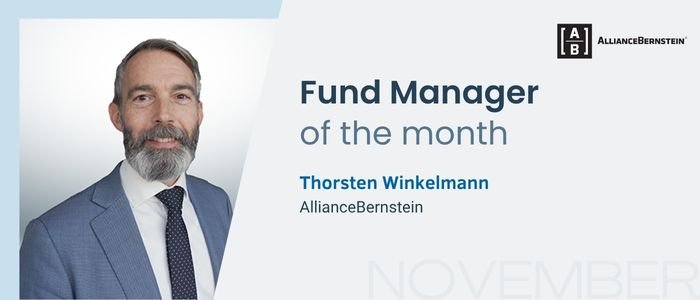
Thorsten Winkelmann is Chief Investment Officer of European and Global Growth Equities at AllianceBernstein (AB), based in Frankfurt. Holding a Master’s degree in Economics from the University of Bonn, he brings more than 20 years of investment experience to the role. Prior to joining AB in 2024, Winkelmann spent over two decades at Allianz Global Investors, where he was CIO of the Global Growth team and portfolio manager for the Global Equity Growth and Europe Equity Growth strategies. Earlier in his career, he also managed portfolios within AllianzGI’s European Equity Core and Multi-Asset teams.
When and why did you start your career in the financial sector?
My mother used to work in a bank, my father worked in an advertising agency. While I was flashed by the glamorous advertising world, I decided to embark in the financial universe and start my business life in 1993 with a trainee program in a bank. During my university studies, I needed to earn some money for my living, so I have worked part-time in the brokerage department of Deutsche Bank starting 1996. Fascinated by learning more about companies and their stocks, I had the pleasure of doing two internship programs at asset management firms in New York and Zurich. At that moment in time, it became clear to me that I had found the best job you can have on planet earth: managing equity portfolios on behalf of my clients.
How does a typical workday unfold for you? How do you organize your time?
After my morning routine with a strong black coffee and a workout, I jump in the car to drive to work. Typically the first thing I do after opening my computer is to check the world’s latest news, be it politics, culture or sports. But then it’s time to focus on the portfolio.
It starts with reviewing company news and updates, followed by conducting research on potential investment opportunities. Throughout the day, I allocate time to engage in discussions with company representatives to gain deeper insights into their business models and growth prospects. Collaborating with my team is a crucial aspect of my day, as we regularly debate investment ideas, challenge assumptions, and assess risks together. We also have a weekly team call dedicated to focusing on portfolio construction, where we review our current holdings and discuss potential adjustments.
What key principles guide your investment process?
We strive to behave rationally at all times. As generalists, all team members contribute to stock ideas and debates, and we fixate on business models, not short-term stock prices. We remain true to our long-term process even in challenging periods, recognizing that patience is key to successful investing. We believe that this approach helps us to avoid the temptation of chasing short-term gains and to stay focused on the long-term prospects of our investments.
We have the patience to think like owners, recognizing that time is on our companies' side, and this should make us better investors. We will not buy if the price is not right, and we are willing to wait for the right buying opportunity. We believe that this approach helps us to avoid overpaying for investments and to stay disciplined in our investment process.
Finally, we approach our work with gratitude. We manage our clients' assets with integrity, discipline, and transparency, recognizing the trust that they have placed in us. We remain fully aware of the risks we take on our clients' behalf and are committed to exercising our passion for investing in a responsible way. We believe that this approach helps us to build strong relationships with our clients and to earn their trust over the long term.
How are you adapting your portfolio to the current market situation?
An important principle that guides our research is to focus on businesses without trying to forecast macroeconomics. We believe that the best way to generate long-term returns is to invest in companies with strong business models that can weather economic storms. We recognize that macroeconomic factors can have an impact on our investments, but we don't try to predict them. Instead, we focus on understanding the underlying businesses and their competitive advantages. This approach helps us to avoid the noise of short-term market fluctuations and to stay focused on the long-term prospects of our investments.
What kind of companies are most interesting to you when building a portfolio? Which kind of companies would you avoid investing in?
We look for structural growth. To assess the growth opportunity we adopt a business owners’ mindset and look 5 to 10 years into a company’s earnings trajectory to seek to identify companies with quality franchises, strong competitive moats and above average structural earnings and cash flow growth potential, which the market has not fully priced in.
We define structural growth as long-term earnings and cashflow growth which comes from either secular growth drivers (e.g. automation, digitalization, ageing populations) or company specific factors (e.g. differentiated business model, a specific technological advantage, or best in class product etc.). Structural earnings and cash flow growth aligns with our longer term investment horizon and this type of growth tends to be more stable. Over time, our analysis has shown that these companies are able to deliver growth above the market across a full market cycle. We actively avoid companies dependent on cyclical growth, where performance may be more sensitive to macro events and the market cycle.
What is the biggest challenge you have faced as a fund manager?
I think the biggest challenge for a portfolio manager is to accept that you are facing several challenges every week. In a world with ever faster communication and news flows, your thesis and conviction in your long term holdings in the portfolio are constantly tested, pushing you to question your portfolio positioning every day. You also need to accept that you will make mistakes. Understanding why you were wrong and learning from it to get better should not be seen as weakness but is testament to a well-functioning investment philosophy and a strong team culture.
What advice would you give to someone who wants to pursue a career in asset management?
Remember that earnings and cash flow growth are the basic source of long-term equity investment returns. It may sound like a truism, but this simple principle is often forgotten in volatile markets. Over time, the performance of the MSCI Europe Index has closely tracked the earnings growth of its constituent companies. And the MSCI Europe Growth Index, whose members have higher growth than the broad market index, has delivered even better returns. We believe that investors who are able to identify companies with stronger earnings growth than the market tend to be rewarded with outperformance.
To do this, we believe cash flows should be prioritized in fundamental analysis. That’s because cash flows are the lifeblood of a healthy business and underpin a company’s ability to sustain earnings growth over time. Even when macroeconomic challenges and geopolitical hazards rattle market performance, equity returns over time are ultimately driven by a company’s underlying earnings trajectory.
Another important principle is to remain humble. Investors should recognize that we don't have all the answers and that we can always learn from others. This is why we foster a culture of learning and debate, where team members are encouraged to share their ideas and challenge each other's assumptions. We believe that this approach helps us to make better investment decisions and to avoid the pitfalls of overconfidence and complacency. We recognize our mistakes and seek to learn from them.
What do you like to do when you are not working?
I play a lot of sport, in particular tennis, and in the winter, I like to snowboard. I also read a lot to stay on top of how the world is changing. I find that reading is a fantastic way to learn more about the world and stay informed about the latest trends and developments. By delving into books, articles, and reports, I can gain valuable insights into different industries, market dynamics, and emerging technologies that could impact the companies I am interested in.