Tim Peeters from Miles Ahead Investment Company is our Advisor of the Month

18 SEPT, 2024
By Jose Luis Palmer from RankiaPro Europe


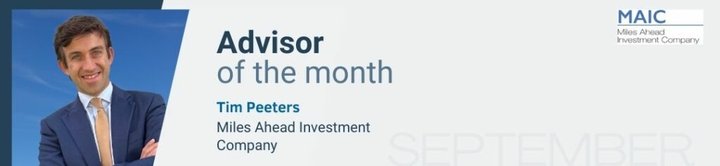
Tim developed a passion for investments at the age of 17. During his Master's degree in Applied Economic Sciences at KU Leuven, he founded an educational investment club and dedicated his thesis to gold as a tool to optimize and reduce the risk of an investment portfolio.
After his studies, he joined BNP Paribas Investment Partners and worked as an analyst on what was then the flagship fund: BNP Fortis Obam fund.
In 2012, Tim became Head of Investments for one of the largest Belgian family offices, and in 2015, he started Miles Ahead Investment Company. Through this company, he advises both wealthy families and institutional clients in their investment processes.
Why did you choose to go into financial advice? Did you have other vocations? How were your first steps in the financial sector?
In my teenage years, I initially wanted to become a surgeon because that way, you could really help people. The long track to that position made me later choose economics instead. A good financial advisor should be able to help a hospital run its finances better, so that more specialized medical equipment could be purchased. So your impact could be even bigger. So the day I could start advising a major hospital in our country, I was really happy that I could fulfil my earlier dreams.
I was 17 when I got passioned about the stock market and started an investment club for students to share practical investment experiences. We learned a lot, as in my university years the market crashed. A lesson in which you learn how to handle money and deal with risk. Lessons for life.
My career started at BNP Paribas Investment Partners. An interesting experience where I met a lot of people and had the chance to work with the analysts of flagship fund BNP Obam. What you don’t know when you’re that young, is that these people will become friends, business contacts and even clients when your life and business evolves. That is how you learn that trust and partnerships build over years. How could I ever know that the ‘portfolio allocation of the year’ contests I did on the whiteboard at my job would ever result in a client so many years later. It’s amazing, but it’s also a ‘good to know’ for all young people working to get somewhere. Everything in life is possible, although sometimes it’s building step by step. You just need to think Miles Ahead.
How do you see the current macro-economic environment? Which macro data do you look at most when advising your clients?
GDP growth and inflation are some of the key criteria. The current macro data are poor and geopolitics aren’t good either. If you put these data next to the valuations of let’s say the S&P500, we can only conclude that the market is ready for a pullback. It’s always difficult to predict the exact timing of a pullback, but why wait till it’s too late? If you can sell your car for double the price it should be worth, you should not wait for a next buyer to sell it, as he might not come. The same is true for a stock market where the Shiller Price/Earnings ratio marks 36, where the mean is 17 over the long run.
How should investors orient their portfolios for the remainder of 2024?
Quite conservative as you can still make very good returns with short duration dollar bonds yielding around 5%. In a combination with well chosen value funds or trackers, this might bring you a stable but profitable New Year.
What characteristics do you think a good financial advisor should have?
Most important is dedication as your work and learning process never stops. An advisor should be passionate about the markets, and has to be eager to learn more about sectors and regions which weren’t in the investment scope before. The market moves, so should the advisor.
Which portfolio allocations are most interesting in the current market situation? Which sector do you consider particularly interesting at the moment?
Since the last couple of years, we advised more funds that focus on real assets. With real assets we mean gold, silver, oil and other commodity markets. Lately, we stressed more on adding real estate funds, and we think that this sector will outperform the broader market by far. Reason is that this sector got hit too hard when rates went up, while some REIT’s can perfectly handle the current rates as their rental incomes grew faster.
What does a typical workday look like for you? How do you organize your time?
I think the answer is that we have no typical workday, as we have a variety of tasks.
If the market moves a lot, we spend more time on analysis of absolute and relative attractiveness of the different sectors and regions. Due to the market moves, the risk/return characteristics of a portfolio might change. In that case we will contact the clients to rediscuss the weightings of the different allocations in their portfolios.
In general we try to meet our clients regularly, explain the market and their portfolio results, consolidated as well as per selected fund manager. Sometimes we also present new funds or investment ideas. When we discover new opportunities and select new fund managers, more time will be dedicated to meet these people too so that we can analyse their investment process in depth.
What role do you think regulation plays or should play in driving Socially Responsible Investment?
Too much market regulation is mostly a bad thing even when the original goal might look ok. I think by now everyone agrees that Europe is killing its own car industry by its regulatory goals. So my question to the regulators is how socially responsible it was to make all these people jobless.
In the financial industry, we see identical patterns. More and more regulation is making the private bankers job worthless. In the past, bankers could talk about investments, now all time is taken by administration and client questionnaires.
Instead, people and firms should be stimulated to become leaders in new and existing technologies. Long term thinking will be rewarded by the market by itself. Investors will buy the new market leaders, because they create the future and make money. Companies like Tesla and Apple were founded by passionate leaders, not by governments forcing investors to allocate money that way.
What do you do in your free time?
Love to be with friends and meet new people from everywhere in the world as I like the hear their stories and passions.