Yosr Meddeb from Amadeis is our Advisor of the Month

1 OCT, 2025
By Joanna Piwko from RankiaPro Europe


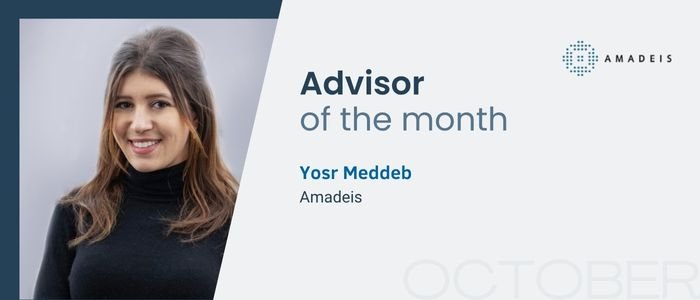
Yosr holds a Master’s degree in Asset Management from Université Paris Dauphine. During her academic and early professional career, she gained experience at the Banque de France as a credit analyst, followed by a position at Natixis Wealth Management within the ALM team. She then joined BNP Paribas Asset Management as an assistant portfolio manager, focusing on convertible bonds.
In 2022, she joined Natixis Investment Managers as an assistant multi-asset portfolio manager, supporting senior managers with asset allocation, fund selection, and portfolio monitoring over a period of 18 months.
Yosr joined Amadeis in March 2024, where she continues to develop her expertise in asset allocation and fund research, with a strong focus on ESG integration and responsible investment. She has also complemented her asset management background by earning the CFA Institute Certificate in ESG Investing, equipping her with advanced skills and expertise to excel in the field of sustainable finance.
Why did you choose to go into financial advice? Did you have other vocations? How were your first steps in the financial sector?
My interest in financial advice grew from a strong curiosity about how economic environments influence individual decision-making. While studying finance at Paris Dauphine University, I specialized in Asset Management and completed a year-long apprenticeship with convertible bond managers, gaining practical insight into portfolio strategy. That same year, I joined a portfolio management challenge organized by Natixis Investment Managers, which led to a fixed-term role on their Multi-Asset team. There, I developed a top-down, macroeconomic approach to investing. Rather than a single vocation, I see financial advice as the ideal blend of analysis and human connection helping clients make informed, long-term decisions.
How do you see the current macroeconomic environment? Which macro data do you look at most when advising your clients ?
We’re currently in a transitional phase. The global economy is adjusting to a new cycle where inflation is gradually easing, while economic activity is slowing, creating a delicate balance for central banks. At the same time, the return of protectionist policies, especially since the re-election of Donald Trump is adding a new layer of uncertainty, particularly regarding trade flows, global supply chains, and corporate margins. In this context, I focus on macro indicators that offer clarity on the broader direction of the economy. Inflation remains a key variable, as it directly shapes monetary policy and market expectations. I also closely monitor interest rate guidance, growth momentum, labor market data, and business sentiment. These indicators help us understand the overall macro backdrop.
How should investors orient their portfolios for 2025? Which do you think will be the biggest challenges and opportunities?
In 2025, investors should remain selective and adaptable. The key challenge will be navigating persistent uncertainty from slowing disinflation and data-dependent monetary policy to geopolitical tensions and regulatory shifts that could weigh on global supply chains and margins. That said, this environment could also create opportunities. Valuation troughs in certain sectors or regions may offer attractive entry points. Undervalued values, particularly in parts of Europe or emerging markets, could benefit from improving fundamentals or policy shifts. Similarly, neglected sectors like industrials or certain areas of clean energy may outperform as the cycle evolves. Maintaining a diversified, fundamentals-driven approach while staying alert to mispricings will be key to capturing upside in a more mature, uneven market landscape.
What characteristics do you think a good financial advisor should have?
A skilled financial advisor combines strong analytical skills with adaptability in a constantly changing environment. Rather than relying on intuition, we have to base decisions on careful analysis of data and trends. Trust is essential because clients need a reliable, transparent, and consistent partner, especially in uncertain times. Equally key is clear communication by explaining complex financial concepts in simple terms to empower informed decisions. Patience and discipline also help guide clients through volatility, always with a focus on long-term goals.
Which portfolio allocations are most interesting in the current market situation? Which sector do you consider particularly interesting at the moment?
A cautiously balanced portfolio could be appropriate in the current environment. Fixed income is reasserting its role as a genuine diversifier and short-term investment-grade credit is particularly attractive, offering better compensation for interest rate risk. On the equity side, policy-driven volatility and supply-side constraints continue to weigh on growth, but AI-driven productivity gains are supporting earnings. I maintain a constructive view on U.S. equities, where valuations are underpinned by stronger earnings growth and profitability compared to other developed markets. As for Europe, greater political cohesion and a pro-growth agenda could lift sentiment, but I remain cautious until structural challenges are more clearly addressed. Finally, thematic allocations particularly in areas such as the energy transition or innovation-focused infrastructure may offer compelling opportunities, even in a less supportive macro backdrop. In a long-term perspective, private markets play a key role, offering access to innovation and potential returns uncorrelated with public markets, while rewarding patient capital.
What does a typical workday look like for you? How do you organize your time?
There is no typical day as an investment advisor, given the dynamic nature of the role. I usually start by reviewing market updates to stay ahead of trends and client concerns. My day blends strategic tasks like portfolio audits and asset allocation with operational duties such as preparing materials for committees, selecting investment vehicles, and producing reporting on our clients’ portfolios. We also dedicate a significant portion of our time to direct client support, meeting with them regularly for comprehensive portfolio reviews or on an ad hoc basis to address specific needs or questions. Time management is key so I organize my day around deadlines but keep flexibility to address urgent client needs or new opportunities.
What role do you think regulation plays or should play in driving Socially Responsible Investment?
Regulation plays a central role in making Socially Responsible Investment more transparent, credible, and comparable across the market. In my role as an investment advisor, we regularly assess the ESG quality of investment portfolios for institutional clients. Regulations such as the SFDR or the EU Taxonomy help us structure our ESG analysis and reporting by providing clear frameworks and definitions. For example, when advising a client on aligning its portfolio with Article 9 requirements, we need to map each asset to the appropriate sustainability criteria, assess data coverage, and sometimes even question ESG ratings provided by asset managers. These regulatory guidelines give us a foundation to challenge investment strategies and drive more consistent, measurable outcomes. But the regulatory landscape is still evolving and sometimes lacks practical alignment with real-world constraints especially when data is missing or inconsistent. To be truly effective, ESG regulation should be developed alongside market practitioners to ensure it encourages meaningful progress while remaining feasible in day-to-day portfolio construction and monitoring.
What do you like to do in your free time?
In my free time, I enjoy going to the gym. I like trying new workout classes like indoor cycling or crossfit, it allows me to discover different training styles and sports. I also love traveling, mainly for the opportunity to explore different cultures and ways of life. Finally, I value spending quality time with my family, whether it’s going for walks to discover new places around the city or trying out new restaurants and cafés together. It's a great way to unwind and stay connected.