Andrea Florio from Zurich Bank is our Fund Selector of the Month

22 JAN, 2025
By Jose Luis Palmer from RankiaPro Europe


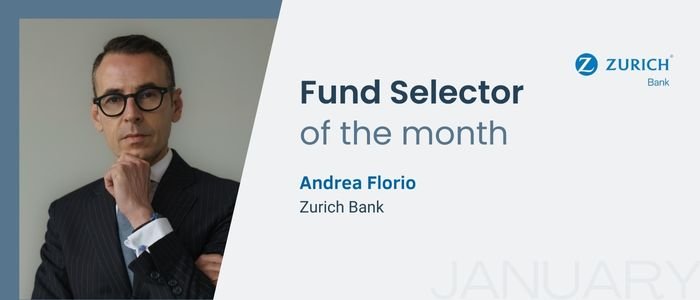
After graduating from Università Commerciale L. Bocconi and embarking on a consultancy career during which he followed an important project related to the private banking sector, Andrea Florio joined the Intesa Sanpaolo Private Banking group as an equity analyst supporting the group's network of private bankers. In this context, in addition to developing a deep knowledge of the private banking sector thanks to close collaboration with professionals of the highest standing, he developed important skills and techniques for structuring portfolios dedicated to the group's private bankers (both in single stocks and investment funds).
He joined the ANIMA Sgr group in the role of relationship manager. During his time spent on the sell side, in addition to increasing his knowledge of investment products, he acquired important commercial techniques aimed at making their placement more efficient and effective in response to the needs of his reference clients. Attention to understanding clients‘ needs and continuous research in terms of efficiency in structuring its clients’ portfolios were elements matured also thanks to an intense promotional activity through specific conferences and/or industry talks. He later joined the Generali Group, focusing on the development of investment strategies and the selection of funds to feed financial and insurance portfolios. Among the pioneers of ESG, within the Banca Generali group, he developed in partnership with a major player a platform dedicated to sustainable investments.
In May 2022 he joined the Zurich group to actively participate in the development of the Zurich Bank project within which he now mainly oversees the development of financial and insurance investment solutions, the selection of funds for the various portfolios and ESG issues.
Can you walk us through your experience in fund selection? When and how did you start your career in the financial industry?
After beginning my career in consulting, where I had the opportunity to integrate my academic journey with important organizational skills, I joined the Intesa Sanpaolo Private Banking group, which provided me with an interesting journey in the innovation world related to the private banking business.
My first experience was in the advisory team of Intesa Sanpaolo Private Banking, where I could better understand the different approaches to the financial market, the various techniques to build strong and balanced portfolios in equity, fixed income and multiasset (in stocks and funds); and gain a better understanding of the best investment solutions and the specific needs of private bankers and HNWIs.
I have always had a very strong vocation for the financial market. Early in my career, I was particularly interested in understanding the private banking sector because my academic focus centered on private banking and the evolution of the industry.
The first phase of my professional journey was dedicated to understanding the private banking world and its infrastructure. During that period, I learned the best approaches for private customers in terms of portfolio construction and investment solutions.
This was the first step in deepening my expertise in fund selection and investment solutions for Private Banking customers.
Taking a brief look at your working life, what would you highlight about your professional career?
In my professional career, there are three key aspects that I follow with great attention. First, continuous improvement to ensure up-to-date knowledge of financial markets and fund selection, paying special attention to the macro environment, key developments of the markets and the competitors, particularly in terms of solutions, propositions, and approaches.
The second aspect concerns investment instruments, meaning the importance of understanding new tools to build portfolios, in terms of funds, solutions and anything that can help maintain a current and relevant market approach.
The third aspect is the analysis of customer needs. With these three components in mind, I aim to build the ‘near-term investment for the long term’ – a very consistent approach based on strong near-term investing for the long term. By considering the evolution of financial instruments, the evolution in approaches and customer needs, I strive to provide the best solutions for our clients, make the best selection to build strong and balanced portfolios, and offer the best solutions to build consistent investments in insurance solutions.
What aspects do you consider most important when selecting a fund for a portfolio? Which ratios and metrics do you value the most?
Our process is based on three main principles. First of all, when selecting a fund, we define a very clear investment universe, with a very strong peer group analysis and a close relationship with asset managers to understand the team’s track record, the investment process and how it integrates key risk metrics.
After that, before selecting funds, we use two different approaches. First, we conduct a thorough peer group analysis, focused on a very specific investment universe. The second approach to fund selection is based on the analysis of the asset manager, analyzing their position in the asset class and peer group, as well as the team’s track record and investment process.
Our analysis is primarily quantitative, where we examine traditional metrics, but we also integrate a qualitative approach based on the outputs of peer group analysis and asset manager analysis.
What is the current asset allocation of your model portfolios? How should investors navigate current market uncertainty?
This environment requires a high level of diversification, focused on fund selection and a highly dynamic approach to asset allocation strategies. In my opinion, a more dynamic and flexible approach to portfolio construction could enhance the ability to generate a sustained performance, improve risk management, and align investment strategy more closely with an investor's long-term goals.
In my view, a good approach to managing ‘near-term investing for the long term' can be achieved through a multi-dynamic strategy with three components:
The first is based on a combination of core fundamental equity strategies and a basket of thematic funds with a specific focus on megatrends or emerging trends such as artificial intelligence, low-carbon neutral economy, big data etc.
The second is a selection of fixed income strategies with a strong macro approach to manage beta and duration.
And lastly, a pool of systematic risk factor strategies focused on reducing volatility and increasing decorrelation.
With a multi-dynamic and flexible approach, you can manage the different scenarios in the short and medium term, building a position in the current environment, with which to go ahead in the long term protecting investments and catching new market opportunities.
What mistakes are most frequently made in fund selection?
For me, it's absolutely important to base fund selection on a specific investment universe and use a very clear peer group analysis. Only in this way can investment professionals compare the right strategy and assess the potential and the quality of a specific strategy.
It’s also important to maintain strong relationships with asset managers, to stay informed on new regulations, new developments, and focus changes. I want to emphasize the importance of paying attention to the quality of the peer group used for comparing strategies when selecting a fund.
Looking ahead to 2025, which assets do you think will outperform and which are likely to suffer the most?
It’s always difficult to give an answer on this topic, as market perspectives often present uncertainties and are influenced by many variables However, I believe that by adopting a broad approach in the equity space and a flexible approach in the fixed income space, professional investors can minimize risks. With a well-diversified portfolio, the impact and risk of a specific underperformer is reduced.
Diversification and a broad approach help reduce or eliminate sector-specific and concentration risks.
How has the work of the fund selector changed in recent years? How do you think it will evolve in the coming years?
The rules of fun selection have shifted from a purely quantitative approach to an integration of quantitative and qualitative methods in recent years. New trends, emerging sectors and market volatility have driven fund selectors to incorporate qualitative elements into their fund selection processes.
I believe that in the future, fund selection will further integrate customers’ needs to better identify the best solutions for them. In my view, the process will evolve from a purely quantitative analysis to a hybrid approach that incorporates customer needs to determine the best portfolio positioning for the future.
Initially, only quantitative analysis was used. Today, we are in a period where it’s essential to combine quantitative and qualitative approaches. Including customers’ needs when building consistent portfolios will be a must in the future. Therefore, I believe the process will eventually be split into three components.
What qualities do you believe make an exceptional fund selector stand out?
Being an analytical professional is a key quality for standing out as a Fund Selector. Moreover, it’s important to stay informed about market dynamics, understand and anticipate new trends and strategies, stay aligned with regulations and identify opportunities. Another important quality for fund selectors is the ability to analyze market flows and compare trends across different sectors, markets, geographies, investment instruments.
What do you like to do in your free time?
In my free time, I enjoy running and playing padel. Practicing sports helps me relax and provides a different type of focus, which allows me to relax and come up with new ideas.