Barbara Katzdobler from Wiener Stadtwerke is our Fund Selector of the Month

29 AUG, 2025
By Jose Luis Palmer from RankiaPro Europe


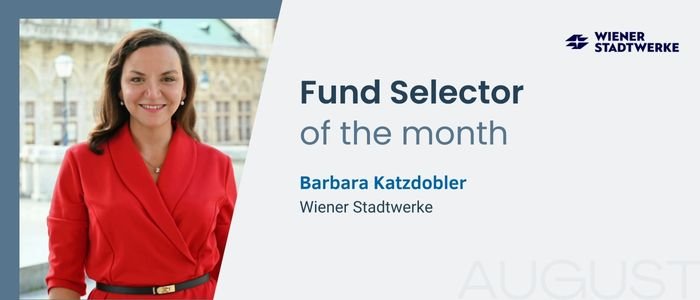
Barbara has built a profound career in the financial industry, beginning in private banking and later moving into portfolio management, where early exposure to manager selection sparked a lasting interest in fund analysis and portfolio construction. Over the years, she has developed a broad skillset in evaluating funds. Drawing on experience and guided by strong mentors, Barbara combines analytical rigor with persistence, curiosity, and long-term vision.
In her current role, she is Senior Treasury and Portfolio Manager at Wiener Stadtwerke, one of the largest infrastructure and utility companies in Austria, headquartered in Vienna. Prior to this position, she worked as a fund manager at an investment boutique, focusing on fund-of-fund management, manager selection, and the administration of discretionary mandates.
Barbara completed the program to become a certified stock trader and holds the designations of Certified Portfolio Manager (CPM) and Certified ESG Analyst (CESGA). She earned a Master of Science degree in Business Administration and is currently pursuing an MBA degree in Sustainable Leadership as well as doctoral studies in Innovation & Creativity Management.
Can you walk us through your experience in fund selection? When and how did you start your career in the financial industry?
I started my professional journey in the financial industry within private banking, where I initially worked in the trading department. This gave me a solid grounding in financial markets and operational processes. After relocating to Vienna, I applied for a position as a Junior Portfolio Manager, where I became responsible for managing discretionary accounts. It was in this role that I was first introduced to the fundamentals of manager selection, which provided valuable insights into how investment decisions are structured and implemented. Looking back, this experience not only shaped my understanding of portfolio construction but also sparked a lasting curiosity about manager selection, market dynamics, and broader investment trends.
Taking a brief look at your working life, what would you highlight about your professional career?
Looking back at my career, I would highlight the importance of having strong mentors. Having people who trust in your abilities and support your development is invaluable, especially early on. Equally, good leadership and role models play a vital role in shaping your mindset and encouraging professional growth. At the same time, I believe that inner ambition and persistence are just as crucial. Challenges are inevitable in this industry, and it is essential to maintain a healthy mindset, stay true to your values, and remain dedicated even during difficult periods. Hard work, deep commitment, and a clear sense of purpose are, in my view, the cornerstones of building a meaningful and sustainable career.
What aspects do you consider most important when selecting a fund for a portfolio? Which ratios and metrics do you value the most?
When selecting a fund for a portfolio, I believe it is never about relying on a single metric, but rather about balancing and interpreting a range of factors. Ratios such as the Sharpe ratio, Sortino ratio, Information ratio, and maximum drawdown are all relevant, yet what matters most is reflecting critically on these numbers and the environment in which they were generated. For instance, applying a risk-free rate during a zero-interest-rate environment can distort the Sharpe ratio and lead to misleading conclusions. Therefore, I place strong emphasis on consistency of returns, downside protection, and risk-adjusted performance, always within the broader market and economic context. Ultimately, a holistic view is essential to building resilient and well-constructed portfolios.
What mistakes are most frequently made in fund selection?
Many investors evaluate performance over very limited periods, which can lead to premature conclusions and hasty reallocations. Fund performance must always be assessed across a full market cycle to truly understand consistency and resilience. Another common pitfall is focusing too heavily on past returns without sufficiently analyzing risk factors, portfolio construction, or the manager’s investment philosophy. Overreliance on single ratios without considering the broader context can also be misleading. In my view, successful fund selection requires patience, discipline, and a long-term perspective that aligns with the overall objectives of the portfolio.
In your view, what are the biggest challenges asset managers face today in attracting investors?
One of the biggest challenges asset managers face today is differentiating themselves in a competitive market. Investors are demanding more transparency, not only in terms of performance and fees, but also regarding the investment process and the integration of ESG criteria. At the same time, higher interest rates have shifted the investment landscape: with attractive yields available in relatively low-risk assets, it has become harder for active managers to demonstrate clear added value. In addition, digitalization has raised client expectations around communication, reporting, and accessibility. To attract investors, asset managers must therefore combine strong performance with clarity, cost efficiency, and a convincing narrative.
How has the work of the fund selector changed in recent years? How do you think it will evolve in the coming years?
One major development has been the rapid rise of active ETFs, which are gaining traction and changing the competitive landscape between passive products and traditional active managers. At the same time, selectors must carefully evaluate where passive strategies are efficient and where active management can truly add value. Another important shift has been regulatory change, particularly regarding ESG. ESG is now being interpreted in a broader and more nuanced way, requiring deeper due diligence and a critical assessment of how managers integrate sustainability into their strategies. Overall, the role of the fund selector has become more complex, demanding broader expertise and greater adaptability. In addition, technological innovation, particularly in data analytics and AI, will become increasingly relevant in screening, monitoring, and comparing funds. Fund selectors will therefore need to combine analytical rigor with long-term vision, adaptability, and strong conviction.
What are key “soft” qualities in fund selection?
I would emphasize three key qualities: curiosity, discipline, and persistence. This role requires a genuine interest in markets, investment strategies, and the people behind them. At the same time, it demands rigorous analysis, attention to detail, and the ability to remain objective, even when market sentiment is strong in one direction. It is also a field where patience and long-term thinking are essential.
What key skills do you think the next generation of fund selectors will need to succeed?
The next generation of fund selectors will need to master both technology and market insight. Understanding complex environments — especially shifting interest rate regimes — will be essential for building resilient portfolios. At the same time, AI and advanced data analytics will become powerful tools in screening and comparing funds. Yet, human judgment remains key: the ability to interpret numbers in context and make thoughtful, long-term decisions will define success.