Edoardo Cozzani from ING is our Fund Selector of the Month

1 APR, 2026


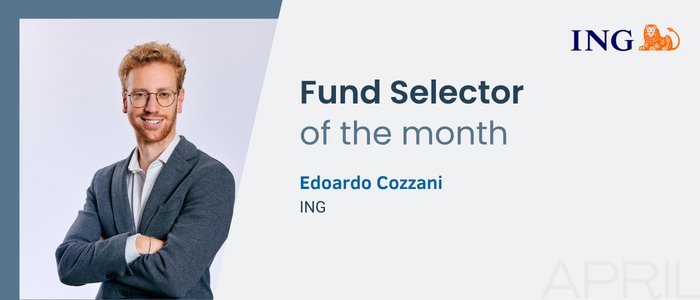
After finishing studies and completing an internship at Intesa San Paolo, Edoardo Cozzani started in January 2018 as a Sales Trainee in Personal Banking – ING is effectively his first employment. During this time, he gained extensive knowledge of the various functions within a branch. After 15 months, he had the opportunity to join the Product Management team, where he became responsible for communication around funds while also learning about the selection processes.
In 2021, the activities linked to funds – and Edoardo – were moved to what is now the Global Investment Centre of ING Group, supporting multiple countries (Belgium, the Netherlands, Germany, Italy, and Spain).
Since then, Edoardo has specialized in fund selection activities: identifying the best funds for ING Flagship funds and satellite offerings, monitoring performance, managing relationships with preferred partners, and developing new offering structures. He continues to be actively involved in content creation related to these activities and projects.
How did you get started in fund selection, and what attracted you to this area? Was there ever another career you considered?
I started my career in a bank branch, as a sales trainee. My goal was to learn the world of financial advice and become a Personal Banker. But I quickly noticed that I was not suited for this kind of function. I liked the technicalities, how the fund was managed, etc. Many things that weren’t very useful when advising and selling investment products to a retail client.
In 2019, I managed to meet the right people at the right time and ended up in the ING central teams managing the product offering. I started supporting the fund selection team, creating content and tools for the exact bankers I once supported as trainee. And a few years later (in 2021), I got promoted to the Fund Selection team inside the ING Investment Center.
This job offers a good balance between fund selection technicalities, project management to deliver the selections made (operational, stakeholder management, partnership management,…) and some content creation to support the commercial forces. These are things I still enjoy and keep me attracted to this world.
How different is the sector today compared to when you first started?
My career is probably not long enough to see or experience a metamorphosis of the sector, but what I can mention is definitely its granularity (and maybe also its complexity).
I experienced the arrival of “sustainable” funds (between 2018-2019), the appearance of “thematic” funds (2020-2021), now we talk more and more about active ETFs, ETPs (crypto,...) and the hot topic of the year 2025 were definitely the Private Markets resurgence.
The products universe feels certainly wider than when I first started.
Which performance indicators or financial metrics do you trust most when evaluating a fund’s potential?
There are more than a hundred quantitative metrics we assess and monitor on a monthly basis in our ING fund selection process (for both active and passive instruments). But if I had to choose one, I would probably opt for a consistency indicator such as the batting average. This metric (which can be relative or absolute) measures the manager’s ability to meet or beat an index and the number of investment decisions that actually contributed positively to that performance (profitable trades).
For me, predictability is always more important than just past performance alone.
How has your approach to fund selection evolved over time, and what key lessons have most influenced the way you work today?
The first lesson I learned is probably an obvious one, but as a young fund selector, it was certainly key: to understand how the quantitative metrics work before interpreting it.
At the beginning of my career, I was giving a big importance to the Morningstar rating for example. It was (and still is) a good comparison between funds of the same category. But when you deep-dive how it is calculated, how the rating for a single product can fluctuate depending on the shareclass, the costs, the historical weights, but also on qualitative factors like the philosophy of the product (ESG, thematic approach,…) a lot can change and more granularity is needed.
So, I really had to learn that granularity and integrate it in my selection process.
What advice would you give someone starting out in fund selection today?
Be curious (don’t be afraid to ask “stupid” questions when something is not clear), patient (the learning curve is long – I am still learning every day even after 7 years in product management / fund selection), and intellectually honest (stay honest in separating skill from luck – in managers and in yourself).
How much of your fund selection is driven by quantitative metrics versus qualitative judgment and intuition?
The quantitative part is the first step of our selection process. This is where we are going to build our shortlist of candidates. We then deep-dive both quantitatively and qualitatively. So, after this screening, it’s fifty-fifty.
As said previously, there are other things out there then past performance or risk metrics. Funds’ philosophy and processes can change over time. It is important to have a deep understanding of the product, both quantitatively but also qualitatively.
Where do you currently see the most interesting opportunities in the market, and why?
There are many interesting opportunities in the market today:
- the development of the active ETFs instruments that we are using more and more in our ING Flagship solutions,
- at ING, we started commercializing private markets funds (also in the new ELTIF format), cryptos ETNs,...
- last year, we saw also a lot of appetite of more prudent clients for fixed maturity products and funds offering capital protection,...
The number of tools and products clients might request has increased a lot recently. But at the end of the day, the place where we see the most inflows (which are the most representative data about clients’ demands) are, in fully tailor-made diversified multi-asset solutions: funds might sometimes look un-appealing or “only for boomers”, but at the end of the day, if managed in a professional way for a client, they should always represent the basis of that client’s portfolio.
What do you enjoy doing in your free time, and do the markets ever really leave your mind?
Markets actually do leave my mind. Otherwise, one would become crazy at some point.
Markets do leave my mind when I’m either on the football pitch, a padel course or on the golf course (especially when I focus to fix my slice)... I believe it is important to disconnect: when you selected good funds, you just need to let the markets do the rest of the job.