Eduardo Monteiro from BPI Gestão da Ativos is our Fund Selector of the Month

16 JUL, 2025
By Jose Luis Palmer from RankiaPro Europe


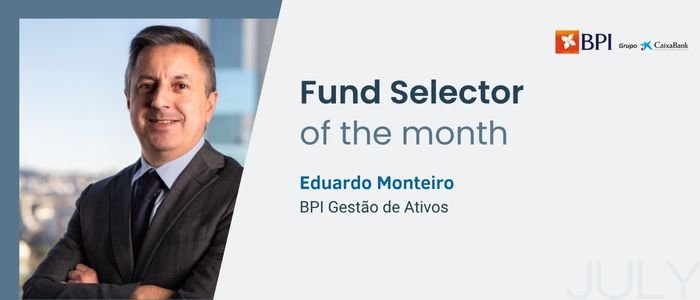
Eduardo Monteiro serves as an executive member of the BPI Gestão de Ativos directors committee. His primary responsibility lies within the Wealth Division at BPI Gestão de Ativos, overseeing portfolios close to 4 billion euros. With over two decades of experience at BPI, Eduardo has consistently contributed to the organization’s success through his expertise in asset allocation.
His key responsibilities include designing and implementing Asset Allocation Models to optimize portfolio efficiency and select the best vehicles to execute the strategy. Eduardo is also deeply involved in leveraging Data Science tools to enhance asset allocation strategies.
Eduardo holds a master’s degree in economics and has completed a postgraduate program in Finance at the Faculdade de Economia do Porto. Recently, he achieved the CESGA certification, a prestigious professional qualification offered by EFFAS. Eduardo’s skill set includes proficiency in Python, VBA, and various data analysis and visualization tools. He applies these skills to develop Machine Learning algorithms within the wealth division team, driving data-driven insights and strategic decision-making.
Can you walk us through your experience in fund selection? When and how did you start your career in the financial industry?
I began my career in financial markets in 2000 as a financial analyst, covering consumer-related sectors such as discretionary goods, luxury brands, and tobacco companies. Over time, my focus shifted toward developing models for asset allocation and risk management, which naturally evolved into a specialization in fund selection with a strong quantitative foundation.
Today, our investment process combines rigorous quantitative analysis with a structured qualitative scorecard to support informed and consistent decision-making. Being part of the CaixaBank Group—particularly with the collaboration of the Risk Department and the Third-Party Fund Selection team—has significantly strengthened our analytical depth and operational reach.
Taking a brief look at your working life, what would you highlight about your professional career?
Throughout my career, one of the most rewarding aspects has been the opportunity to grow within BPI Gestão de Ativos, where I currently serve as an executive member of the Directors Committee.
What truly drives me in this industry is the privilege of cultivating a globally integrated perspective—systematically analyzing the forces that shape the world around us and drawing lessons from them every day. This continuous cycle of observation, reflection, and learning not only sharpens my understanding but also strengthens my effectiveness as an investment professional.
A particularly fulfilling part of this journey has been bridging traditional investment expertise with cutting-edge data science. By incorporating quantitative methods and machine learning into our asset allocation framework, we’ve been able to enhance both the depth and agility of our decision-making process.
Ultimately, what defines my professional path is a deep intellectual curiosity, a commitment to lifelong learning, and a constant focus on translating insights into meaningful value for our clients.
What aspects do you consider most important when selecting a fund for a portfolio? Which ratios and metrics do you value the most?
When selecting a fund for inclusion in a portfolio, our primary focus is on risk-adjusted performance. We believe that achieving consistent returns while actively managing downside risk is fundamental to long-term investment success. As such, we place strong emphasis not only on how a fund performs, but also on how it behaves across different market environments.
Key metrics in our evaluation include the Information Ratio and Sharpe Ratio, which help us determine whether the fund is generating excess returns relative to the level of risk assumed. Beyond these, we pay close attention to indicators such as Maximum Drawdown and the Number of Months Required to Recover from drawdowns or periods of underperformance. These metrics are especially critical when assessing absolute return strategies, where capital preservation is central, as opposed to long-only strategies, where relative performance is more relevant.
In addition to the quantitative dimension, we incorporate qualitative criteria—such as the stability and structure of the investment team, the consistency of the investment philosophy, and the alignment of interests between managers and investors.
Ultimately, our fund selection process is anchored in a disciplined, risk-conscious framework designed to prioritize resilience, adaptability, and long-term value creation.
What is the current asset allocation of your model portfolios? How should investors navigate current market uncertainty?
Our current asset allocation reflects a cautious but balanced approach to market uncertainty. We are underweight U.S. equities and the U.S. dollar, while maintaining a neutral overall equity exposure, with a preference for equities outside the U.S.. On the fixed income side, we are slightly overweight duration, reflecting our view that bonds can serve as effective diversifiers in risk-off environments.
Despite ongoing market volatility—driven by geopolitical tensions, policy uncertainty in the U.S., and inflation fluctuations—we maintain a constructive long-term view on equities. Historically, equities have proven resilient and rewarding over time, and we believe this trend is likely to persist, especially outside the most crowded markets.
Lower energy prices are helping to offset the impact of tariffs and other inflationary pressures. If the current disinflationary trend continues, as we expect, bonds should perform well, particularly in periods of heightened volatility or economic slowdown.
In this environment, we believe investors should remain diversified, focus on quality assets, and avoid making abrupt shifts based on short-term noise. A disciplined, risk-aware allocation—supported by robust scenario analysis and stress testing—remains the best way to navigate uncertainty.
What mistakes are most frequently made in fund selection?
One of the most common mistakes in fund selection is overemphasizing short-term performance. Investors often chase recent winners without fully understanding the underlying drivers of performance or whether those results are sustainable. This can lead to poor timing decisions and increased portfolio turnover, which may erode long-term returns.
Another frequent error is insufficient attention to risk-adjusted metrics. Focusing solely on absolute returns without considering volatility, drawdowns, or consistency can result in selecting funds that look attractive on the surface but carry hidden risks. That’s why we prioritize indicators like the Information Ratio, Sharpe Ratio, Maximum Drawdown, and Recovery Time—they provide a more complete picture of a fund’s resilience and efficiency.
A third pitfall is neglecting qualitative factors. Even the best quantitative metrics can be misleading if the investment team lacks stability, the process is not repeatable, or there are governance issues. Understanding the people, philosophy, and culture behind the fund is essential to avoid surprises.
Lastly, lack of process discipline can undermine fund selection. Decisions driven by personal bias, market noise, or pressure to act quickly often lead to suboptimal outcomes. A robust, repeatable, and transparent selection framework—grounded in both data and judgment—is key to long-term success.
Which assets do you think will outperform and which are likely to suffer the most during 2025?
In 2025, we expect non-U.S. equities, particularly in Europe and Japan, to outperform. These markets are benefiting from attractive valuations, improving corporate fundamentals, and structural reforms—especially in Japan, where governance changes are unlocking shareholder value. Additionally, emerging markets may gain traction, supported by a weaker U.S. dollar and stabilizing inflation dynamics.
On the fixed income side, we see duration bonds as attractive, especially in Europe, where central banks are entering a rate-cutting cycle amid subdued growth. If disinflation persists, as we anticipate, bonds should act as effective diversifiers in risk-off scenarios, particularly given the current volatility in geopolitical and policy environments.
Conversely, U.S. equities—especially large-cap growth stocks—may face headwinds due to stretched valuations and policy uncertainty under the new U.S. administration. We are currently underweight in this segment.
Overall, we believe that maintaining a diversified, risk-aware allocation—favoring regions and asset classes with stronger relative value and policy tailwinds—will be key to navigating the uncertainties of 2025.
How has the work of the fund selector changed in recent years? How do you think it will evolve in the coming years?
In recent years, the role of the fund selector has become significantly more complex and multidimensional. What was once a role focused primarily on performance analysis and manager meetings has evolved into a discipline that requires deep quantitative skills, regulatory awareness, and ESG integration. The explosion of data availability and the increasing sophistication of investment products have pushed selectors to adopt more structured, data-driven approaches, often incorporating tools from data science and machine learning to enhance decision-making.
Another major shift has been the growing importance of sustainability and transparency. ESG considerations are no longer optional—they are now central to the due diligence process. Fund selectors must evaluate not only financial performance but also how managers integrate ESG into their investment process, how they report on it, and how aligned they are with evolving regulatory standards.
Looking ahead, we believe the role will continue to evolve toward greater technological integration and automation, especially in screening and monitoring tasks. However, the human element—judgment, experience, and qualitative insight—will remain irreplaceable, particularly when assessing investment culture, governance, and long-term alignment.
Ultimately, the fund selector of the future will need to be a hybrid professional: part analyst, part technologist, part strategist—capable of navigating complexity, embracing innovation, and maintaining a strong investment compass in a rapidly changing world.
What qualities do you believe make an exceptional fund selector stand out?
An exceptional fund selector stands out by combining technical expertise, strategic thinking, and strong interpersonal skills. At the core, they must have a deep understanding of both quantitative and qualitative analysis, allowing them to assess not only performance and risk metrics, but also the consistency of investment processes, team dynamics, and governance structures.
What truly differentiates top selectors is their intellectual curiosity and open-mindedness. Markets evolve rapidly, and so do investment strategies—being willing to explore new ideas, question assumptions, and continuously learn is essential. This includes staying up to date with innovations such as AI-driven strategies, ESG integration, and alternative data sources.
Another key quality is discipline. Exceptional selectors follow a robust, repeatable process and avoid being swayed by short-term noise or market sentiment. They understand that fund selection is a long-term endeavor and that patience is often rewarded.
Finally, communication and collaboration are critical. The ability to clearly articulate investment rationales, challenge fund managers constructively, and work effectively within a team environment ensures that decisions are well-informed and aligned with broader portfolio objectives.
What do you like to do in your free time?
In my free time, I deeply value the moments shared with family and friends—they provide balance, perspective, and a grounding presence amidst the pace of professional life.
Travel is another passion of mine. Exploring new cultures not only broadens my worldview but often offers fresh perspectives that influence how I think about markets, behaviors, and global dynamics.
I also have a strong appreciation for wine tasting, which I see as a unique blend of culture, history, and sensory exploration. Much like fund selection, it demands curiosity, discernment, and a keen attention to detail.
Staying active is a priority, and I make it a point to go to the gym regularly. It’s a vital way for me to maintain both physical and mental well-being—especially important in a field that requires sustained focus and resilience.
And of course, I’m an avid football fan. Whether it’s watching a game or debating tactics with friends, it’s a great way to unwind and connect through a shared passion.