Gonçalo Ormonde from Banco Invest is our Fund Selector of the Month

25 NOV, 2026
By Joanna Piwko from RankiaPro Europe


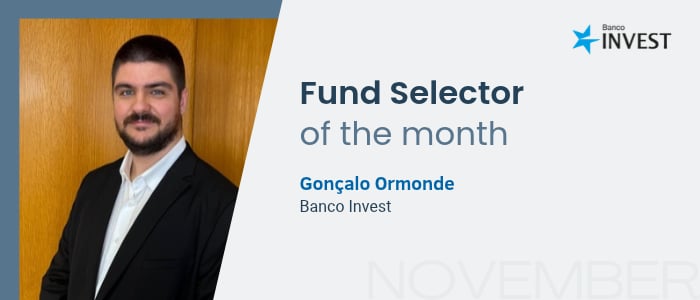
Gonçalo Ormonde was born in the Azores (Terceira Island). He holds a Bachelor’s degree in Finance and Accounting and a Master’s degree in Finance, both from ISCTE Business School.
His career in financial markets began at Millennium BCP, where he worked on the Rates/Govies desk and later on the Credit Sales desk. He then moved into Asset Management at Banco Invest S.A., where he had the opportunity to join the Discretionary Management team. Shortly afterwards, he also took responsibility for the bank’s third-party offering (i.e. fund selection).
What first attracted you to the investment industry, and how did your path eventually lead you into fund selection?
My academic background is in Finance. My working experience started within the financial markets, in a trading floor, on the Sell side of individual securities such as government bonds and corporate bonds. There, I worked closely with institutional investors and asset managers. That experience helped me understand investor needs and market dynamics. It made me increasingly curious about the investment and asset allocation decisions taking place on the other side of the table (i.e. the Buy side). And so, the interest in asset management emerged quite naturally, as it combines quantitative/qualitative rigor with strategic thinking. When it comes to fund selection, it attracted me the clear fund selection’s intersection of (1) markets, (2) research, and (3) portfolio construction. In resume, evaluating different investment styles, understanding how managers make decisions, and identifying which strategies are most likely to deliver strong risk-adjusted returns over the long term.
Looking back on your career so far, which experiences or milestones have had the greatest impact on your development as an investor?
Being invested. Having capital at risk teaches lessons that theory alone cannot. It has strengthened my understanding of risk, conviction, and long-term thinking, while giving me a better perspective on what investors truly value when selecting funds, strategies and respective portfolio managers.
When evaluating a fund, what are the key characteristics you focus on, and how do quantitative measures complement your assessment?
Consistency. That is the key measure I take into consideration. For that purpose, track record is crucial. It is important to see whether a fund manager, and respective strategy, works in different market cycles, conditions and sentiments. Having continuous communication with the management team is a must. On the quantitative side, I use a model that gives me a score based on a combination of a number of metrics namely volatility, drawdowns and sharpe ratios.
What are some common pitfalls investors should avoid when choosing investment funds?
Financial literacy, with time, will help but the truth is that I could name an infinite number of pitfalls when choosing investment funds. Currently, in my opinion, the key pitfalls are (1) chasing past performances, (2) overlooking style drift, (3) ignoring team changes, (4) focusing only on volatility and not drawdowns, concentration, or liquidity, (5) not understanding the benchmark or the asset class and (6) owning overlapping funds. Bottom-line, I believe investors should focus less on recent returns and more on the process, risk, and how the fund fits the investor’s overall portfolio.
In your view, what skills, traits, or habits distinguish the most successful fund selectors from the rest?
The best fund selectors combine curiosity, discipline and humbleness. They are able to look beyond short-term performance, ask the right questions, and stay open-minded enough to challenge their own investment views. In the end, consistency in the process matters most.
As you look ahead, where do you see the most attractive opportunities across asset classes, and which areas appear more vulnerable?
Regarding Fixed Income, assuming, as discounted in the markets, a future normalization of inflation to levels closer to the central banks' target (2%), and the maintenance of relatively low real economic growth rates, we identify value in Govies, especially in the Eurozone in countries like the Netherlands and Germany. On the credit side, we continue to favour the Investment Grade segment over High Yield. In both segments, credit spreads have remained low for the past couple of years and so, in our opinion, there is lack of potential for continued compression. In our house view (i.e. Banco Invest S.A.), a further correction in equity markets will have a greater (negative) impact on High Yield, as a result of the increase in credit spreads. Alternatively, in order to boost the portfolios yields, within the Investment Grade universe, we selectively maintain exposure to Hybrid and Subordinated debt as an alternative to High Yield.
When it comes to Equity, we are cautious and selective. The main stock markets seem to us, at most, properly valued and without significant upside beyond future earnings growth. Likewise, they seem vulnerable to any disappointment in future forecasts, especially for companies related to the AI Trade (e.g. semiconductors, chips and memories), whose weight has become quite sizable in the main global benchmarks. Sectorally, we maintain a diversified exposure to the AI theme (including some hyperscalers, semiconductor production equipment, and software) with the combination of low beta sectors such as Infrastructure/Utilities, Healthcare, and medical equipment.
The fund selection landscape has evolved significantly over the past decade. What changes have had the biggest impact on your role, and what developments do you expect to shape the profession going forward?
Drawing on my experience, the biggest changes have been the amount of data and products available today. Those have made fund selection more analytical and demanding. Looking ahead, I expect technology/AI to play a larger role in screening and monitoring, while the real differentiator will remain sound judgement and strong manager due diligence.
How would you describe the markets in 2026 so far in one word?
Recalibration. Investors are balancing the enormous optimism around AI with the inflationary pressures and uncertainty coming from the Middle East conflict, which has made markets daily reassessing their assumptions.
Outside of the markets, how do you spend your time, and what interests help you switch off from work?
I started, when I was 9 years old, playing French Horn and currently I play with a Symphonic Orchestra in Lisbon. Additionally, I practice kickboxing and love to spend hours-and-hours watching football from the main European leagues.