Jade Weill from Rothschild & Co AM is our Fund Selector of the Month

21 OCT, 2026
By Joanna Piwko from RankiaPro Europe


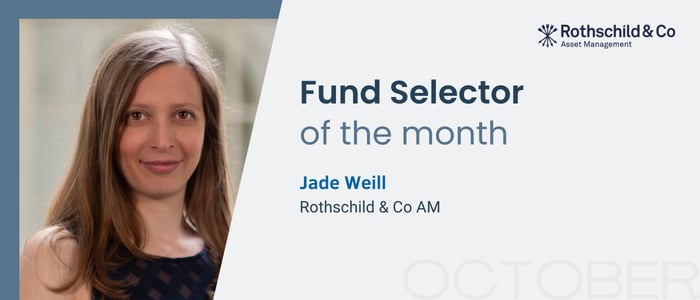
Jade Weill joined HDF Finance (now Rothschild & Co Asset Management) as an Analyst in 2011, specializing in fixed income, credit and global macro strategies. Since 2014, she has been responsible for managing the company’s relationship with private banking and has covered various alternative, long-only and private strategies. Jade holds an MSc in management from EM Lyon Business School and a Master’s degree in Asset Management from Université Paris IX Dauphine. She is a CFA and CAIA charterholder.
Would you mind sharing a bit about your experience with fund selection? What initially drew you to this sector? What did surprise you?
I entered the industry almost by chance, through internships in the fund-of-hedge-funds team at Omega Capital, a Spanish family office. It was an intense period to learn the craft: I started in July 2008, in the middle of the Global Financial Crisis, and returned again in July 2009. Seeing markets under stress early on was a great training ground and convinced me to pursue fund selection when I finished my studies. What surprised me most was how broad the range of approaches can be, even among managers investing in the same universe. That diversity is also what makes fund selection so interesting.
What were the biggest challenges you faced early in your career, and how did you overcome them?
I began as a hedge fund analyst at HDF Finance, a boutique that was acquired by Rothschild & Co shortly after I joined. In France, the fund-of-hedge-funds business faced strong headwinds after the Great Financial Crisis. I was fortunate to be part of a solid group where I could broaden my remit over time, moving from pure hedge fund analysis to a wider fund selection role. Today I cover long-only strategies, alternative UCITS and select liquid private strategies, so the main challenge became an opportunity to diversify my expertise.
How has your selection framework adapted to changing market conditions, such as volatility or macro uncertainty?
Our selection approach remains consistent, but our monitoring becomes more focused when market conditions change. In particular, we pay close attention to the consistency of the manager’s style: in more volatile or uncertain environments, it is essential to assess whether the manager remains disciplined and true to the stated process, or whether the market backdrop is leading to style drift. Continuous dialogue with portfolio managers is therefore key, and that dialogue can increase in frequency when needed, to ensure we understand positioning, risk-taking and any evolution in the way the strategy is being implemented.
When evaluating a fund, how do you balance short-term performance with long-term potential?
We take a long-term view and accept that performance is never linear. The key is to understand why a fund is performing the way it is and whether the outcome is consistent with the strategy. Long-term potential is assessed primarily through due diligence, while short-term performance is evaluated through ongoing monitoring. If underperformance is explainable, within the expected behavior of the style, and the manager remains disciplined within stated risk limits, we can stay supportive. Conversely, if returns are hard to reconcile with the process—because of unexplained losses, active risk-limit breaches, or style drift—then short-term results become a warning signal, regardless of the long-term story.
Could you tell me the most difficult aspects of your job and also the most positive ones?
The best part of the job is its variety: I meet talented and passionate portfolio managers, and I get to analyze a broad range of approaches across geographies, long-only and alternative strategies. There is always something new to learn, which makes the role both stimulating and rewarding. The challenge is keeping pace with markets, regulation and financial innovation—but that is also what makes the role so engaging.
How do you distinguish between luck and skill when evaluating a fund or manager performance?
We look for evidence of repeatability, a proven investment process and a stable and experienced team. First, we require a sufficiently long and relevant track record, ideally across different market environments. Then we decompose returns to identify the true drivers: for example, a bottom-up manager should generate most value through security selection rather than unintended factor or allocation bets. Finally, we cross-check the numbers against qualitative evidence: discussions with the manager and team, portfolio construction discipline, and consistency between stated process and realized outcomes.
What advice would you give someone starting out in fund selection today?
Focus on building a strong foundation of knowledge about asset classes. Be adaptable and stay curious; never hesitate to ask questions until you fully understand the answers. It is also important to know financial history well: understanding past crises, market regimes and cycles gives perspective and puts current developments into context. Meet and engage with managers to understand their strategies and implementations. Even if certain areas aren't in demand right now, knowing your universe well prepares you for future opportunities. Finally, develop relationships within the industry and listen carefully; comparing managers’ perspectives often yields valuable insights.
What type of funds or strategies are you watching most closely for the next 12–24 months?
I am watching alternative strategies particularly closely. After years of abundant liquidity and low rates, dispersion and volatility have returned, which can create a more favorable opportunity set for alternative strategies.
What is your favorite thing to do when you disconnect from the markets?
Spend time with my family.