Hans-Christian Moritz from Munich Private Equity Partners is our Fund Selector of the Month

5 MAR, 2025
By Jose Luis Palmer from RankiaPro Europe


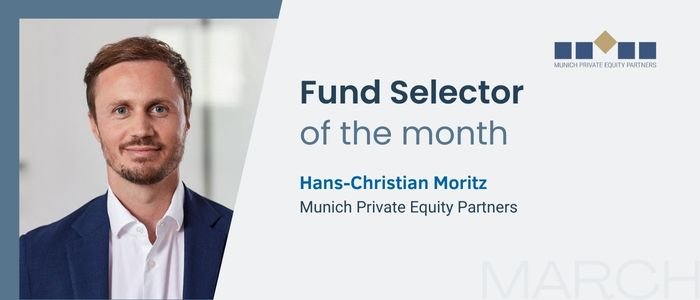
Hans-Christian Moritz is Managing Director at Munich Private Equity Partners, where he oversees the investment advisory including due diligence on target funds. He previously already worked for MPEP from 2014 to 2018, leading private equity fund investments in North America and being part of several advisory boards of private equity funds. Prior to re-joining the company in 2021, he was Director for buyouts and co-investments at Golding Capital Partners. Christian started his career by spending five years leading infrastructure investments in photovoltaic plants across Europe at a renewable energy investment manager. He holds a Master’s degree in Business Administration (“Diplom-Kaufmann”) from Ludwig-Maximilians-University in Munich.
Can you walk us through your experience in fund selection? When and how did you start your career in the financial industry?
I started my career in 2009, leading direct infrastructure investments in larger ground photovoltaic plants at a renewable energy investment firm. In 2014, I transitioned to private equity fund investments by joining MPEP, where I initially focused on the North American market. After almost three years focusing on Europe at another Munich-based fund of funds, I rejoined MPEP in 2021 as a Managing Director. In this role, I now oversee fund investments in both regions.
Taking a brief look at your working life, what would you highlight about your professional career?
I did a lot of sports during my youth and university years, and I feel like I always applied a similar competitive approach to my professional career. You have to work hard and you cannot expect to be good at anything if you don’t put in the effort. That being said, I’m grateful to have met and worked with people that believed in me, giving me opportunities to prove myself and thrive. I feel fortunate to have found a place where I can pursue a strategy I’m passionate about, alongside amazing colleagues I deeply respect and trust.
What aspects do you consider most important when selecting a fund for a portfolio? Which ratios and metrics do you value the most?
While even absolute pooled returns are high in private equity, the difference between median and top quartile returns is really significant. This is why we generally take a bottom-up approach, focusing on manager quality first. On the selection itself, it comes down to team, strategy and track record. You cannot look at any of those aspects in isolation. A differentiated strategy must translate into outperformance, and we won’t invest in a manager with a historically strong track record unless we can identify the replicable and sustainable differentiation driving their success. This is especially crucial as there is typically the challenge of small sample sizes, which make it difficult, if not impossible, to draw statistically relevant conclusions. Last but not least, it’s about the people. We invest in blind pools, which requires a team that is not only trustworthy but also capable and properly incentivized to consistently execute the strategy they have been successful with in the past.
What is the current asset allocation of your model portfolios? How should investors navigate current market uncertainty?
We are an absolute specialist for lower mid-market buyout fund investments, focusing on a single product in one asset class. Hence, we provide investors with exposure to one of the most attractive segments in its purest forms. Our investors typically decide based on factors such as risk appetite, asset liabilities, and time horizons which private equity allocation is right for them. That being said, we believe that a focus on differentiated strategies with a proven track record in creating sustainable competitive advantages, coupled with diversification, provides a solid foundation to navigate uncertainties.
What mistakes are most frequently made in fund selection?
Investors should make sure to consistently invest in the asset class, as exposure is built up gradually given the underlying cash flow profile. Also, vintages can vary in terms of performance, so trying to timing the cycles in private markets can be at least very challenging. Relying on past performance alone can also be dangerous, as returns are mainly driven by people, and people may change over time. They also tend to leave the size segments where they have excelled in the past as they scale organizations and grow assets under management.
Looking ahead to 2025, which assets do you think will outperform and which are likely to suffer the most?
Again, we refrain from predicting which sectors might outperform in the short-term. In private equity, returns tend to be surprisingly similar across sectors, with the real difference coming from top quartile vs. median or even bottom quartile, as well as the size segment. Hence, we believe that maintaining a focused approach – targeting only the very best managers in the lower mid-market, without any other agendas or conflicts of interest – provides a good chance for long-term outperformance, regardless of short-term market trends.
How has the work of the fund selector changed in recent years? How do you think it will evolve in the coming?
The core principles are still the same. However, there are two things I would highlight. First, it has become more important to focus on what differentiation and models drive outperformance in an increasingly competitive market. Just providing capital is no longer sufficient in most markets. You have to be able to convince the entrepreneurs of the most attractive assets that you are the right partner and actively support your portfolio companies in creating value. Second, it has become more challenging to read and interpret track records. Comparing a fund to a benchmark may not be sufficient anymore – or can even be misleading – since portfolios may have been significantly affected by unfortunate end-market exposure in recent years. This makes it harder to draw conclusions about investment acumen or the ability to support the growth of portfolio companies. In this context, GPs seem to have learnt more lessons about portfolio construction recently than in the past.
If you could only ask the fund manager one question what would it be?
How do you measure business success.
What do you like to do in your free time?
As a father of two daughters, aged 4 and 10, and someone who is passionate about his job, it can sometimes be challenging to pursue time consuming hobbies. Aside from my family, I would say that my passions revolve around sports (active and passive) and good food. Rest assured that my New Year’s resolutions also typically center around those two areas.