Laurent Stöckli from Quaero Capital is our Fund Manager of the Month

8 JUL, 2026
By Joanna Piwko from RankiaPro Europe


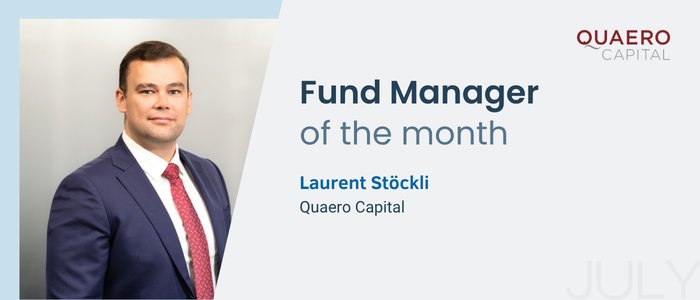
Laurent Stöckli joined Quaero Capital SA in August 2017. He is co-manager of Quaero Capital's small-cap strategies.
He started his career working for a Swiss-based Hedge fund as research analyst and then Portfolio manager. Several years later, he joined the international family office, Stanhope Capital, with responsibility for the portfolio management in Geneva for Ultra High Net Worth Individual clients.
Laurent holds a Bachelor in Business Administration from the University of Applied Sciences Western Switzerland.
Every investor has a different path into the industry. What was yours, and what have been the key turning points along the way?
I was lucky to grow up surrounded by markets. Investing ran in my family, and I started investing in equities myself as a teenager. As a university student in Geneva, I was frankly more interested in working on real positions at a hedge fund than in attending classes, which I caught up on at weekends. For years, I ran an anonymous blog where I published differentiated analysis on under-followed situations — that is how I learned to stand apart. The turning point came through that blog: while managing portfolios for a multi-family office, I met Philip Best (founder of Quaero Capital), who handed me his business card without knowing I was the author he had been reading. That encounter eventually led me to leave an excellent team for a new adventure 10 years ago. Taking that risk shaped everything that followed.
Has your view of investing changed since you first entered the industry? If so, how?
I learned very quickly that cognitive biases are expensive. You cannot eliminate them — that is impossible — but you can build processes that limit their impact, and that conviction now sits at the centre of how I work. As a value investor, for instance, I follow a defined methodology to contain the damage from value traps, and I have explicit rules to counter the very human tendency to hold losers far too long. Much of what I have implemented in my role at Quaero exists precisely to discipline those instincts. The second thing I learned is less technical but just as decisive: success starts with having the right investors. Without a base that understands the strategy and its risks, the job becomes very difficult.
How do you structure your day to balance research, portfolio management, and the constant flow of market information?
I believe strongly in time on task: the more time you devote to something, the better you become at it. As the golf legend Gary Player put it, "the harder I practice, the luckier I get."
That is why I arrive early, before the calls and emails start, and protect that window for reading and deep work — several newspapers and the markets. Around nine, I watch the open and assess how the news is affecting my companies, their competitors and my watchlist. Mornings usually include a few calls with analysts or sector experts. Afternoons are, again, largely deep work. New tools such as AI are emerging that optimise time-consuming tasks, freeing up time for what truly matters: reflection and decision-making. Judgment remains the scarce resource. I generally work until seven, then switch off until the next day. The structure is deliberate: I want quality, uninterrupted thinking to be the default, not the exception.
Which market episode tested your investment process the most, and what did you learn from it?
The major stress episodes I lived through as an investor — 2008, then COVID in 2020 — taught me the same lesson. In a strong sell-off, when everything is falling hard, it is generally neither necessary nor wise to churn the portfolio. The real skill is holding your positions and resisting the urge to overreact, because reacting too strongly is usually counter-productive. And yet these crises do occasionally open opportunities, so you cannot simply freeze either. The whole difficulty lies in that balance: not overreacting, while staying lucid enough to seize the rare real opportunity when it appears. That tension is, to me, why investing is an art rather than a science. No formula resolves it for you — judgment and temperament do.
What helps you distinguish a genuine trend from a temporary market reaction?
It is a hard question. The market tends to get excited about themes, and momentum then becomes a powerful force in its own right. My anchor is to stay focused on company fundamentals and valuation. In the ideal case, I buy a quality business when it is cheap and almost nobody wants it; then the equity story improves, buying interest arrives and lifts the stock, and because it is quality, I am happy to let the momentum and growth investors carry it from there.
The discipline works in the other direction too: I have rules to cut relative underperformers, which counter our natural bias to let losers run too long. Occasionally you have to take off the rational-investor hat and simply cut the dogs. A portfolio clean-up is necessary.
What aspects of the Swiss investment culture do you think set it apart from other financial centers?
I would start with humility: there is extraordinary talent in other centres, and I have been impressed by the quality of the investors I have met in Paris, London and elsewhere
Geneva's edge, for me, is distance from the noise of those larger places. That distance fosters a long-term perspective, which is reinforced here by the quality of our investors at Quaero Capital. I would like to take this opportunity to thank them for their trust and their patience — they are a large part of why this approach works.
By the way, one of my dreams would be to contribute meaningfully to the growth of asset management in Geneva. It is a remarkable place to live, at the centre of the continent, which makes travelling to meet companies and clients easy.
What aspect of your job still excites you after all these years?
Honestly, I love every part of it: generating ideas, the analysis, managing the portfolio and its risks, and explaining that passion to investors and prospects. I particularly enjoy meeting companies and visiting their production sites — it is enriching both in terms of competence and on a purely human level. Our profession is a permanent apprenticeship, not only about the market but about yourself. You have to keep progressing and be willing to question your own conclusions. That is what keeps it alive after all these years: the line between holding conviction and remaining humble is a very fine one, and learning to walk it is never finished.
What's a piece of career advice you wish someone had given you earlier?
Try different experiences early on. They are how you discover what you actually want — and, just as importantly, what you do not want. Beyond that, look for a boutique that is willing to invest in you and believes in you enough to hand you real responsibility; that environment matters more than almost anything on paper. I was fortunate in my own path to come across remarkable mentors who, with real generosity, helped me grow as an investor and as a person. You cannot manufacture that kind of luck, but you can put yourself in the places where it is more likely to happen — and you can be the kind of person worth investing in when someone is willing to take the bet.
Outside of the markets, how do you spend your time, and what interests help you switch off from work?
I have very little free time, in all honesty. I am fortunate to have a wonderful wife who understands my passion and supports it. I also have two children, who have done a great deal to improve my patience. The little free time I have, I devote to golf, which is an incredible school for learning about yourself and managing your emotions.
And this profession would simply not be possible if I did not love reading widely, across as many different subjects as I can, and travelling with an open mind to understand other cultures. That openness to the world beyond finance is not a distraction from the job — it is part of what makes me better at it.