Louis Abreu from Dorval Asset Management is our Fund Selector of the Month

18 JUN, 2025
By Jose Luis Palmer from RankiaPro Europe


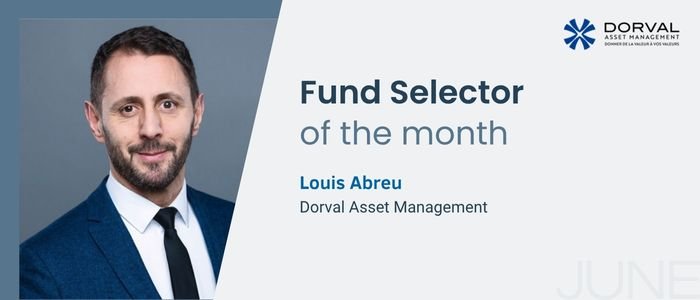
Louis has over 30 years of experience in Asset Management, with a diverse background that spans both operational and investment roles. He began his career in finance as Head of UCITS Accounting at OBC Bank. Two years later, he transitioned to the diversified management team at OBC Gestion (ABN Amro Group). In 2000, he founded the Risk Analysis and Performance department, where he focused on portfolio optimization for collective investment schemes.
He then joined Banque Neuflize OBC, where he was responsible for fund selection and financial product analysis. In 2007, Louis took on the role of Head of Diversified Management at Montpensier Finance, where he broadened his expertise by managing a range of diversified and flexible funds.
In 2018, he joined Dorval AM as Director of Private Banking Multimanagement. In this role, he is responsible for selecting top-performing fund managers, identifying emerging talent, and providing asset allocation and investment recommendations to the private banking team.
Can you walk us through your experience in fund selection? When and how did you start your career in the financial industry?
I began my career in the financial industry nearly 30 years ago – hard to believe it’s been that long! Over the years, I’ve held various roles, starting in support functions, then moving into risk analysis, assistant portfolio management, diversified management, and private banking.
My experience in fund selection began over 20 years ago when I joined the marketing department at Banque OBC. There, I was responsible for selecting financial products for the private banking division. Later, I helped expand the multi-management offering within the discretionary portfolio management division at Neuflize-OBC.
I then spent 11 years at Montpensier Finance, where I served as Head of Diversified Management and Multi-Management. Since 2018, I’ve been with Dorval AM, where I serve as Head of Multi-Management for Private Banking.
Taking a brief look at your working life, what would you highlight about your professional career?
What stands out most to me are the major shifts and shocks in financial markets, the evolution of regulation, the rise of new technologies, and the growing importance of ESG and AI.
But above all, it’s the people I’ve met along the way – the passionate and inspiring professionals – that have made the journey so rewarding. This is a constantly evolving field, full of challenges and surprises.
What aspects do you consider most important when selecting a fund for a portfolio? Which ratios and metrics do you value the most?
The most important thing is alignment between what is promised and how the fund is actually managed. I place high importance on adherence to the investment process, team stability, and above all, transparency.
Every investment style goes through cycles – no manager can outperform all the time – but being open and consistent is key. I also look for performance regularity and track metrics like Sharpe ratio, tracking error, and alpha, always within the broader context of the strategy.
What is the current asset allocation of your model portfolios? How should investors navigate current market uncertainty?
We’re not even halfway through the year, and markets have already been quite eventful. In this more uncertain environment – likely marked by more frequent volatility spikes – our portfolio is positioned close to neutral in terms of risk assets.
We favor European equities, supported by more accommodative monetary policy, infrastructure and defense spending plans, and attractive valuations.
We are underweight U.S. equities due to greater growth and inflation risks but maintain exposure given their global leadership, particularly in AI.
On the fixed income side, we prefer short-term corporate bonds, which still offer appealing yields.
In such an uncertain landscape, diversification remains essential, and maintaining some liquidity allows us to seize opportunities during periods of high volatility.
What mistakes are most frequently made in fund selection?
Relying too heavily on past performance is one of the most frequent errors. Investment styles are not universally suited to all market cycles.
It’s also a mistake to overlook the actual composition of the fund and the manager’s ability to adapt – and consistently deliver – in changing environments.
Which assets do you think will outperform and which are likely to suffer the most during 2025?
With the return of Donald Trump, markets are facing heightened uncertainty, and investors will likely have to contend with increased volatility.
That said, equities still have potential this year, supported by solid fundamentals. European stocks, particularly in the defense and infrastructure sectors, stand to benefit from EU stimulus plans, as do European banks.
We may also see a comeback for small and mid-cap European stocks, as they are more domestically focused and less exposed to global trade tensions.
Despite the correction earlier this year, tech and AI-related sectors should continue to perform well due to sustained demand.
We remain cautious on sectors with heavy international exposure, such as luxury and automotive. In an environment with this level of uncertainty, diversification is again the wisest strategy.
How has the work of the fund selector changed in recent years? How do you think it will evolve in the coming years?
Regulation, ESG demands, and the rise of ETFs have all reshaped our role.
Today, fund selectors must look beyond traditional performance metrics. They need to understand a vast and growing product universe, assess extra-financial criteria, and navigate emerging investment models, including those driven by artificial intelligence.
In the future, we’ll see more hybrid and innovative products, and technology will play an increasingly central role in selection and portfolio construction.
What qualities do you believe make an exceptional fund selector stand out?
Curiosity, analytical rigor, and the ability to listen are essential. Great selectors are those who can identify tomorrow’s talent early, stay true to their convictions, and deeply understand the funds they choose to avoid unpleasant surprises down the road.
What do you like to do in your free time?
I try to maintain a good work-life balance. I enjoy sports, going to art exhibitions – I’m a big fan of contemporary art – and above all, spending quality time with my loved ones. These moments are vital for staying grounded and fueling creative thinking.