Lucas Strojny from Mandarine Gestion is our Fund Selector of the Month

17 JUL, 2024
By Jose Luis Palmer from RankiaPro Europe


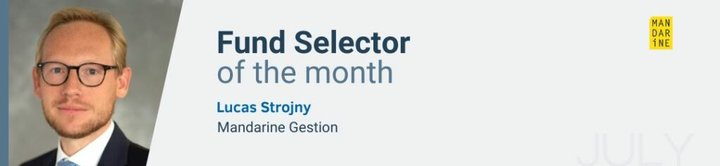
Lucas Strojny is a multi-asset portfolio manager at Mandarine Gestion (formerly Meeschaert AM/Amilton AM) since January 2019. He started his career in 2006 as a fund manager at Avenir Finance IM with a focus on asset allocation and quantitative management and joined RMA AM in 2009 to develop the alternative investments activity and manage low volatility absolute return funds. In 2016, he became head of discretionary mandates at C-Quadrat AM France (formerly Advenis IM). At the beginning of 2019, he joined Amilton AM (which will become Mandarine Gestion through growth operations) to manage flexible asset allocation funds, tailor-made solutions and mandates.
Lucas holds a Master’s of Science in Asset Management from the University of Paris - Dauphine and is a Chartered Alternative Investment Analyst (CAIA).
Can you walk us through your experience in fund selection? When and how did you start your career in the financial sector?
I started my career as an analyst within a multi-management team. Therefore, data analysis, risk modelling and finding differentiators between funds have been there since day one, as has the importance of discussions with management teams and beyond. The profession has obviously evolved with a standardization of processes and documentation (both questionnaires and marketing). The Covid period was an accelerator of video exchanges, much more relevant than the traditional European sales tours of foreign managers. But ultimately, what is at the heart of the selection process, namely identifying risk factors (operational and investment) as well as a manager's ability to provide added value, has not aged in the slightest.
Taking a brief look at your working life, what would you highlight about your professional career?
The importance of human relations at all levels, colleagues, peers, partners, clients, and support functions. Although we manipulate numbers, the entire industry relies on trust and the quality of relationships that we build over time.
What aspects do you consider most important when selecting a fund for a portfolio? Which ratios and metrics do you consider most important when including a fund in your portfolio?
Understanding risk factors (inherent in the investment theme or linked to the manager‘s investment strategy/positioning) is crucial when selecting a fund. One cannot build an efficient portfolio without fully understanding those risks and the potential deviation of performance regarding different market environments. Those risks need to comply with the selector investment convictions and with the overall portfolio construction.
Performance ratios, risk ratios, and risk-adjusted ratios are all meaningful to analyse a manager's track record. Regarding the asset class or risk profile, we will look more carefully at some specific data. Defining the potential maximum drawdown is always helpful to size a position in a portfolio as well as beta and correlation. While analyzing a peer group of absolute return funds, we may use max drawdown/volatility ratio to identify if the risk budget has been controlled over a certain period.
What is the current asset allocation of your model portfolios? Which sectors or geographies would you highlight?
In our multi-asset team, we have the conviction that we have entered into an environment that will be marked by higher inflation than in previous decades. This calls into question the traditional portfolio construction model and our vision of the correlations between different asset classes. Thus, commodities are an example of opportunities relevant to both macroeconomic and portfolio construction considerations. Despite the rise at the start of the year and the persistence of political risks, we maintain a constructive approach to international equities. Local political issues and valuation levels encourage us to favour diversification.
What mistakes are most frequently made in fund selection?
Overconfidence is probably one of managers' most common flaws. Fund selectors tend to overestimate their ability to select funds that will generate alpha and outperform their peers. It is unfortunately impossible to predict the future and as it is written in every document, past performance is not indicative of future results. However, the due diligence process intends to detect potential weaknesses that will certainly lead to higher risk or underperformance and to select investment bricks that do respond to our allocation needs. Understanding an investment process and identifying risk factors at the portfolio and the company level is thus essential to combining market conviction in a portfolio.
What assets do you think will perform better in 2024?
For the second semester, we maintain our positive view on developed market equities. In terms of theme, the ecological transition, real estate companies and small & mid caps, closely linked to economic activity and the evolution of interest rates, could experience a more favourable environment soon.
If you could only ask the fund manager one question, what would it be?
«What does a typical day look like?»
How has the work of the fund selector changed in recent years? How do you think it will evolve in the coming years?
The development of communication technology, particularly during the COVID period, has allowed us to review the method of communication with fund managers and partners.
Over the past few years, we have reduced the average number of meetings to focus primarily on the topics most relevant to us in the immediate future. The objective is obviously to be more efficient. As our range of investment tools is extensive, we mainly focus on strategies offering alpha generation potential or expertise in a niche segment. Furthermore, we are constantly persisting in our efforts to improve our monitoring and analysis tools, thus making it possible to deliver useful data and reports on a daily basis.
When you have free time, what do you like to do?
My family and children are obviously at the centre of my life. I also devote a lot of time to running, an activity essential to my physical and mental balance, with a permanent appetite for competition and the ambition to go each time a little bit further, a little bit faster. I can also mention my passion for art, especially photography and street art.