Luis Andrade from IM Gestão de Ativos is our Fund Selector of the Month

27 DEC, 2024
By Jose Luis Palmer from RankiaPro Europe


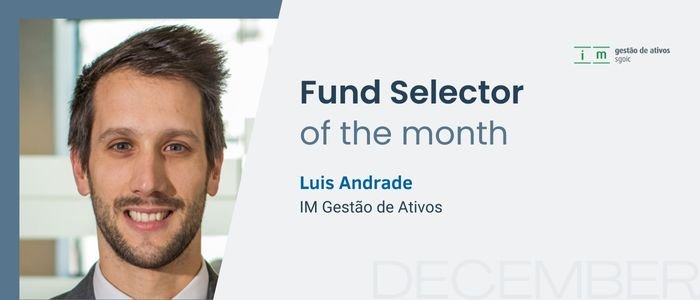
Luis Andrade serves as macroeconomist, Portfolio Manager and Fund selector at IM Gestão de Ativos, the largest independent asset manager in Portugal and second largest overall, with over 4.7 billion euros in assets under management.
Before joining IMGA, Luis accumulated experience as both financial analyst and macroeconomist, and making the bridge between both worlds is undoubtedly his playing field.
Luis Andrade holds a degree in economics and a masters in Monetary and Financial Economics, both taken at ISCTE-IUL. He is also a CFA charterholder.
Can you walk us through your experience in fund selection? When and how did you start your career in the financial industry?
My first experience in this industry was in 2011, right after finishing my masters in Monetary and Financial Economics at ISCTE. It all started at Caixa Gestão de Ativos’ Asset Allocation department as financial analyst, a period I still cherish for all the lessons learned and for the friendships made. The fund selection duties came somewhat later, in 2018, already at IM Gestão de Ativos.
Taking a brief look at your working life, what would you highlight about your professional career?
One thing has always been present in professional career, my passion for macroeconomic analysis and for financial markets. Therefore, I’d emphasize my asset allocation duties, particularly at IM Gestão de Ativos, where I’ve been the centrepiece of our macro thinking and directly involved in the asset allocation decision making process.
What aspects do you consider most important when selecting a fund for a portfolio? Which ratios and metrics do you value the most?
When selecting a fund for our multi-asset portfolios, a wide set of demands is to be fulfilled. In broad terms, we’re looking for consistent alpha generation capabilities, attractive risk-adjusted returns and quality of management. Specific investment biases or non-repeatable alpha drivers are closely scrutinized.
What is the current asset allocation of your model portfolios? How should investors navigate current market uncertainty?
Our asset allocation is somewhat overweight risky assets, particularly on equities, despite our perception that we’re probably running on thinner air, as valuations become increasingly stretched. We still find value on credit against government bonds, but less so when compared to our average positioning during most of 2024.
The combination of higher policy risk in 2025 and tight valuations will probably require a more flexible approach to asset allocation and might leave some space for additional exposure to alternatives.
What mistakes are most frequently made in fund selection?
Past returns are usually one of the key drivers of attractiveness of a given strategy. While it would be hard to justify a different approach, one of the toughest parts of getting fund selection right is to correctly determine if the alpha drivers are repeatable over the long term. If those are related to biases/themes that benefited from specific market conditions which might not apply in the future, it clearly should be seen as a red flag. Easier said than done, though.
Looking ahead to 2025, which assets do you think will outperform and which are likely to suffer the most?
While cognizant of current extended valuations, we’re still constructive on the key market fundamentals and see space for continued high single-digit to low double-digit earnings growth in 2025, which should be beneficial for equities. Our highest conviction levels are still on US equities, although we recognise European equities might be better positioned to surprise on the upside, based on its downbeat expectations.
US denominated debt (when converted to euros) is expected to underperform in 2025, if our expectation of somewhat higher mid to long-term interest rates materializes.
How has the work of the fund selector changed in recent years?
The rise of the willingness to run “virtual meetings” in the post-COVID was quite beneficial in my view, making it a bit easier to reach and interact with Portfolio Managers, when compared to the good old conference calls. There was also some improvement of quant tools for fund analysis.
How do you think it will evolve in the coming years?
It might become a slightly more efficient job over the coming years, based on the growing integration of artificial intelligence in our due diligence processes. It might also contribute to overcome behavioural biases fund selectors might exhibit. Unless I’m proven wrong in the meantime, fund selection will still require a key human touch that can hardly be overthrown, related qualitative analysis.
If you could only ask the fund manager one question, what would it be?
What explains its past performance and how are those factors repeatable over the long run.
What do you like to do in your free time?
Whenever I can, one of the most relaxing activities I find is hitting the gym or going for a run. Watching a TV show and reading are close contenders. One of my “love-hate” hobbies is playing English Premier League Fantasy Football and challenging myself to beat my friends in our mini-leagues.