Paul Weber from Amundi is our Fund Selector of the Month

7 MAY, 2025
By Jose Luis Palmer from RankiaPro Europe


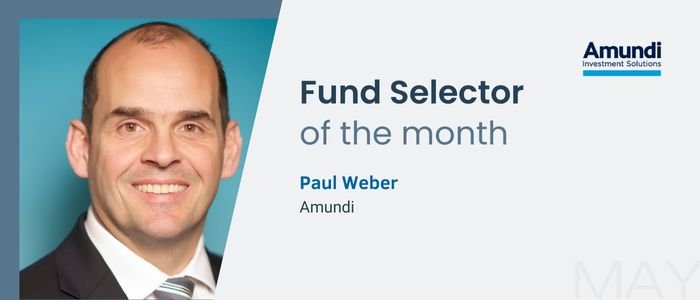
Paul Weber is the Head of Fund Research & Manager Selection.
Paul Weber joined the Long Only Fund Research team at Pioneer Investments in 2004. He was appointed to head this team in 2012. Following the acquisition of Pioneer Investments by Amundi in 2017, Paul was appointed Head of Fund Research and Manager Selection at Amundi. This team oversees external delegated investment managers, recommended mutual funds and ETFs for discretionary retail and institutional clients of Amundi. The acquisition of Lyxor in 2022, saw the extension of the team remit to Hedge Funds.
Between 2013 and 2018, Paul was Portfolio Manager for a range of multi-asset fund of funds for retail clients in both Europe and the United States. Paul previously worked in the Portfolio Analytics team at Pioneer Investments, specializing in the area of Global Investment Performance Standards. Before joining Pioneer Investments in 2002 Paul worked as a Portfolio Analyst for Govett Investments in London.
Paul has an MA and a BSc in Management from Trinity College, Dublin.
Can you walk us through your experience in fund selection? When and how did you start your career in the financial industry?
Having completed my studies in 1999, I joined Govett Investments in London in the Performance Analysis team, conducting performance, performance attribution and risk analysis. The role further developed into quantitative stock screening and portfolio optimisation over time. During my time there, I also evaluated the funds and strategies of a number of merger and acquisition targets. This experience gave me a solid grounding in studying funds from a quantitative perspective. At that stage I hadn’t even considered the role of fund research. I moved to join Pioneer Investments in 2002 in a similar role where I was also involved in some similar projects. Within a couple years an opportunity arose to develop the fund research process at Pioneer Investments and it was an easy decision for me to make.
Taking a brief look at your working life, what would you highlight about your professional career?
Through my career I have been fortunate to meet of some of the smartest minds in the industry in person. Many famous people but many more less well known. This is a genuine privilege and certainly a highlight. Other highlights are equally split between our highest performing choices, on the one hand, and the landmines we managed to avoid on the other. While it is important to select winners, the industry is not a zero sum game, so avoiding the losers is in fact more important. When you lose, you want to be sure that you limit the downside. Without naming specific names, we have reviewed and passed on some notable big losers over the past 20+ years.
What aspects do you consider most important when selecting a fund for a portfolio? Which ratios and metrics do you value the most?
Almost everyone has access to the quantitative ratios and criteria. Where we see most value and the biggest differentiating factor are the softer and more qualitative elements, such as portfolio manager and analyst experience and tenure, alignment of interests around compensation. Charlie Munger, unsurprisingly, called it correctly when he said “Show me the incentive, I’ll show you the outcome”
What mistakes are most frequently made in fund selection?
Across the industry we see routine examples of indiscriminately chasing past performance, from a selection standpoint, with out and under-performing managers, but also with out and under-performing strategies and themes. Let’s take a theoretical example. Is an equity sector that has out-performed the broad market while the aggregate underlying Price Earnings ratio has risen from 15x to 30x a better investment than an equity sector that has seen its Price Earnings Ratio fall from 15x to 7x. It certainly was when both were priced at 15x. It is not often the case after the fact. Yet this is when many investors pile in. The same logic applies to funds. This is where a deeper analysis and thorough investment due diligence is required. We aim to be more objective, trimming winners and adding to losers provided our investment case hasn’t changed.
How has the work of the fund selector changed in recent years?
The major change in a post COVID environment is that you meet less people face-to-face. Many meeting are now conducted online, making face-to-face meetings all the more valuable. I travel to see managers and take face-to-face meetings whenever possible. I continue to find added value in these interactions, while online meetings are often sufficient for routine updates with managers we already know well.
How do you think it will evolve in the coming years?
I believe that AI will play a greater role. We have begun to use AI to a limited degree to assist with our analysis. Our experience of this has prompted many questions to see how we can further enhance both our initial analysis of new managers and ongoing monitoring of our existing panel of recommended managers.
What do you like to do in your free time?
I enjoy spending quality time with family. This generally centres around one sport or another or the occasional concert. I also like to read books on finance and occasionally post some of my favourite reads on LinkedIn.