Ricardo Duarte Silva from Crédito Agrícola Gest is our Fund Selector of the Month

6 NOV, 2024
By Jose Luis Palmer from RankiaPro Europe


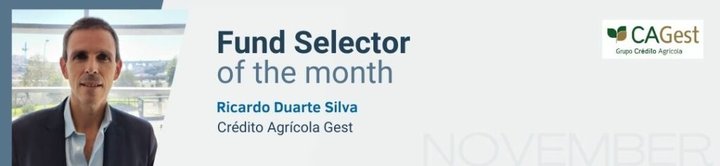
Ricardo Duarte Silva is currently both Portfolio Manager and Fund Selector at Crédito Agrícola Gest, an asset management company fully owned by Crédito Agrícola, a domestic based retail bank in Portugal. The team manages around €1.5 bn for institutional clients (mainly in the insurance and pension fund businesses). For the purpose of in-house fund selection it has developed a proprietary scoring model covering major asset classes. Before joining Crédito Agrícola Gest in 2008, Ricardo worked for Banco de Investimento Global (BIG), first as junior analyst and later as the Head of Equity Research. A few months before leaving for CA Gest, he was promoted as Head of Asset Management. Ricardo has an Economics degree from Universidade Nova de Lisboa and a Post-Graduation in Financial Markets from CEMAF/ISCTE.
When and how did you start your career in the financial sector?
It all started in October 2002, after finishing a post-graduation in financial markets from Cemaf/Iscte. Banco de Investimento Global became my first experience in the financial arena, first as a junior equity analyst and later as the head of research. BIG was located in Praça Duque de Saldanha, a very central and fancy building for which I still preserve very good memories from. Professionally speaking, it was a good place to grow and to apply many of the acquired knowledge. It was a relatively young project that time (today a very successful one).
Taking a brief look at your working life, what would you highlight about your professional career?
Since Banco de Investimento Global period to my current role as head of investments at Crédito Agrícola Gest many things have changed. When I first started, my job was mainly covering equities, producing trading ideas and developing some discounted free cash flow models for a limited number of companies in the Portuguese stock exchange. In 2007, I was proposed internally as the head of asset management at BIG where I managed a team of four. That time, BIG asset management was focused in distributing mutual funds to their retail and high net worth clients. That was the first time I've looked at funds, even though in totally different perspective than today. The idea was mainly producing funds´ shortlists to the retail network and developing products combining both funds and deposits.
What aspects do you consider most important when selecting a fund for a portfolio?
When selecting a fund, we tend to blend a pure quantitative approach, based on an internal scoring model developed for that purpose, and a qualitative approach where we factor in other important criteria. Quality of management, consistency of returns, eventual biases to any style, the diversification effect it may have in the portfolio or even total expense ratios (costs).
What is the current asset allocation of your model portfolios?
At Crédito Agrícola Gest, most of the portfolios are institutionally owned and we do not have the image of a model portfolio. In that sense, the risk/profile of each product is set as defined in their investment policy. I would say, however, that overall we are more exposed to fixed income (government bonds and investment grade credit) and less exposed to equities (mainly Global and European equities). Alternatives average around 5% and comprise a lot of different instruments (from real estate to private equity or liquid alts).
What mistakes are most frequently made in fund selection?
Typically, alpha generation is difficult to evaluate over time. It's true that the bigger the period of consistent returns over benchmark and peers, the more likely you are of getting it right. But it is also true that market environment is dynamic and there's no way of just using the past as a blind predictor of future alpha generation.
What assets do you think will perform better in 2024?
In the portfolios that may invest into equities, we have been more on the cautious side, with a higher exposure to Europe than to US. Markets seem to be a bit complacent lately and, in some cases, overvalued. The geopolitical risks, the overoptimism around Artificial Intelligence, the highly priced expectation of a “soft landing” and friendly central banks next year make us a bit skeptical. In what regards fixed income, we have been actively managing the duration risk since the beginning of the year. We feel that yields are still at decent levels even though credit spreads are thin. That induces us to be somewhat selective in credit.
When you have free time, what do you like to do?
Whenever I have free time, I enjoy reading a good book, watching a movie or go out with friends and family. Traveling is also one of my hobbies. Other is sports (I have a season ticket for Sporting Clube de Portugal for 10 years now).
What role do you think regulation plays or should play in driving Socially Responsible Investment?
Socially Responsible Investment is a big theme and deserves all our attention, not only because of regulation but because driving investment towards more ESG efficient companies may turn out to be a game changer. That said, regulation may help to increase industry awareness even though it should be followed by real client demand for new and more ESG friendly products. Too much complexity should be avoided, specifically in Europe, where it seems that we are a step ahead in this front.